

 Image 1 of 2
 Image 2 of 2
Sample Pages



Contents List
-
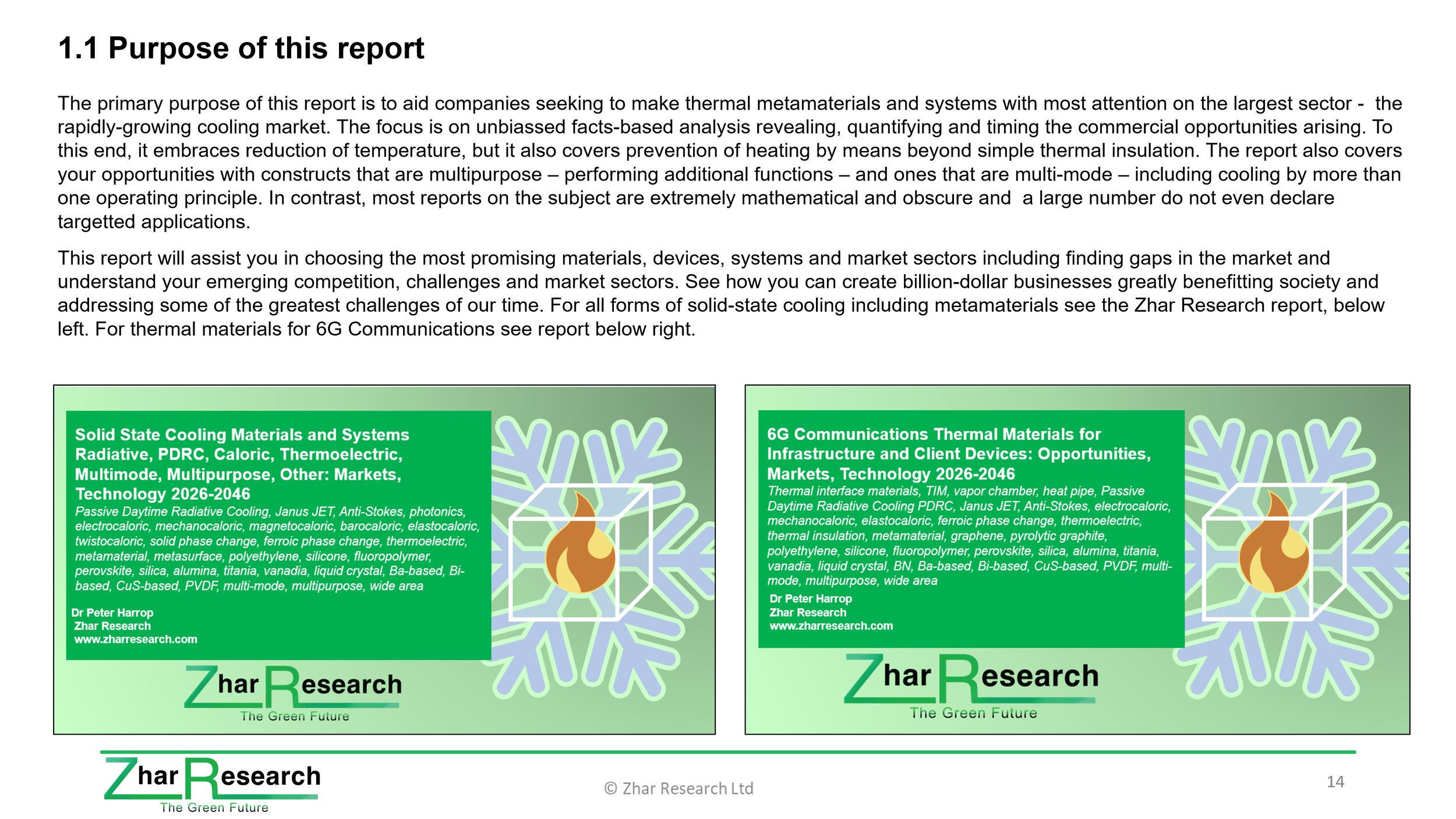
1.1 Purpose of this report
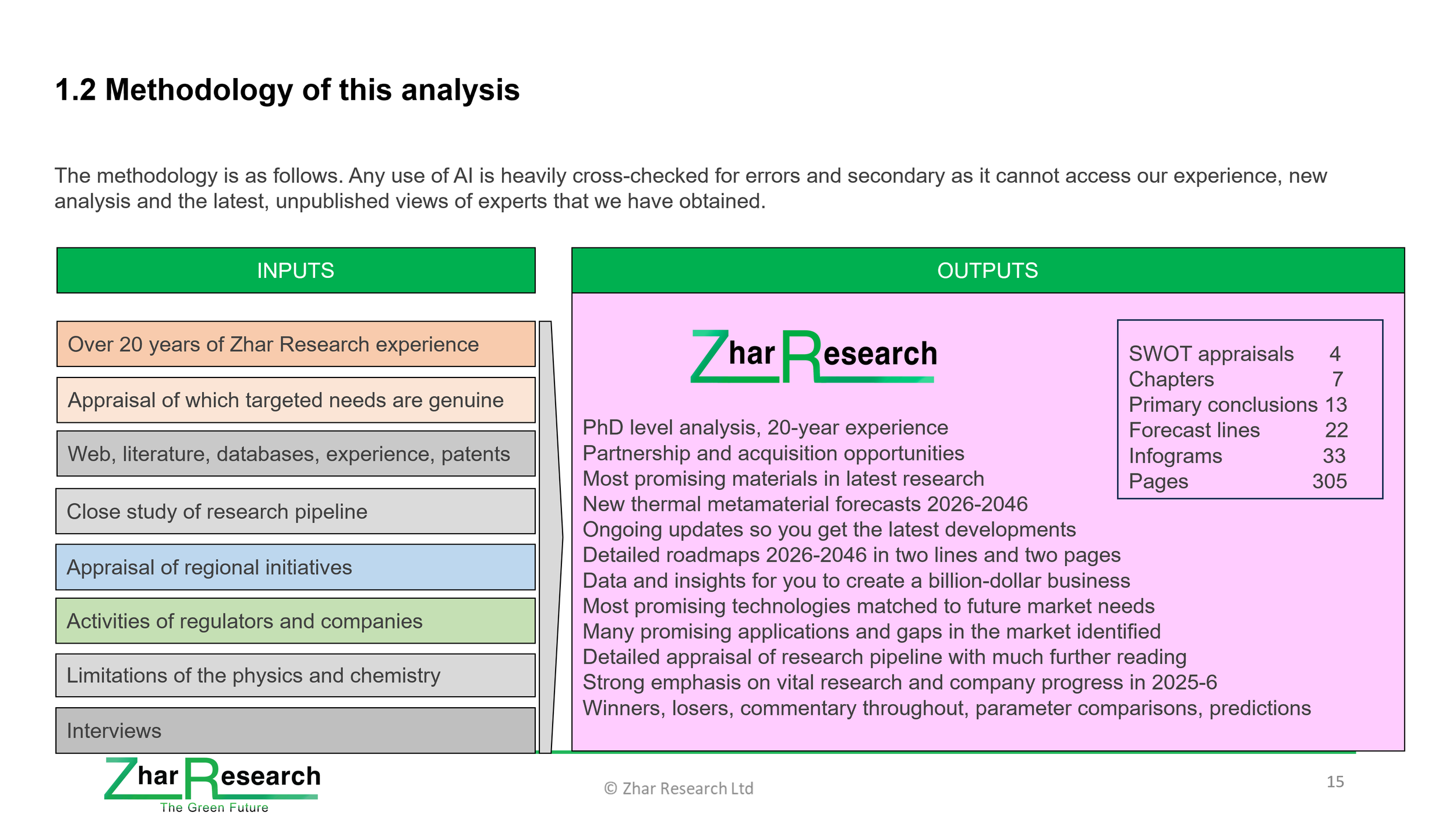
1.2 Methodology of this analysis
1.3 Thermal functions and applications
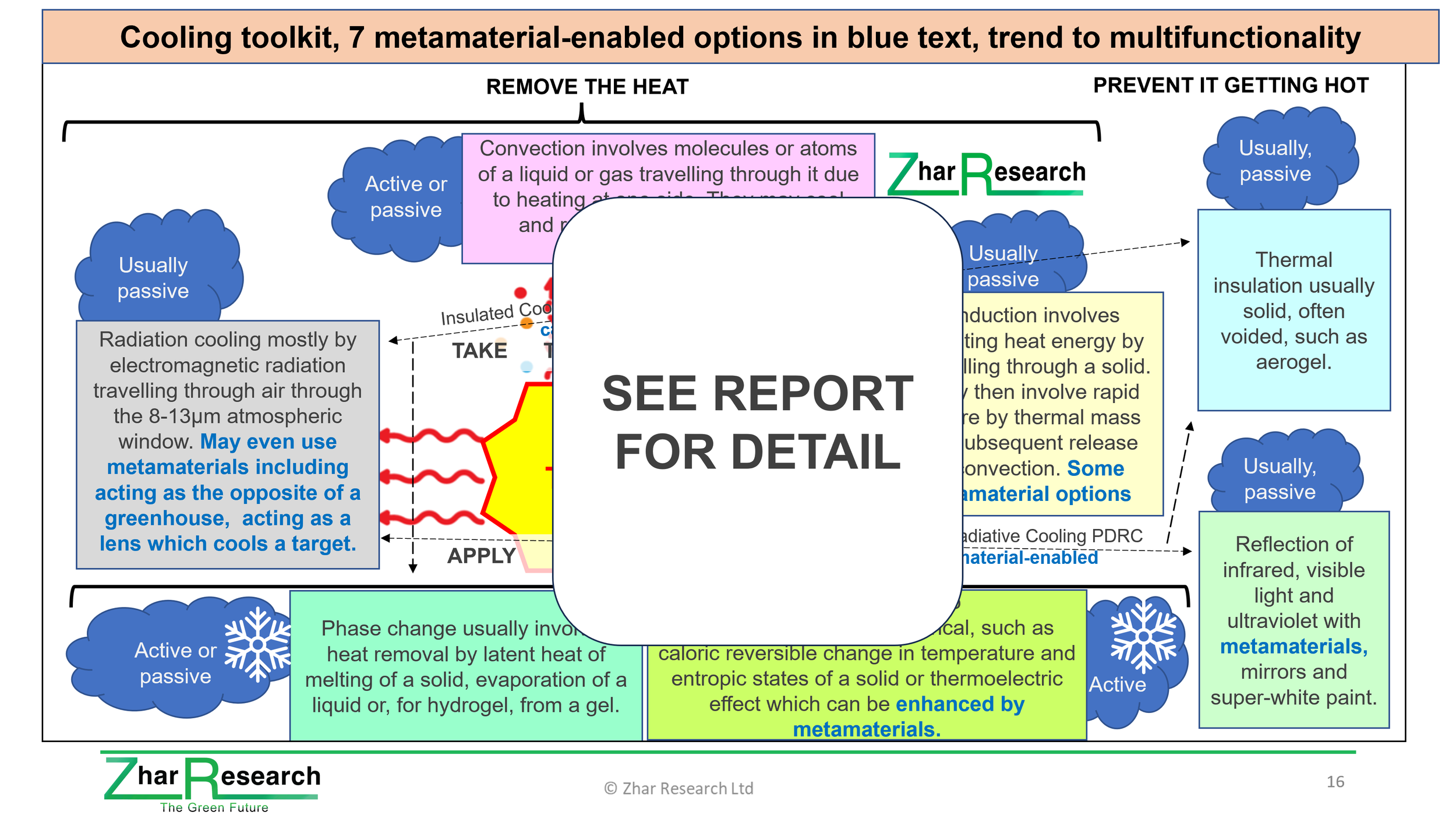
1.3.1 Market drivers and general situation
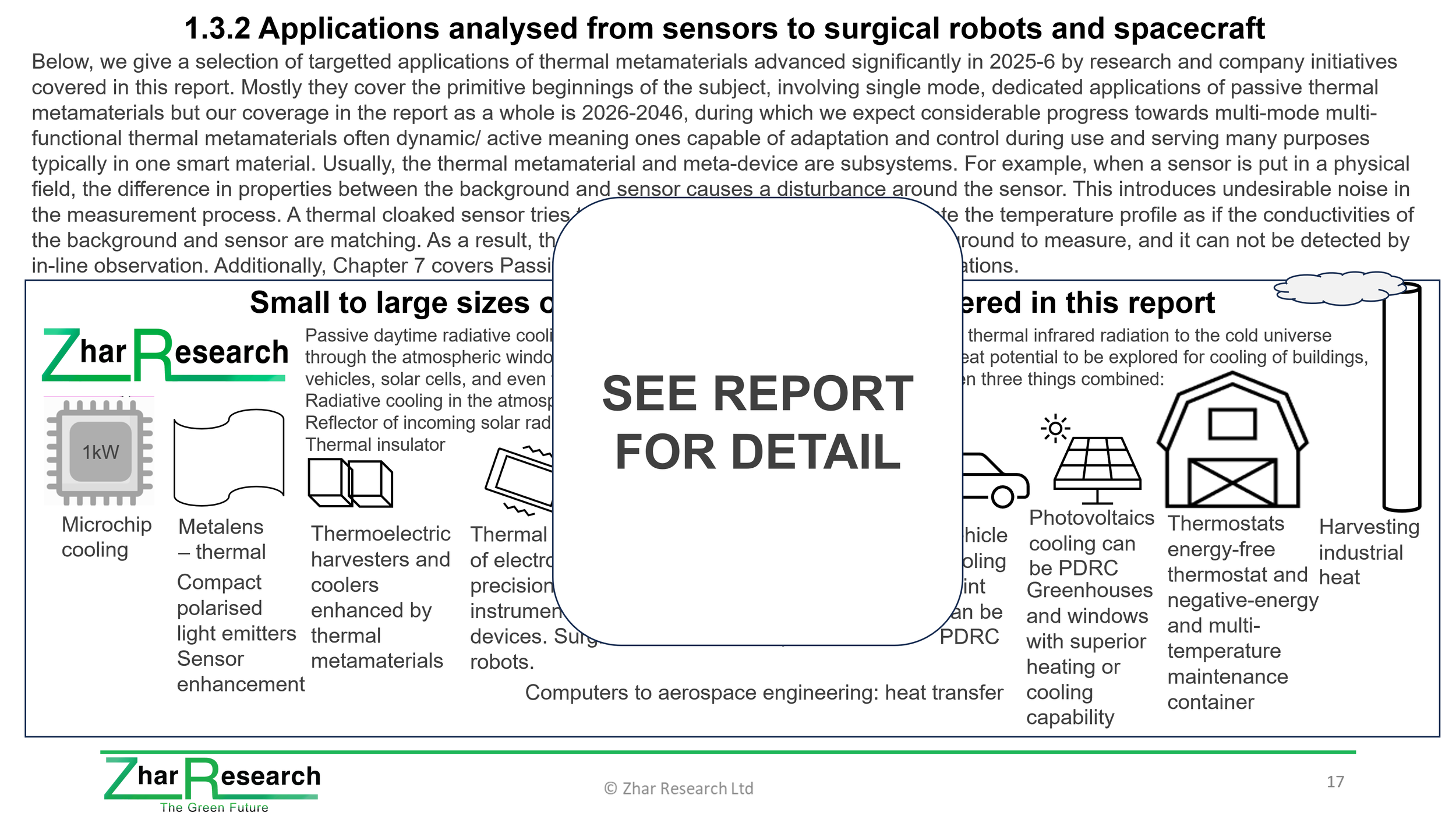
1.3.2 Applications analysed from sensors to surgical robots and spacecraft
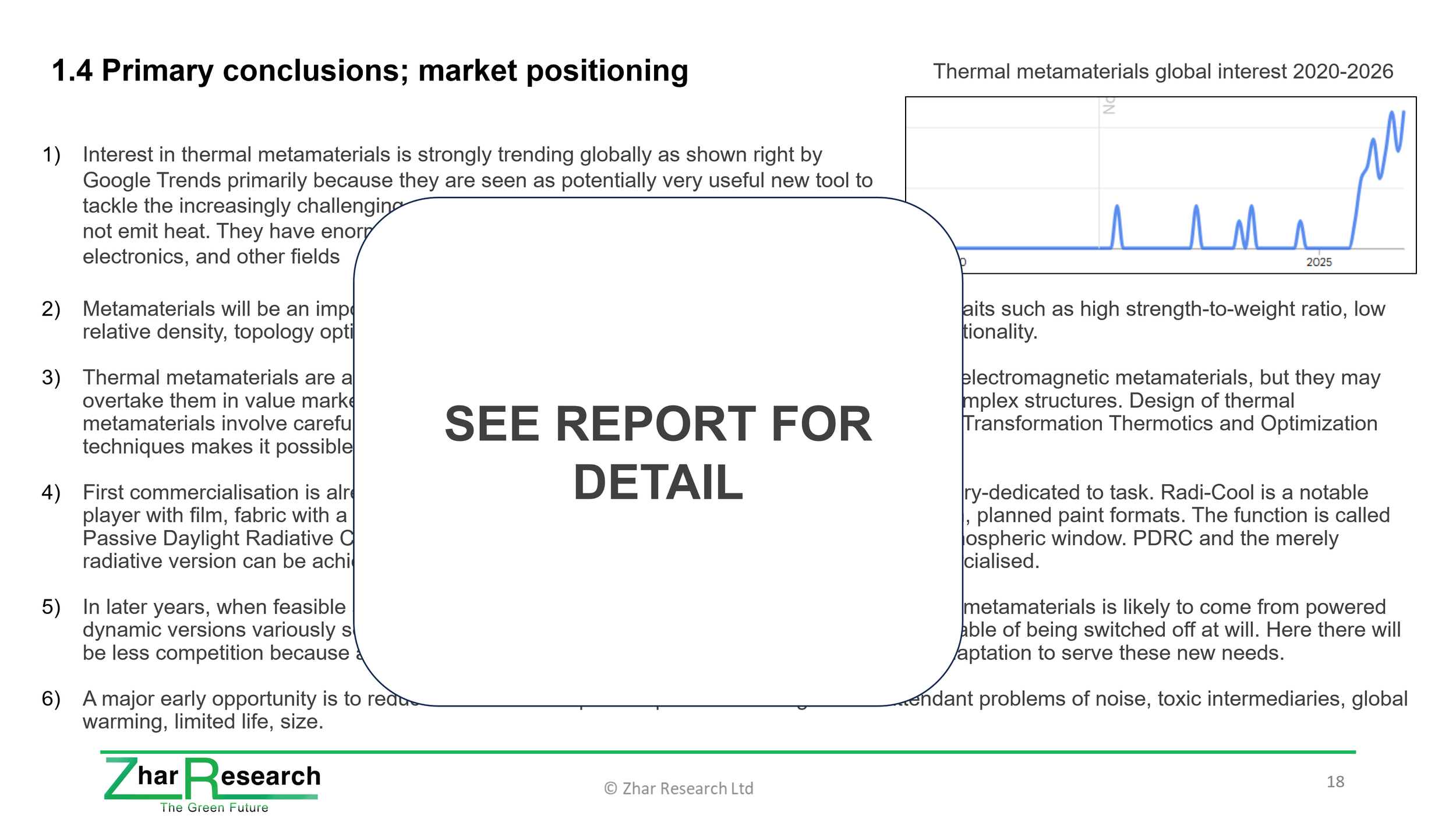
1.4 Primary conclusions; market positioning
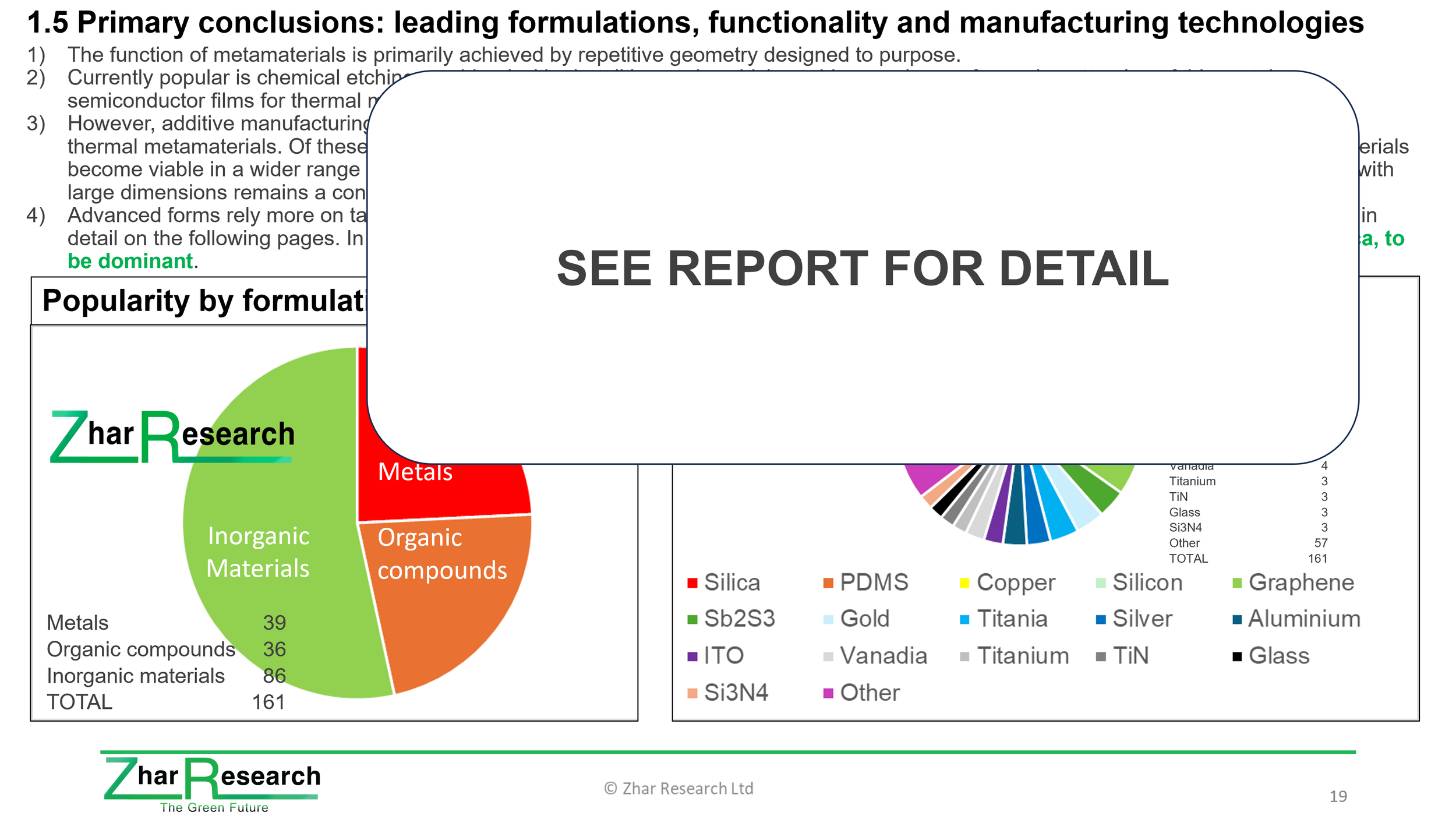
1.5 Primary conclusions: leading formulations, functionality and manufacturing technologies
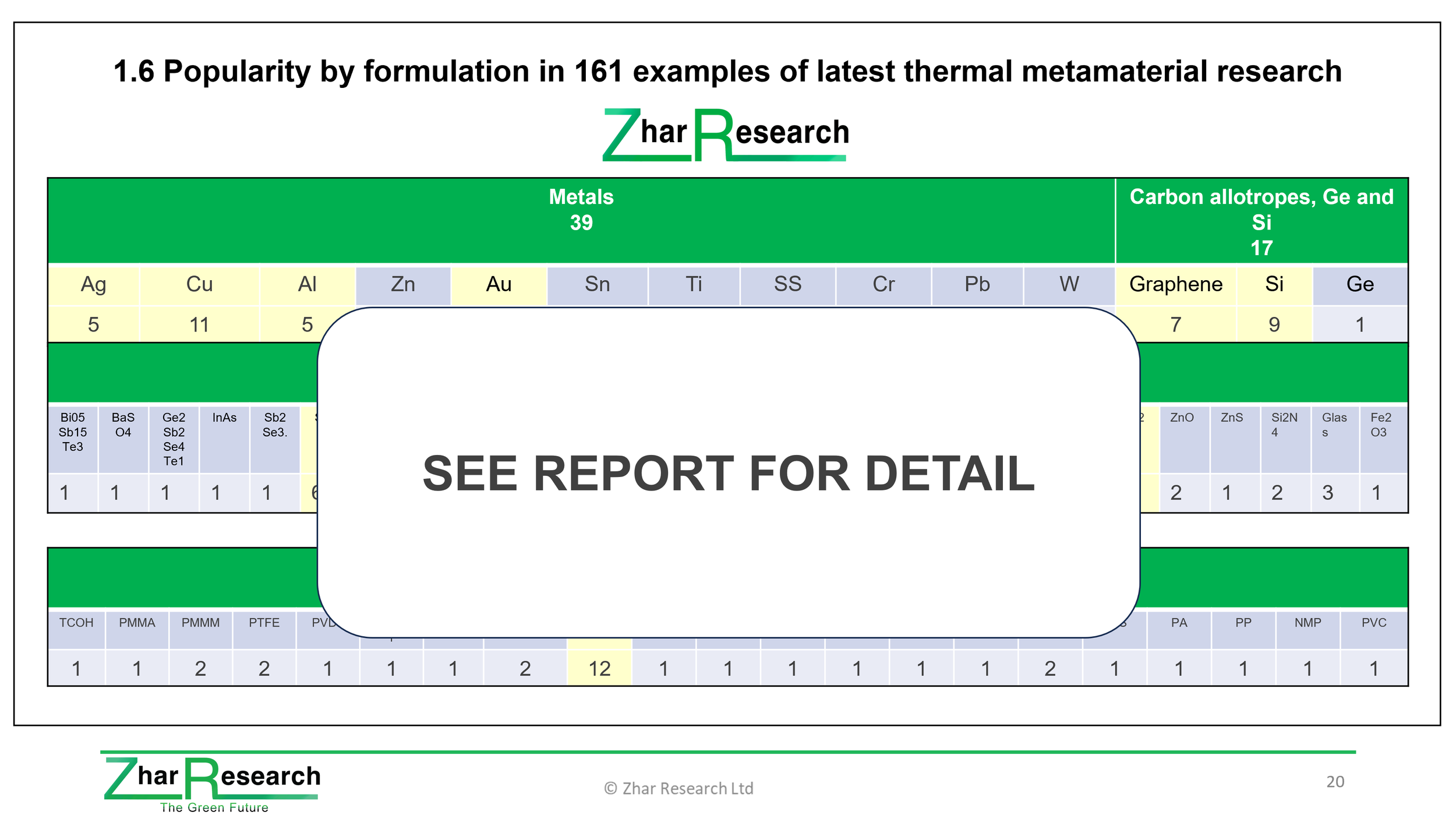
1.6 Popularity by formulation in 132 examples of latest thermal metamaterial research
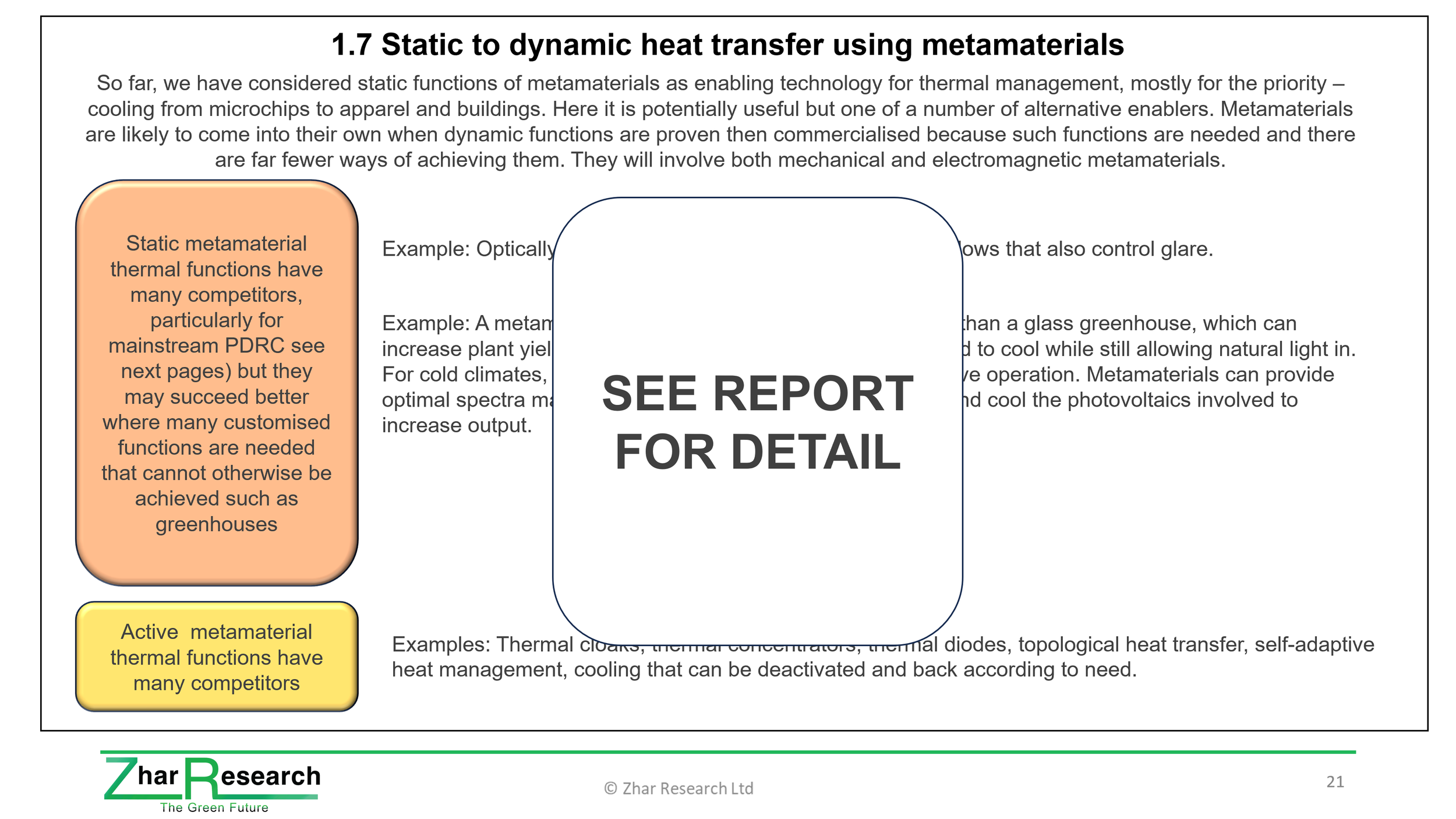
1.7 Static to dynamic heat transfer using metamaterials
1.8 Static radiative cooling materials showing metamaterials as one of many options
1.9 SWOT appraisals
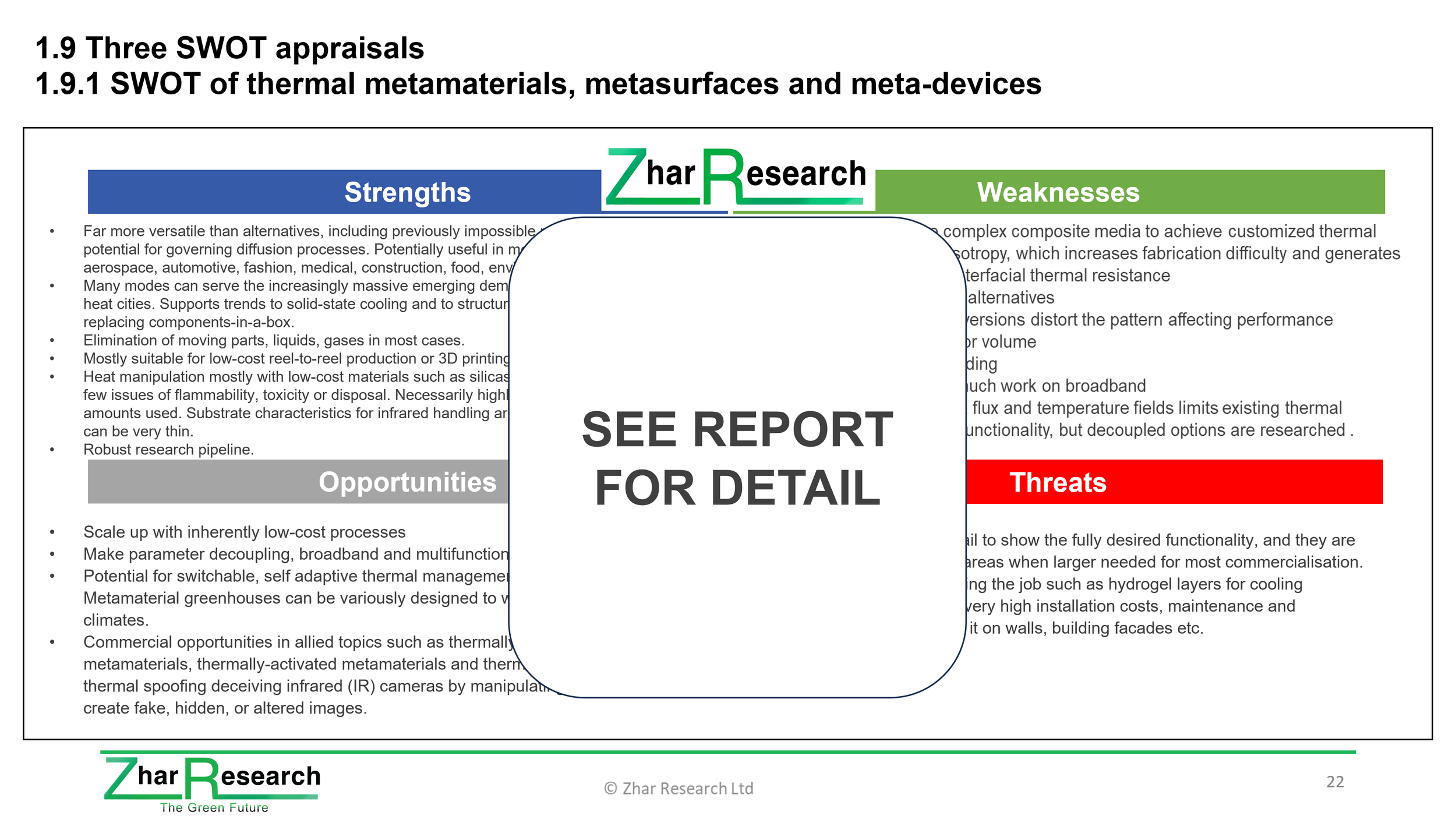
1.9.1 SWOT of thermal metamaterials, metasurfaces and meta-devices
1.9.2 SWOT appraisal of Passive Daytime Radiative Cooling PDRC
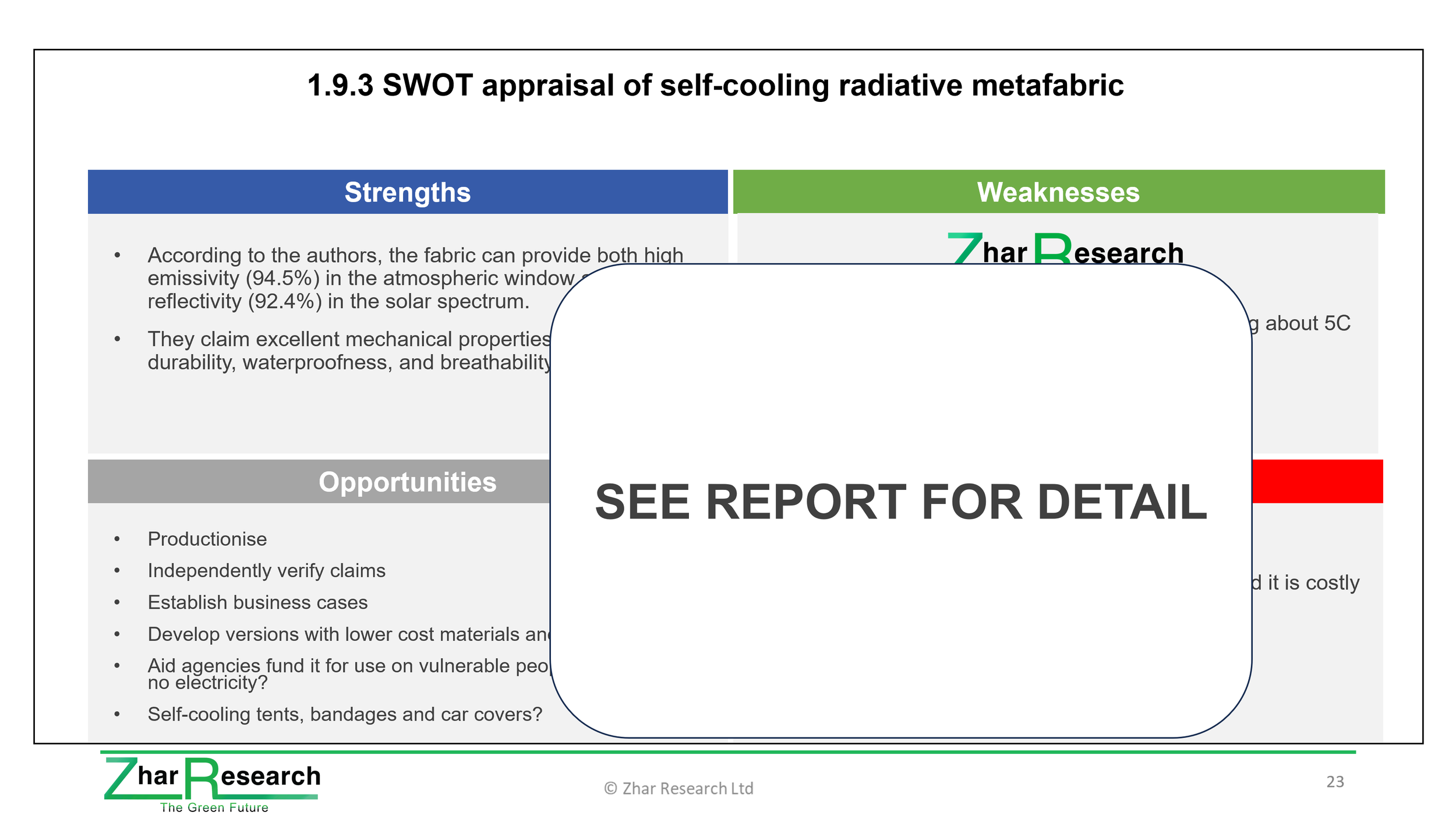
1.9.3 SWOT appraisal of self-cooling radiative metafabric
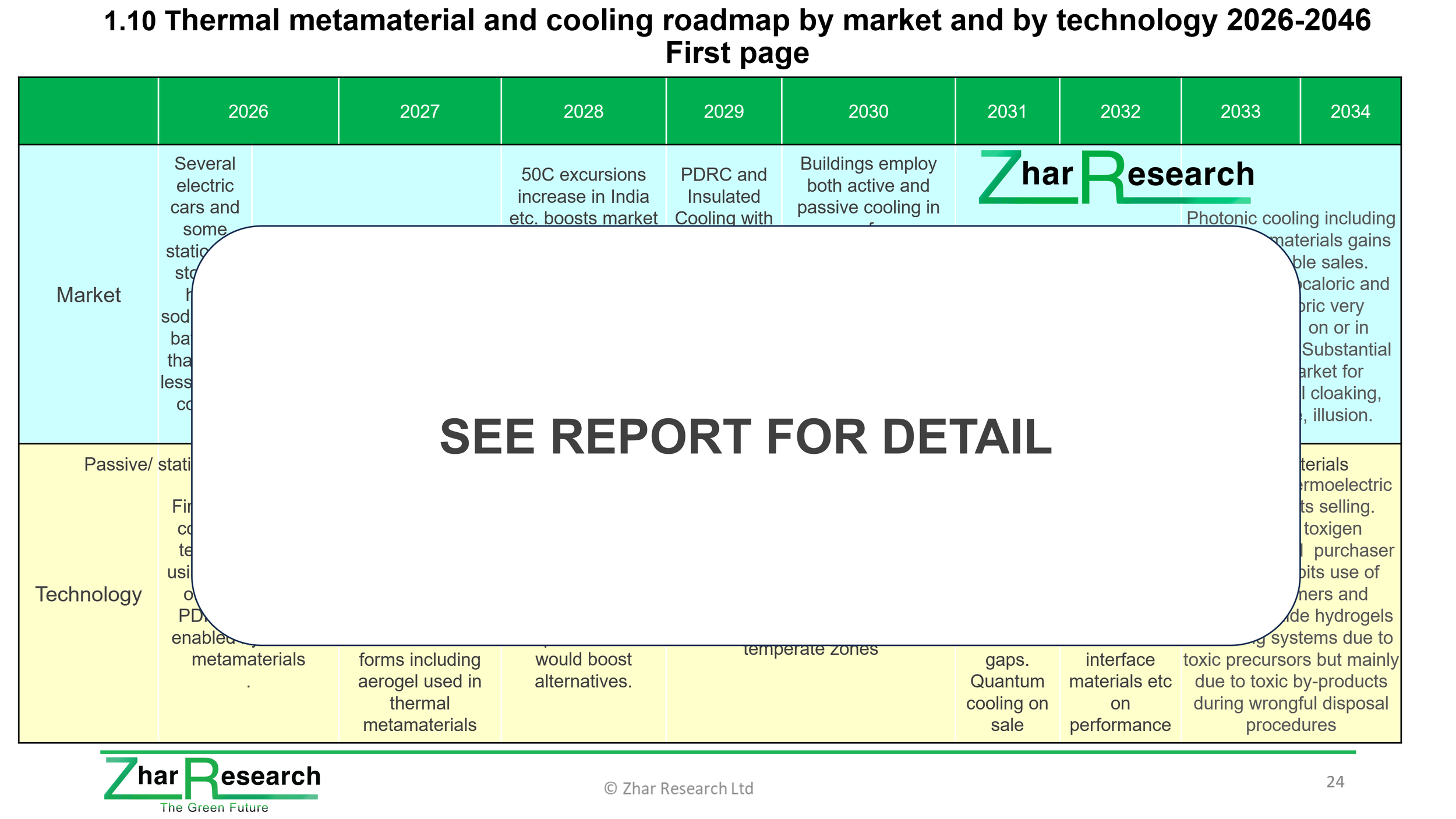
1.10 Thermal metamaterial and cooling roadmap by market and by technology 2026-2046
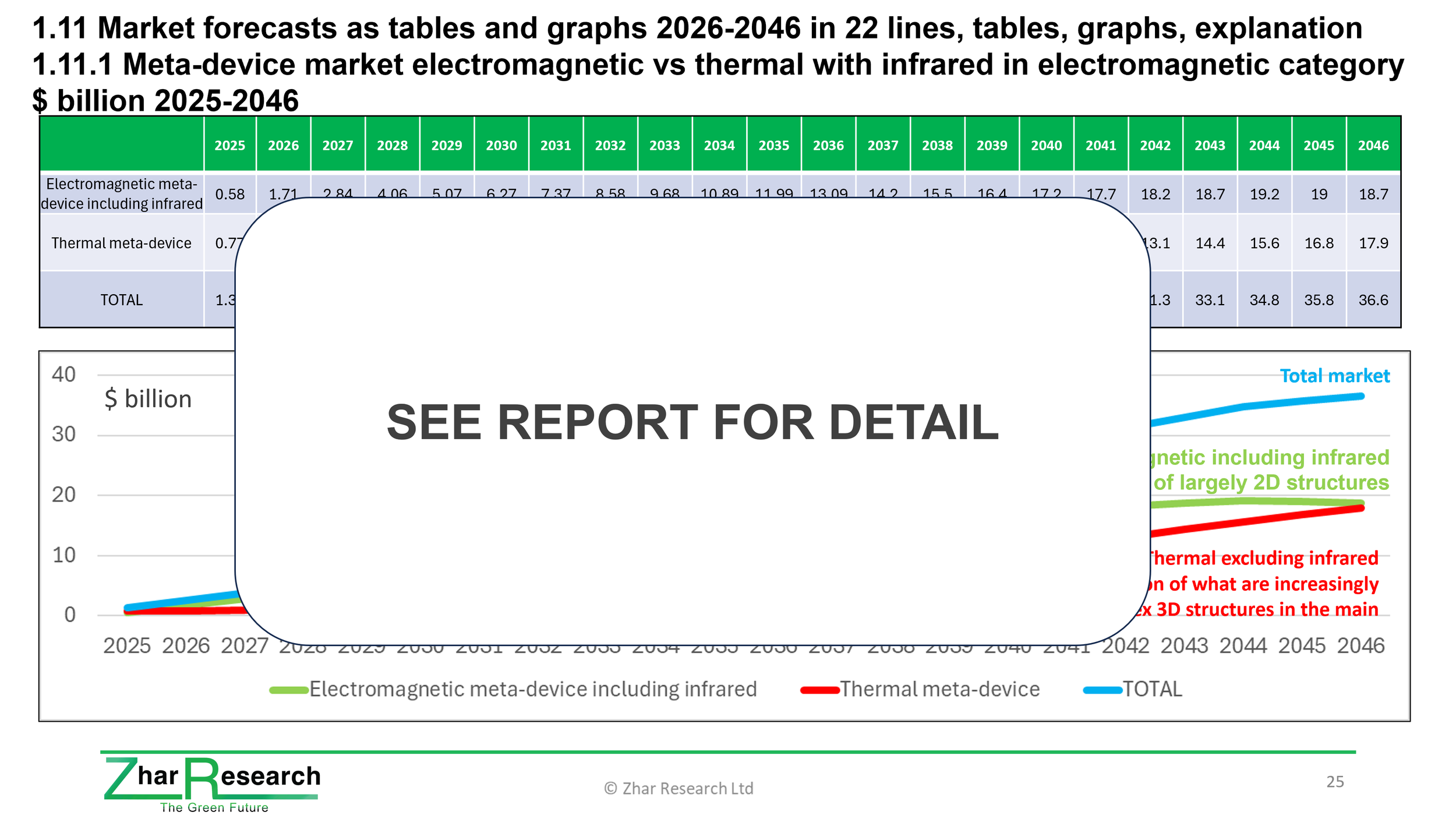
1.11 Market forecasts as tables and graphs 2026-2046 in 22 lines including 1.12, tables, graphs, explanation
1.11.1 Meta-device market electromagnetic vs thermal with infrared in electromagnetic category $ billion 2025-2046
1.11.2 Thermal meta-device market $ billion 2025-2046 by application segment
1.12 Background market forecasts as tables and graphs 2026-2046
1.12.1 Cooling module global market by seven technologies $ billion 2025-2046
1.12.2 Terrestrial radiative cooling performance in commercial products W/sq. m 2025-2046
1.12.3 Air conditioner value market $ billion 2024-2046
1.12.4 Global market for HVAC, refrigerators, freezers, other cooling $ billion 2025-2046
1.12.5 Refrigerator and freezer value market $ billion 2024-2046
1.12.6 Thermal management material and structure for 6G Communications infrastructure and client devices $ billion if 6G is successful 2026-2046
1.12.7 Dielectric and thermal materials for 6G value market % by location 2029-2046
-
2.1 Overview
2.2 Types of metamaterial thermal management materials
2.3 Three families of metamaterials overlap
2.4 Cooling needs increase for many reasons 2026-2046
2.4.1 Escalation of demand for air conditioning and forthcoming changes in requirement
2.4.2 Problems of traditional vapor compression cooling and progress to solid state cooling
2.4.3 Desire to eliminate liquid cooling for electric vehicles and solid-state cool solar panels
2.4.4 Severe new microchip cooling requirements arriving
2.4.5 Much greater need for thermal materials in 6G Communications
2.4.6 Other cooling problems and opportunities emerging in electronics and ICT
2.5 How cooling technology will trend to smart materials 2026-2046
2.6 Cooling is the largest potential for thermal metamaterials
2.7 The potential for ultra-conductive thermal metamaterials
2.8 Temperature responsive and controlling metamaterials
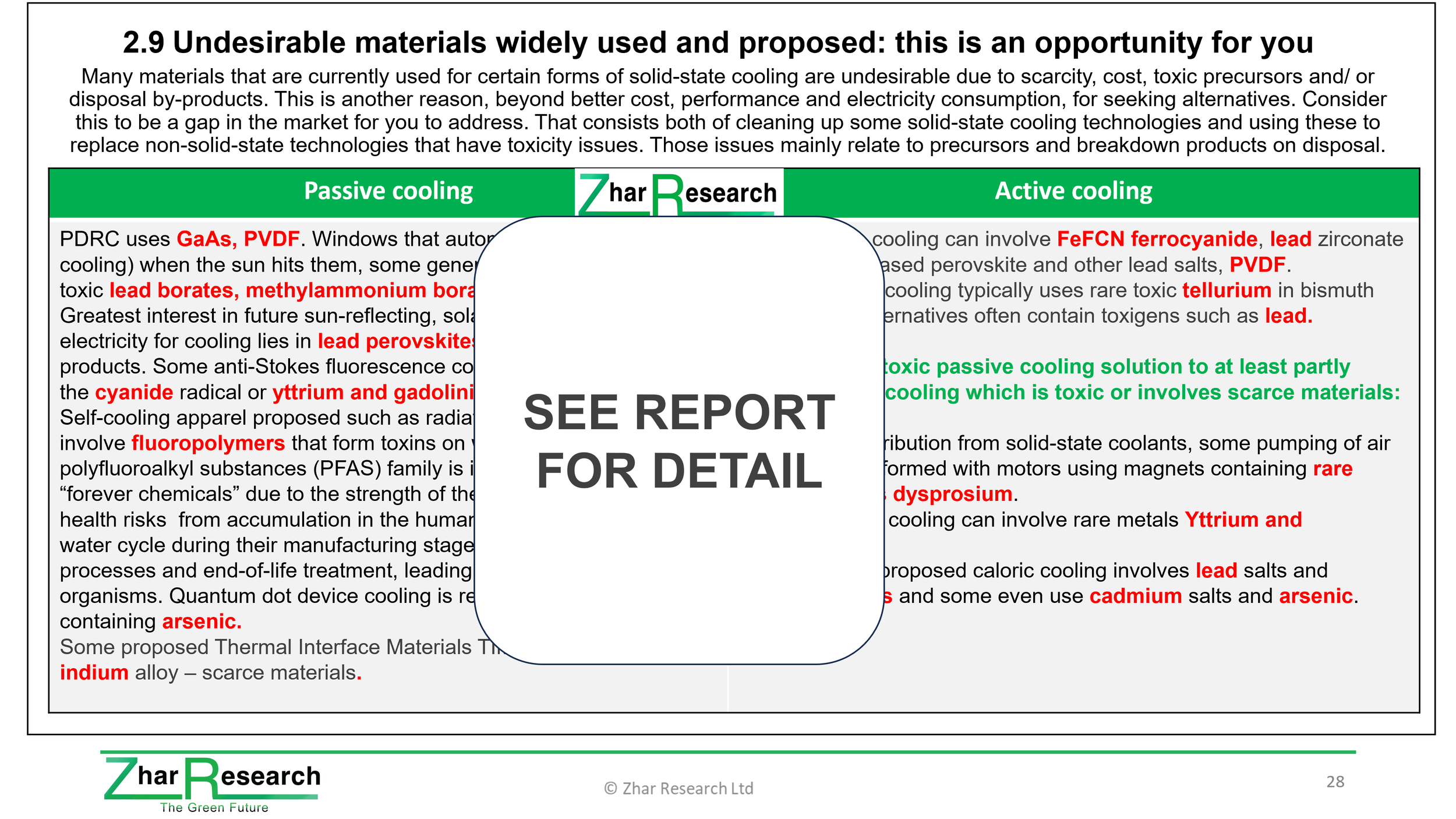
2.9 Undesirable materials widely used and proposed: this is an opportunity for you
-
3.1 Overview
3.2 Basis in physics
3.3 Examples of new theoretical approaches in 2026 leading to new applications
3.4 Types of metamaterial thermal management materials with the currently most commercialised sectors
3.5 How three families of metamaterials overlap
3.6 Examples of thermal metamaterial structures in 2026 and earlier advances
3.7 SWOT assessment for thermal metamaterials and metasurfaces
3.8 Commercially important functions
3.8.1 Thermally radiative metamaterials, advanced photonic cooling and prevention of heating
3.8.2 Ultra-conductive thermal metamaterials
3.8.3 Thermal convective metamaterials
3.8.4 Multimodal thermal metamaterials
3.9 Thermal cloak, camouflage, concentrator, diode, expander, rotator metamaterials
3.9.1 Introduction
3.9.2 Thermal cloaks and camouflage
3.9.3 Thermal concentrators
3.9.4 Thermal diodes
3.9.5 Thermal expanders
3.9.6 Thermal rotators
3.10 Multifunctional thermal metamaterials with examples from 2024-5
3.11 Far more options for thermal metamaterials ahead
-
4.1 Overview
4.2 4D printing and multi-coupling of thermal metamaterials
4.3 Use of electrochemistry
4.4 Examples of progress and target applications
4.4.1 Tunable liquid-solid hybrid thermal metamaterials
4.4.2 Unified static and dynamic thermal metamaterials
4.4.3 Sensing and responding to ambient temperatures
4.4.4 Advanced thermal radiation devices: stealth with thermal management
4.4.5 Active remote sensing and thermal camouflage
4.4.6 Dynamic control of heat flux and heat flow direction possibly for electric vehicle batteries
4.4.7 Adaptive radiative cooling and passive thermoregulation
4.5 Thermal-mechanical metamaterials
4.5.1 Overview
4.5.2 Programmable mechanical-thermal metamaterials
-
5.1 Overview including needs, approaches, materials and additive vs subtractive options
5.2 Additive manufacturing design, fabrication, property and application
5.3 3D printing of thermal meta-devices
5.3.1 Metal 3D printing of thermal meta-devices
5.3.2 Metal polymer and metal graphene 3D printing of thermal meta-devices
5.3.3 Functionally graded materials in thermal meta-structures
5.3.4 Other materials options
5.4 Printing technologies for laminar thermal metamaterials manipulating infrared radiation
5.5 Materials and manufacturing technologies for Passive Daylight Radiation Cooling PDRC using thermal metamaterials
-
6.1 Overview: applications from sensors to surgical robots and spacecraft
6.2 Compact polarised light emitters
6.3 Computers to aerospace engineering: heat transfer
6.4 Greenhouses and windows
6.5 Energy harvesting advances using thermal metamaterials in 2026
6.6 Metalens – thermal
6.7 Microchip cooling
6.8 Photovoltaics cooling
6.9 Satellite thermal control
6.10 Thermal packaging of electronics
6.11 Textiles that cool
6.12 Thermoelectric harvesters and coolers enhanced by thermal metamaterials
6.13 Thermostats energy-free thermostat and negative-energy and multi-temperature maintenance container
6.14 Vehicle cooling paint
-
7.1 Overview with SWOT appraisal
7.2 Radiative cooling based on thermal metamaterials compared to alternatives
7.3 Approach using translucent thermal metamaterials in 2024: patterned PDMS
7.4 Transparent PDRC for facades, solar panels and windows using thermal metamaterials
7.5 Cellulosic power generating and other radiative cooling wearable meta-fabrics with SWOT appraisal
7.6 Metamaterial PDRC cold side boosting power of thermoelectric generators in 2024
7.7 Other metamaterial radiative cooling research 2024 and 2023
7.8 Commercialisation of metamaterial cooling
7.8.1 Radi-Cool Japan, Malaysia
7.8.2 SRI USA
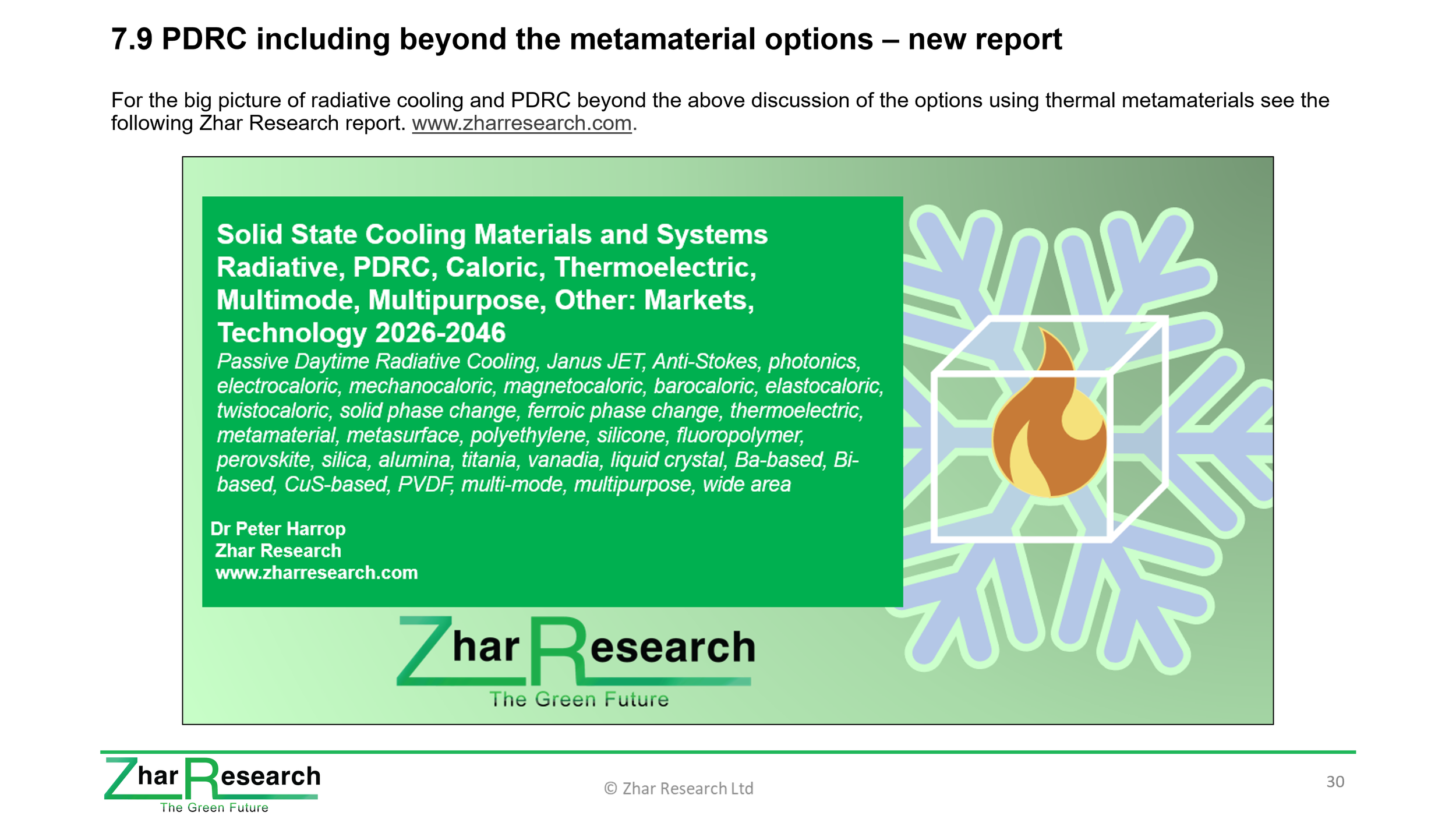
7.9 PDRC including beyond the metamaterial options – new report
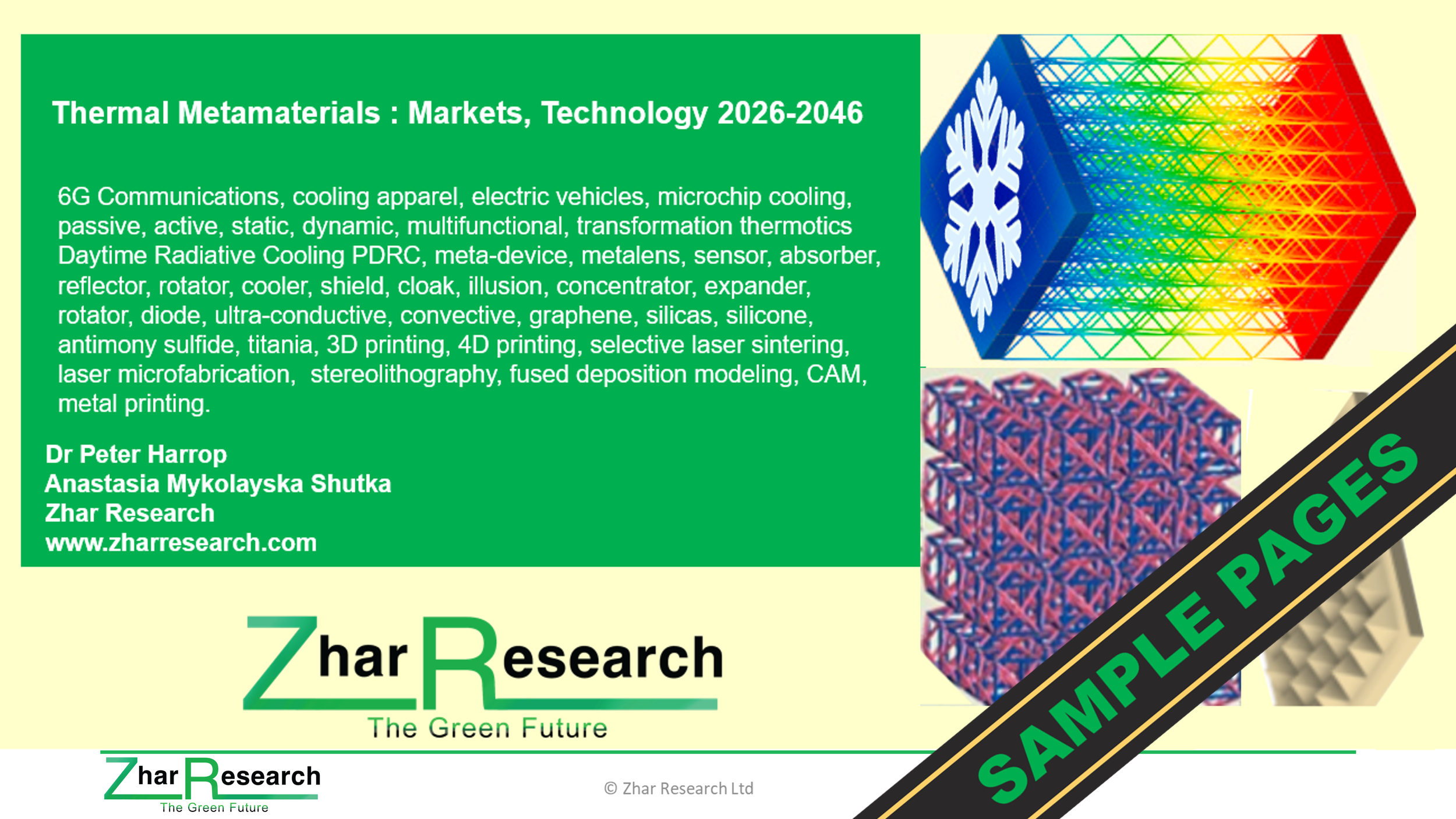
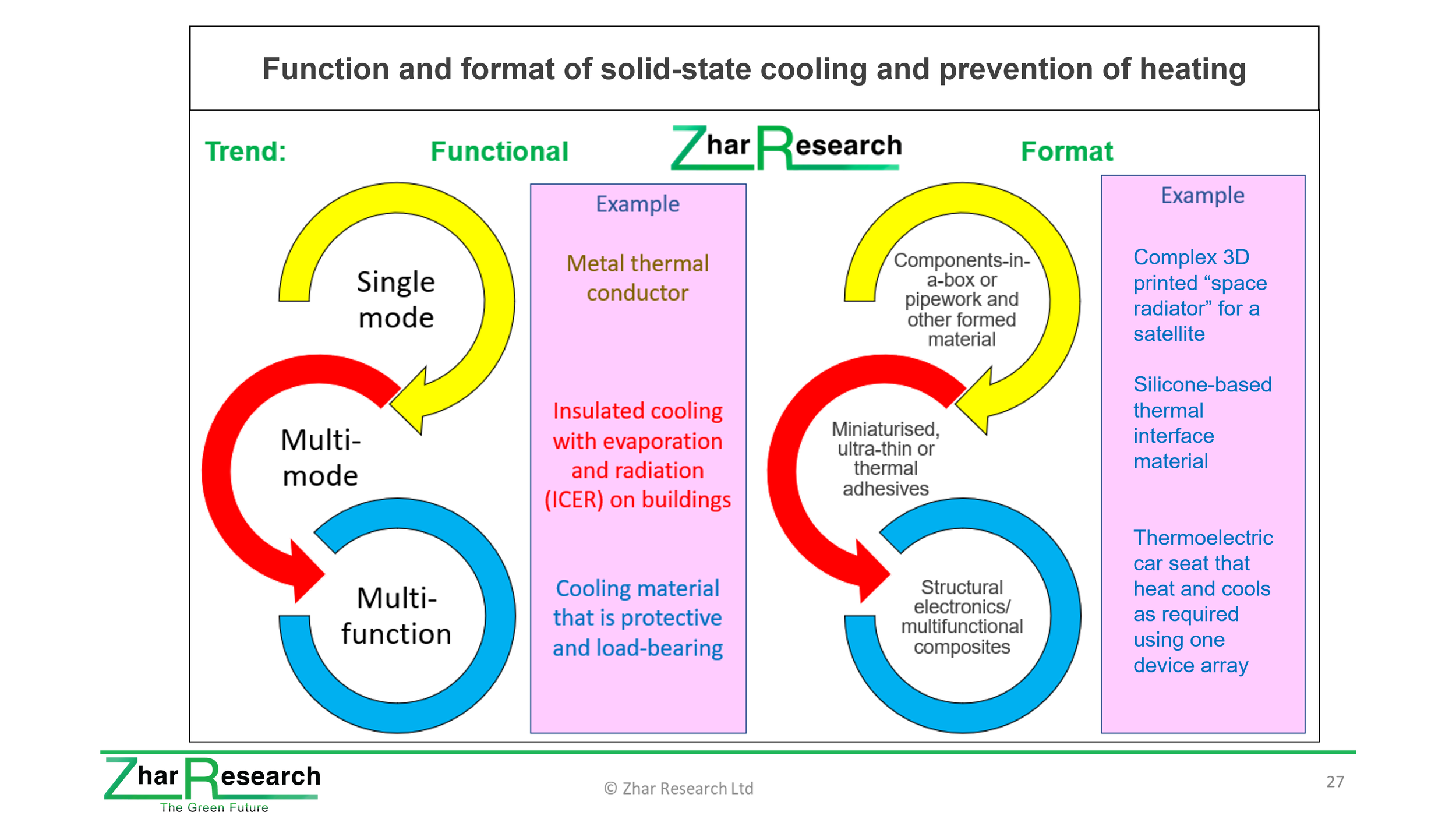
The new Zhar Research report, “Thermal Metamaterials : Markets, Technology 2026-2046” explains how thermal metamaterials follow many major trends emerging. They include the need for much more cooling, due to arriving AI datacenters, 1kW microchips, emerging countries in hotter locations such as India, and global warming. Thermal metamaterials support the trend to solid-state cooling without moving parts, liquids or gases and to cooling that does not heat cities. They follow the trend to structural electronics and other smart materials replacing components-in-a-box. They take us towards the use of affordable everyday materials, non-toxic, non-flammable and with minimal disposal issues. Think silicas, silicones, silicon, copper.
Astonishing versatility
In addition, these thermal gymnasts can perform the previously-impossible such as military thermal spoofing and camouflage. They exhibit unprecedented potential for governing heat diffusion, radiation and convection – yes, all three. Thermal metamaterials are therefore sought in most industry sectors - military, aerospace, fashion, medical, construction, environmental and more. Sales have commenced and they will surge as certain issues are overcome, thanks to the robust research pipeline. For example, low-cost reel-to-reel printing and 3D printing are in the frame. Necessarily highly-voided structures limit amounts used. Substrate characteristics for infrared handling are often relatively non-critical and can be very thin.
Your guide to commercial success
Commercially-oriented, the 305-page report, “Thermal Metamaterials : Markets, Technology 2026-2046” has 33 new infograms, 22 forecast lines 2026-2046, 13 primary conclusions, seven chapters, four SWOT appraisals and there are roadmaps for 2026-2046.
The Executive Summary and Conclusions (35 pages) is sufficient in itself for those with limited time. Here are the definitions, basics, conclusions and forecasts. The Chapter 2. Introduction (40 pages) explains metamaterials, temperature responsive and controlling versions, the burgeoning need for cooling, and how undesirable materials widely used and proposed are an opportunity for you to replace them. Understand the thermal metamaterial gymnastics including cloak, concentrator, rotator, camouflage, thermal illusion and enhanced and redirected conduction, convection and radiation.
Chapter 3. Thermal Metamaterial Principles and Functions (52 pages) dives into these basics in detail with new advances in theory and practice, mainly in 2025 and 2026, and evidence that there is much more ahead. Examples are thermal expanders, thermally radiative metamaterials, advanced photonic cooling and prevention of heating, ultra-conductive thermal metamaterials, thermal convective metamaterials and multimodal versions with multifunctional ones – for example doubling as windows – coming along. This naturally leads to Chapter 4. The Next Stage: Active, Dynamic and Tunable Thermal Metamaterials (20 pages). This includes unified static and dynamic versions and programmable mechanical-thermal metamaterials arriving.
Chapter 5. Manufacturing Technologies and Materials for Thermal Metamaterials (25 pages) introduces needs, approaches, materials, merits of additive vs subtractive manufacture and evidence of the many manufacturing technologies currently employed including 4D printing and photolithography. Learn how conventional heat management necessitates 3D thermal metamaterial structures but infrared manipulation trends to 2D printing reel-to-reel. Also covered are materials and manufacturing technologies for Passive Daylight Radiation Cooling PDRC using thermal metamaterials.
Chapter 6. Many Targetted Applications of Thermal Metamaterials with Research Advances 2025-6 (55 pages) is impressively broad. It includes sensors, surgical robots, spacecraft, information-rich thermal radiation meta-emitters, computers, aerospace engineering, greenhouses, windows, energy harvesting, thermal metalenses, microchip thermoelectrics and solar panel cooling, satellite thermal control, thermal packaging of electronics and textiles that cool. Much is new in 2026 and the report is constantly updated so, vitally, you get the latest.
The report closes with Chapter 7. Passive Daytime Radiative Cooling (PDRC) Using Metamaterials (60 pages) because this is a particularly strong focus for this technology. See PDRC basics, hype curve, SWOT, appraisal of latest research and company advances and products offered.