

 Image 1 of 2
 Image 2 of 2
Sample Pages

Contents List
-
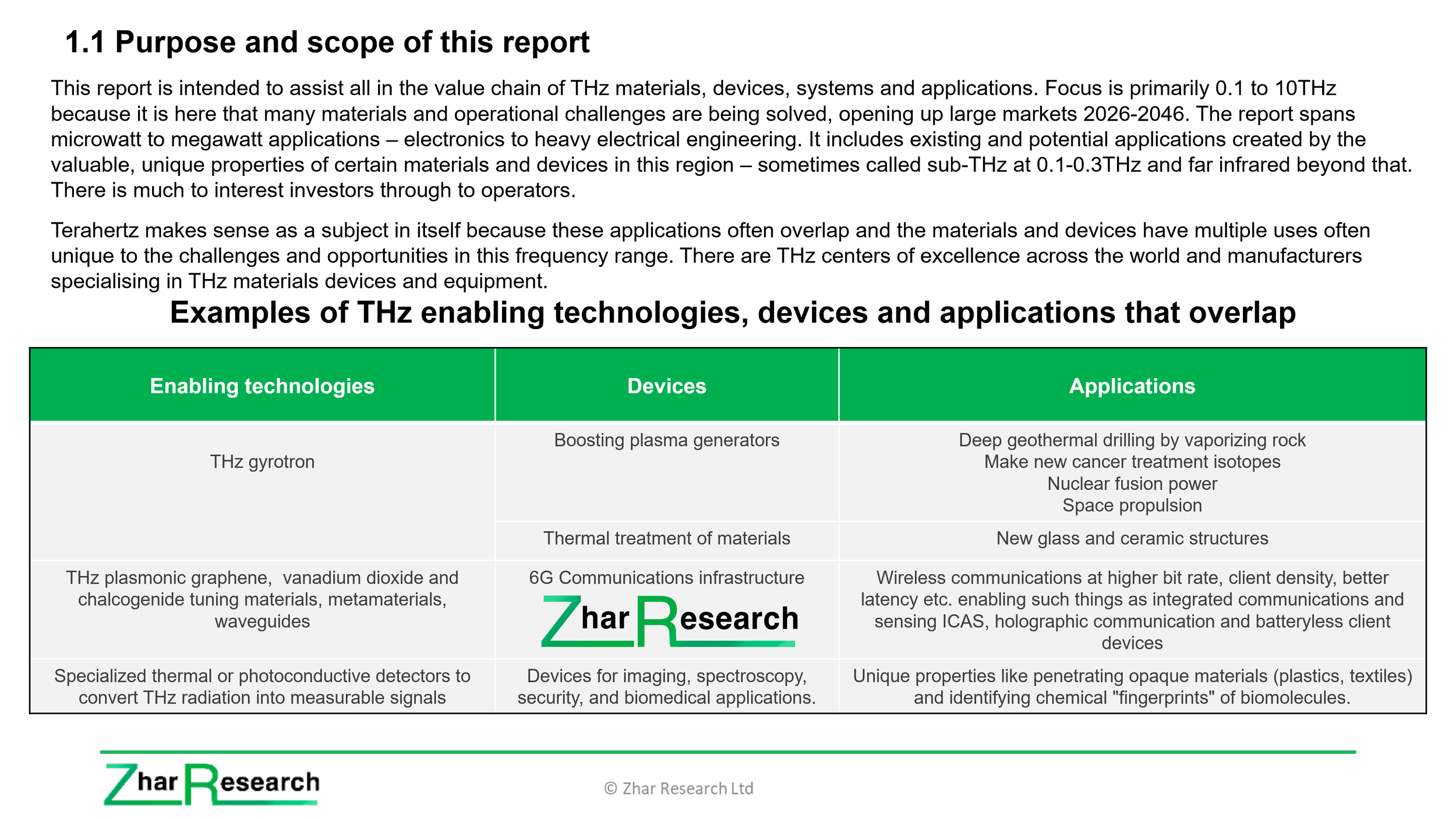
1.1 Purpose and scope of this report
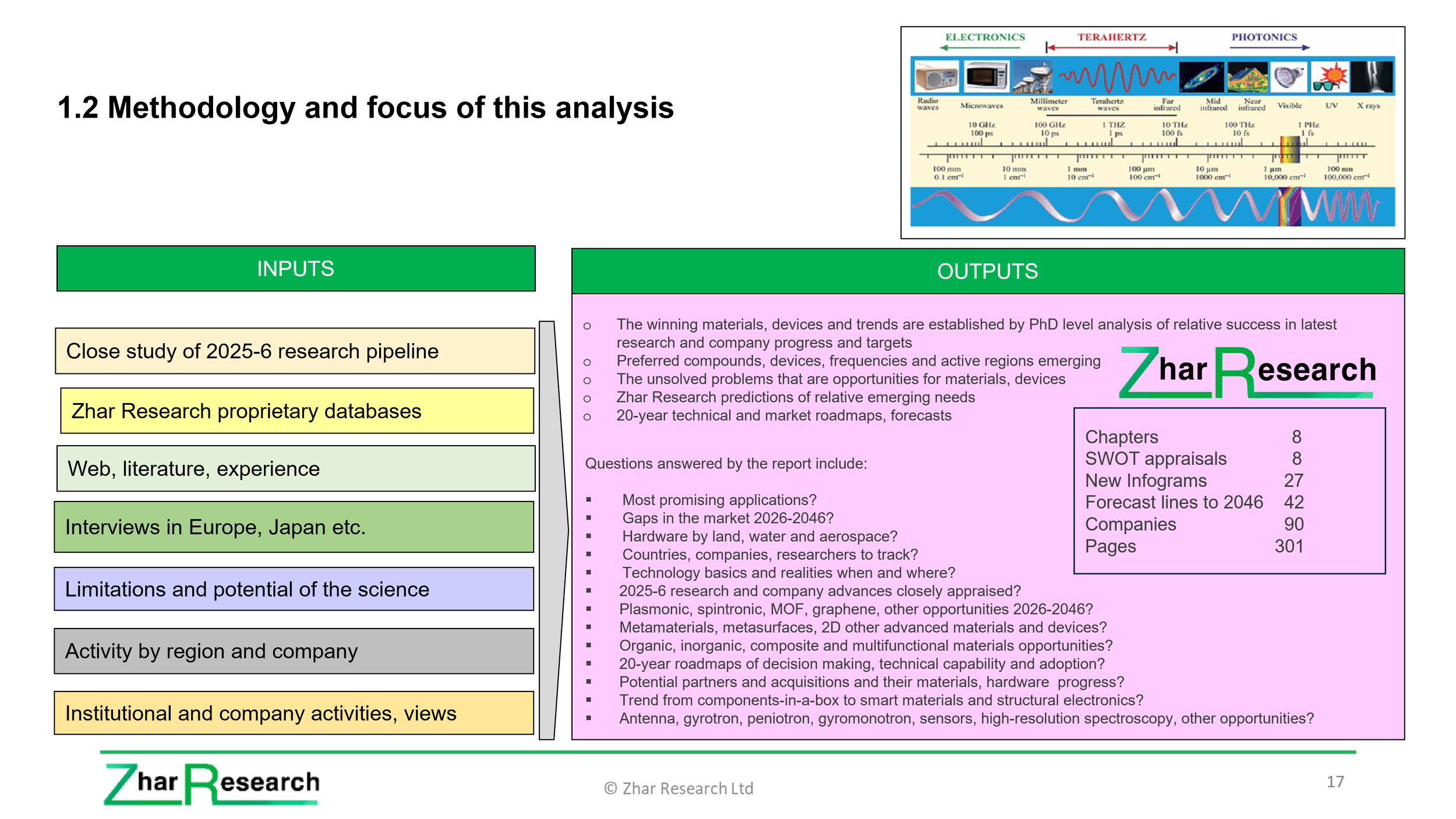
1.2 Methodology and focus of this analysis
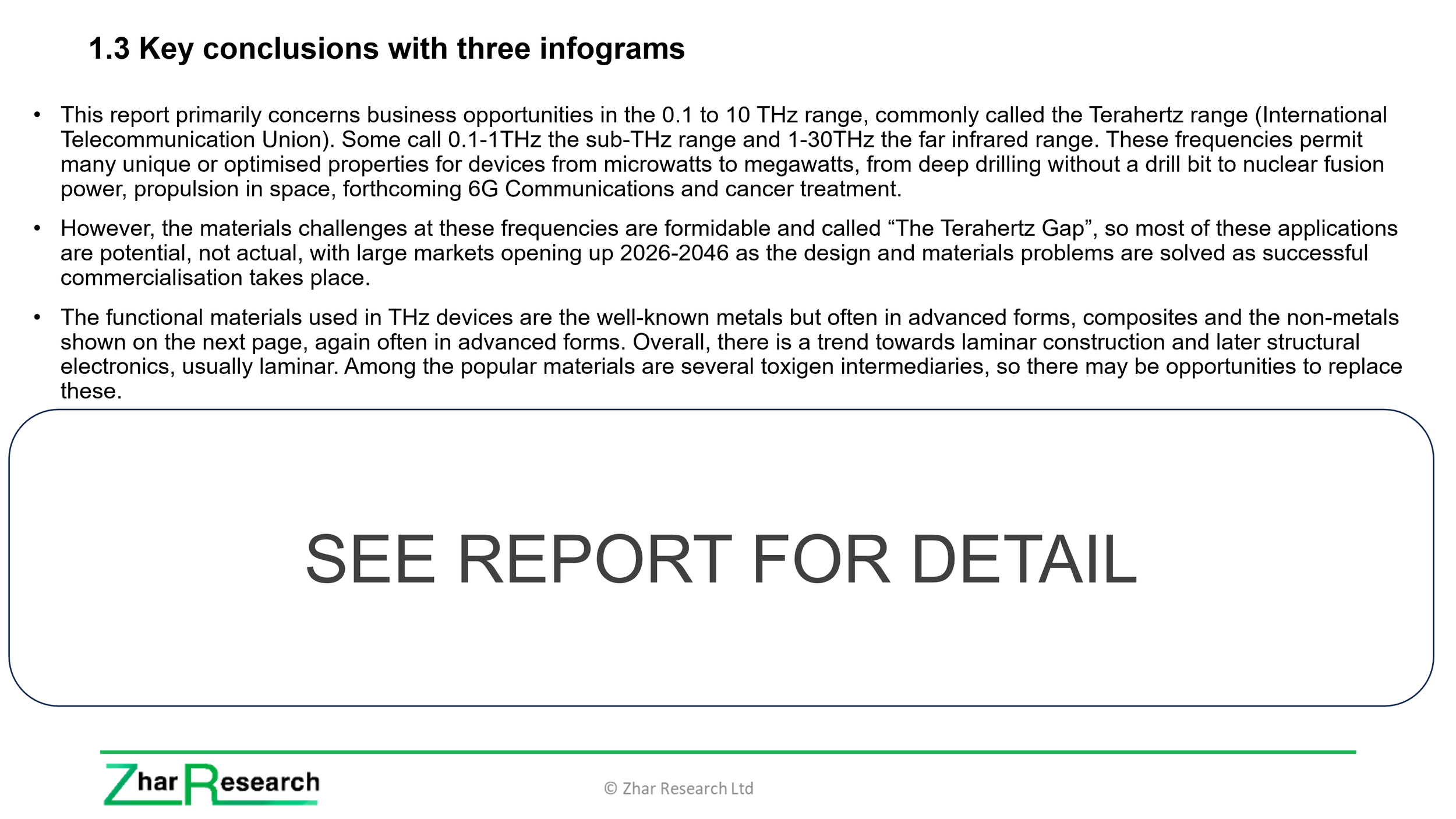
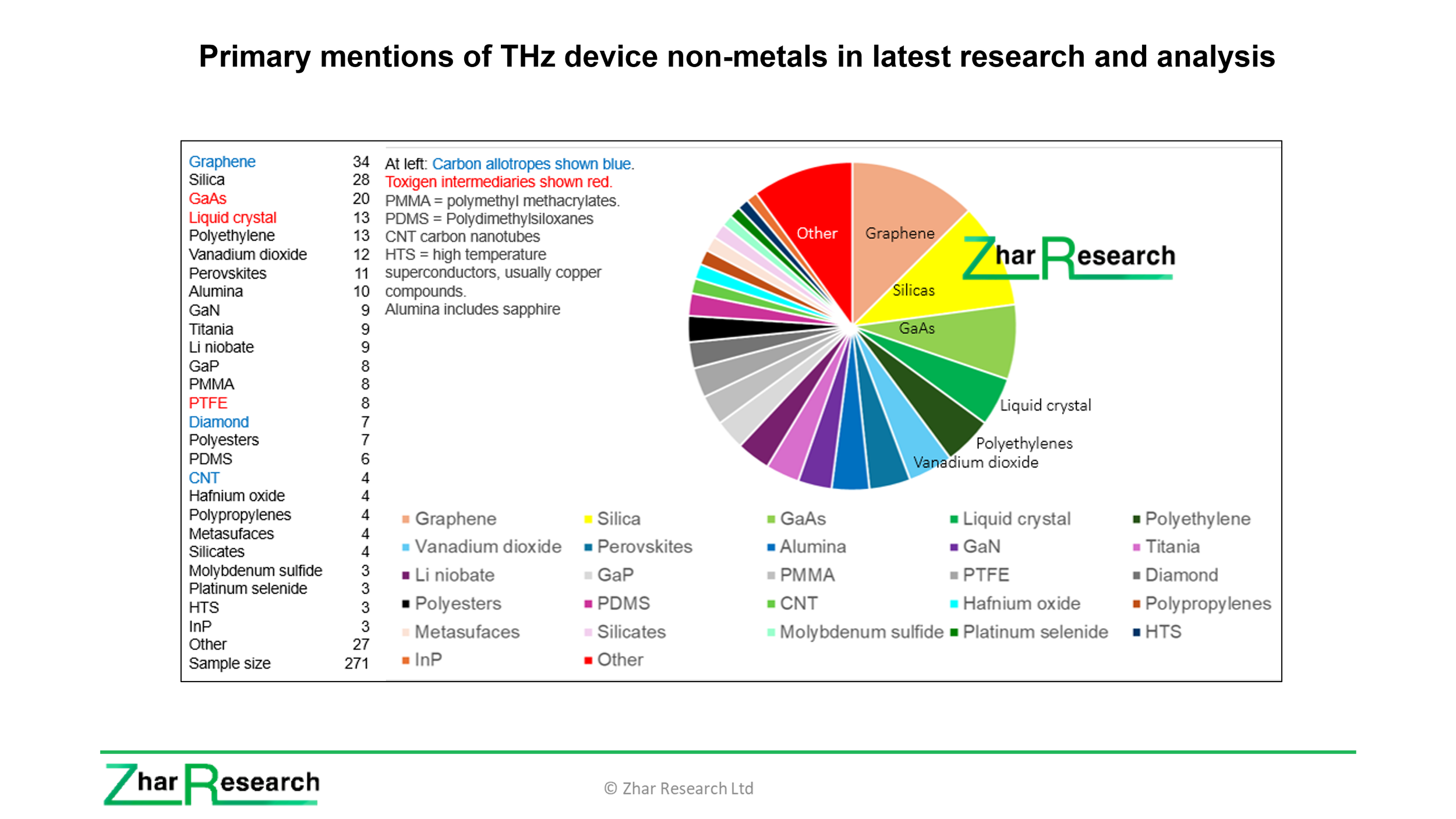
1.3 Key conclusions with three infograms
1.4 Enabling technologies and SWOT appraisals
1.4.1 THz gyrotron designs and their uses
1.4.2 THz waveguide designs and their uses
1.4.3 Infogram: The future of THz antennas
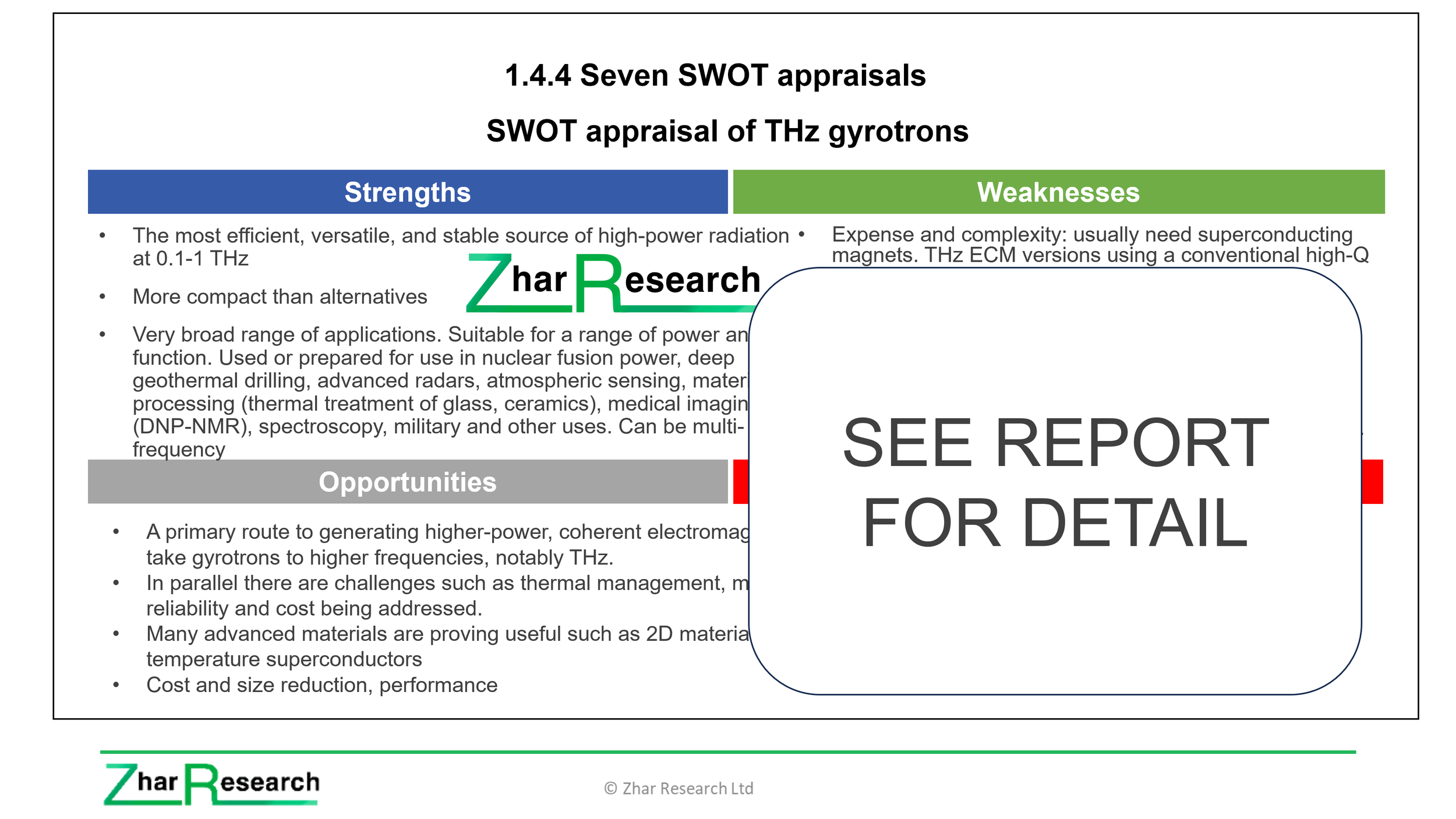
1.4.4 Seven SWOT appraisals
1.5 Centers of THz excellence and specialists in key verticals
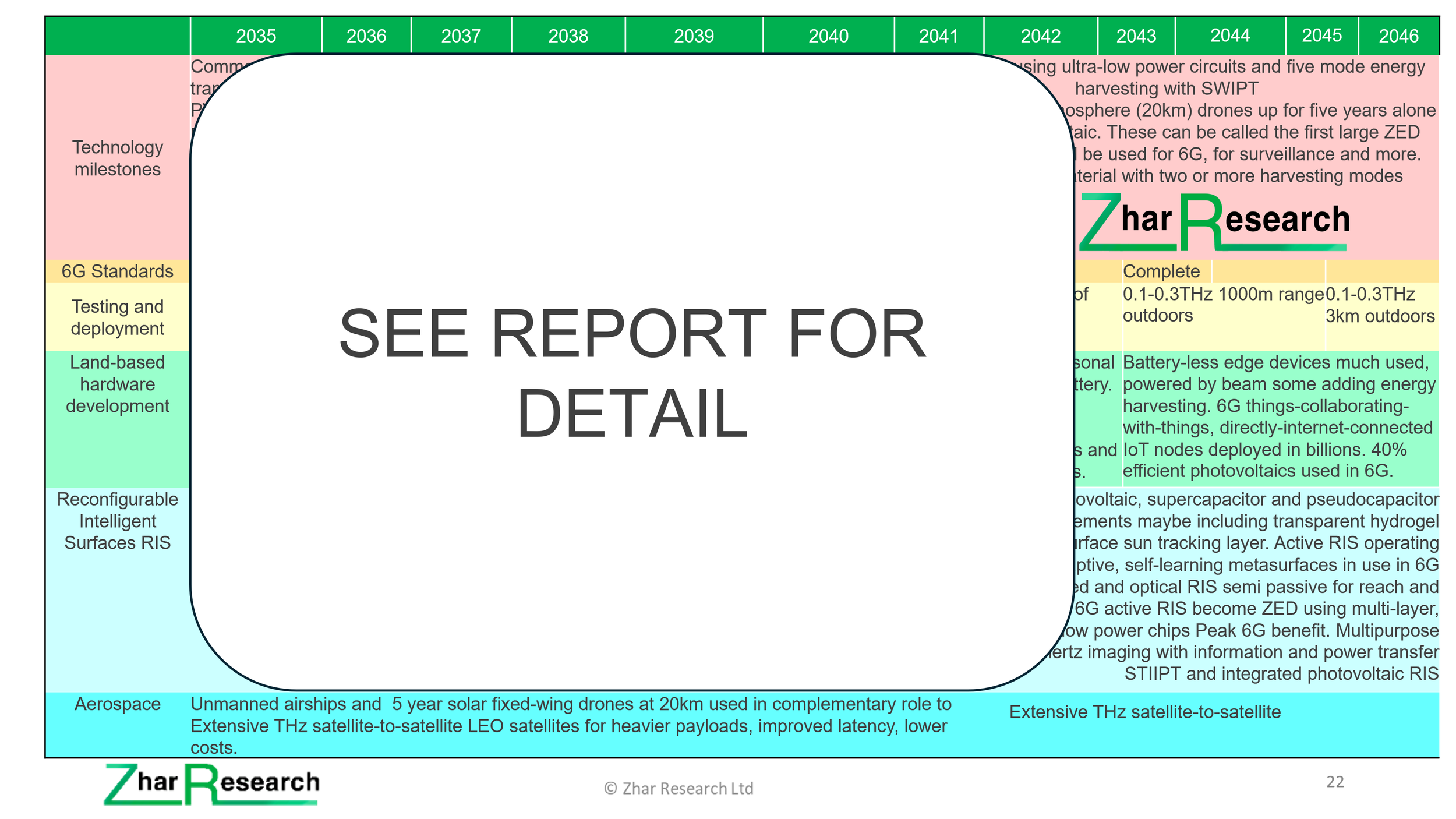
1.6 Roadmaps 2026-2046
1.6.1 6G Communication systems, materials and standards roadmaps in six lines 2026-2046
1.6.2 Fusion and allied systems, materials and hardware roadmap for technology vs market 2026-2046
1.7 Market forecasts in 46 lines with tables, graphs and explanation 2026-2046
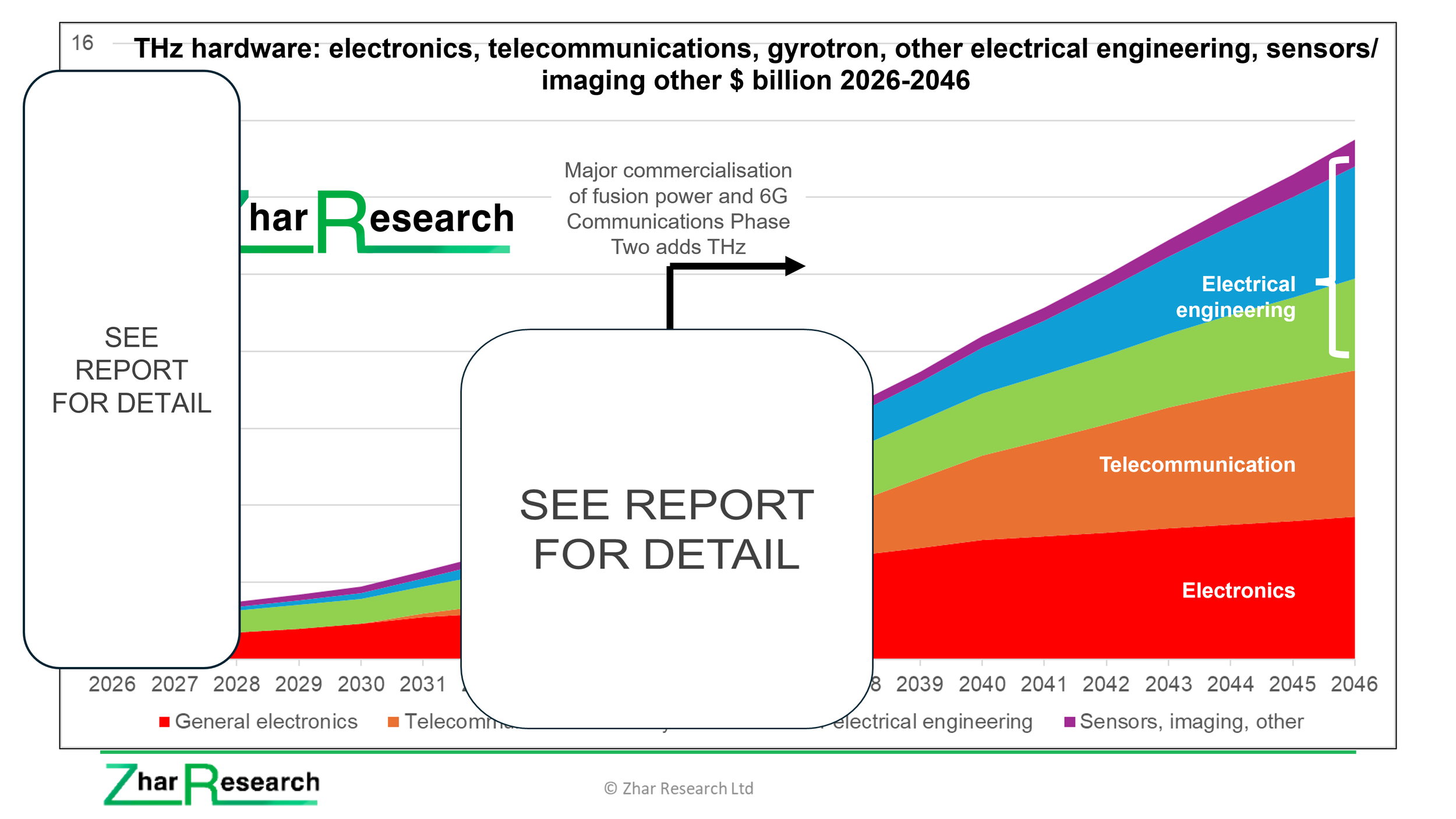
1.7.1 THz hardware: electronics, telecommunications, gyrotron, other electrical engineering, sensors/ imaging, other $ billion 2026-2046
1.7.2 Optical and optronic 6G materials and device market 2026-2046
1.7.3 Percentage share of global 6G hardware value market by four regions 2026-2046
1.7.4 Functional materials for 6G value market % by location: client devices, CPE, RIS, other 2026-2046
1.7.5 Smartphone and successor billion units sold globally 2024-2046 in two scenarios
1.7.6 Market for 6G vs 5G base stations units millions yearly 2025-2046
1.7.7 6G base stations market value $bn if 6G successful 2029-2046
1.7.8 6G RIS value market 2027-2046 $ billion
1.7.9 6G RIS area sales yearly billion square meters 2027-2046
1.7.10 Average 6G RIS price $/ square m. ex-factory including electronics 2028-2046
1.7.11 6G RIS value market $ billion: active vs four semi-passive categories by THz and other frequency 2026-2046
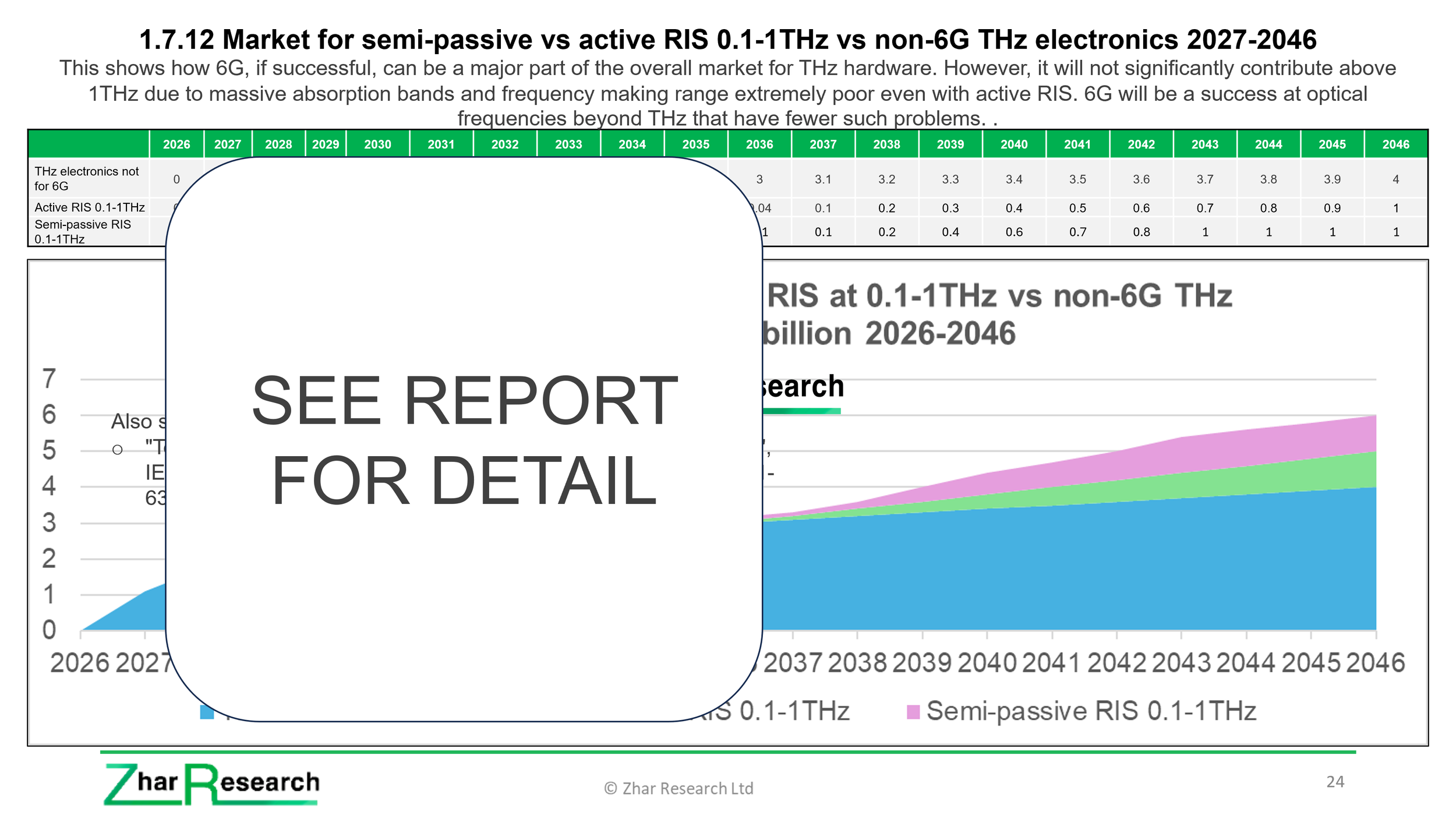
1.7.12 Market for semi-passive vs active RIS 0.1-1THz vs non-6G THz electronics 2027-2046
1.7.13 6G fully passive metamaterial reflect-array market OWC and total $ billion 2029-2046
1.17.14 Electromagnetic meta-device market $ billion by application segment 2025-2046
-
2.1 Overview
2.2 Some aspects of THz compared to adjoining frequencies
2.3 Some applications of THz technology
2.4 Example: THz TeraFET applications and their frequency and wavelength ranges
2.5 Example: gyrotrons
-
3.1 Overview
3.2 THz physiological effects, thermal and non-thermal
3.3 Advances of terahertz technology in neuroscience
3.3.1 General potential
3.3.2 Terahertz stimulation alleviates anxiety: research advance in 2025
3.4 THz diagnosis and treatment of head and neck diseases
3.5 Terahertz endoscopy advances through 2025-6
3.6 Precise stimulation and wireless control in retinal, cochlear, cardiac implants in 2025
3.7 THz medical tools
3.7.1 Sensing and imaging molecules, proteins, cells: THz nanoscopy, super-resolution imaging, spectroscopy overview
3.7.2 THz sensors, super-resolution imaging, nanoscopy and spectroscopy: many major advances 2025-6
3.8 SHINE Technologies USA
3.9 TeraSense USA
3.10 Teraview USA
-
4.1 Overview
4.2 Gyrotron designs and their uses
4.3 Plasma technology sometimes powered by THz gyrotrons: initiatives, applications
4.4 Capability and improvement of THz gyrotrons and allied devices 2025-2046
4.4.1 Increasing frequency to aid performance including Kyoto Fusioneering Japan
4.4.2 Many THz gyrotron research advances 2025-6
4.5 Applications of THz Gyrotrons
4.5.1 Military and security applications: microwave and THz
4.5.2 Plasma heating for nuclear fusion power and other high power: many research advances 2025-6
4.5.3 Sensing, imaging and security
4.5.4 Material processing
4.5.5 Nuclear magnetic resonance and other high precision spectroscopy
4.5.6 Other examples
-
5.1 Overview
5.1.1 6G frequencies, hardware and other plans
5.1.2 THz and other RIS
5.2 Infogram: Progress from 1G-6G rollouts 1980-2046 with THz arrival
5.3 Infogram: 6G materials opportunities with infrastructure and client devices 2026-2046
5.4 Infograms: increasing adoption of optics/ optronics for 6G
5.4.1 Infogram of some options
5.4.2 Infograms: Options by frequency for 6G to add higher frequencies capable of better performance
5.4.3 Sub-THz range meters achieved in good weather by LG and Samsung with Gbps levels of data
5.4.4 The case for multi-frequency 6G Phase Two including THz “so one gets through”
5.4.5 Primary wireless transmission parameters of 6G compared by frequency: subTHz to visible
5.4.6 Pie chart: Mismatch of planned and researched 6G frequencies may invite usurpers
5.5 Analysis of 6G opportunities THz and other on Earth and in aerospace with infograms
5.6 Analysis of 245 latest THz, nearIR and visible frequency 6G-related researches and recommendations
5.7 Infogram: Trend from discrete boards, stacked films to full smart material integration
5.8 Infogram: Printing options for 6G hardware by frequency of operation
5.9 Five SWOT appraisals
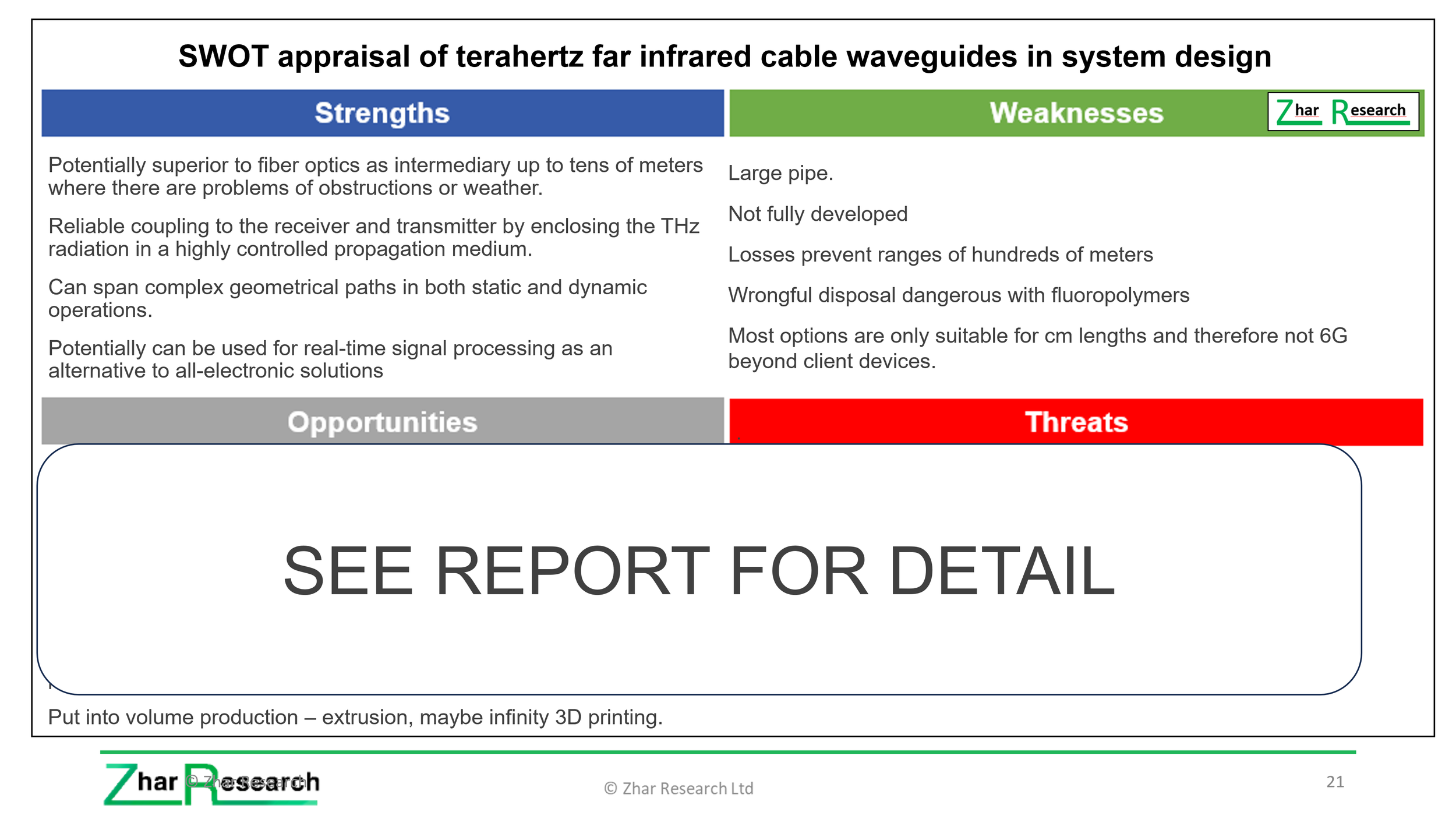
5.9.1 SWOT appraisal of 6G adding sub-THz, THz, near infrared and visible frequencies
5.9.2 SWOT appraisal of Optical Wireless Communications for 6G
5.9.3 6G RIS SWOT appraisal
5.9.4 Simultaneous Transmission And Reflection STAR-RIS SWOT appraisal
5.9.5 SWOT appraisal of terahertz far infrared cable waveguides in 6G system design
5.10 6G THz research advances through 2025-26
-
6.1 Overview: definition, basic types, SWOT
6.1.1 Definition, basic types
6.1.2 A closer look with examples and SWOT
6.2 Challenges and innovations with 2025-6 advances
6.3 THz waveguide applications with some 2025-6 research advances
6.3.1 Astrophysics
6.3.2 Chemical analysis
6.3.3 High-speed communication and wireless systems
6.3.4 Non-destructive testing
6.3.5 Medical diagnostics
6.3.6 Process monitoring
6.3.7 Security and inspection
6.3.8 Sensing, biomolecule identification, non-invasive cell analysis
6.3.9 Spectroscopy
6.3.10 Transmitters and accelerators
6.4. Current and future THz waveguide materials and principles in action
6.4.1 Formulations: examples of compounds and plasmonics advances through 2025-6
6.4.2 Advanced materials demonstrated for THz waveguides: 2025-6 research advances
6.5 Manufacturing polymer THz cable in long reels and waveguides and 3D printing
-
7.1 Overview with examples of research advances 2025-6
7.2 Enabling technologies: metamaterials, 2D materials with advances 2025-6
7.2.1 THz metamaterials
7.2.2 THz 2D materials
7.3 Sensors
7.3.1 Basics: biomimetics, inputs, anatomy, outputs, smart sensors
7.3.2 Example: Photonic Crystal Fiber Surface Plasmon Resonance (PCF-SPR) THz sensors
7.3.3 Other sensors using or detecting THz with advances through 2025-6
7.4 Super-resolution imaging and spectroscopy basics and advances through 2025-6
7.5 Generators: X-ray sources, THz laser-generated fields advances through 2025-6
7.6 THz lasers
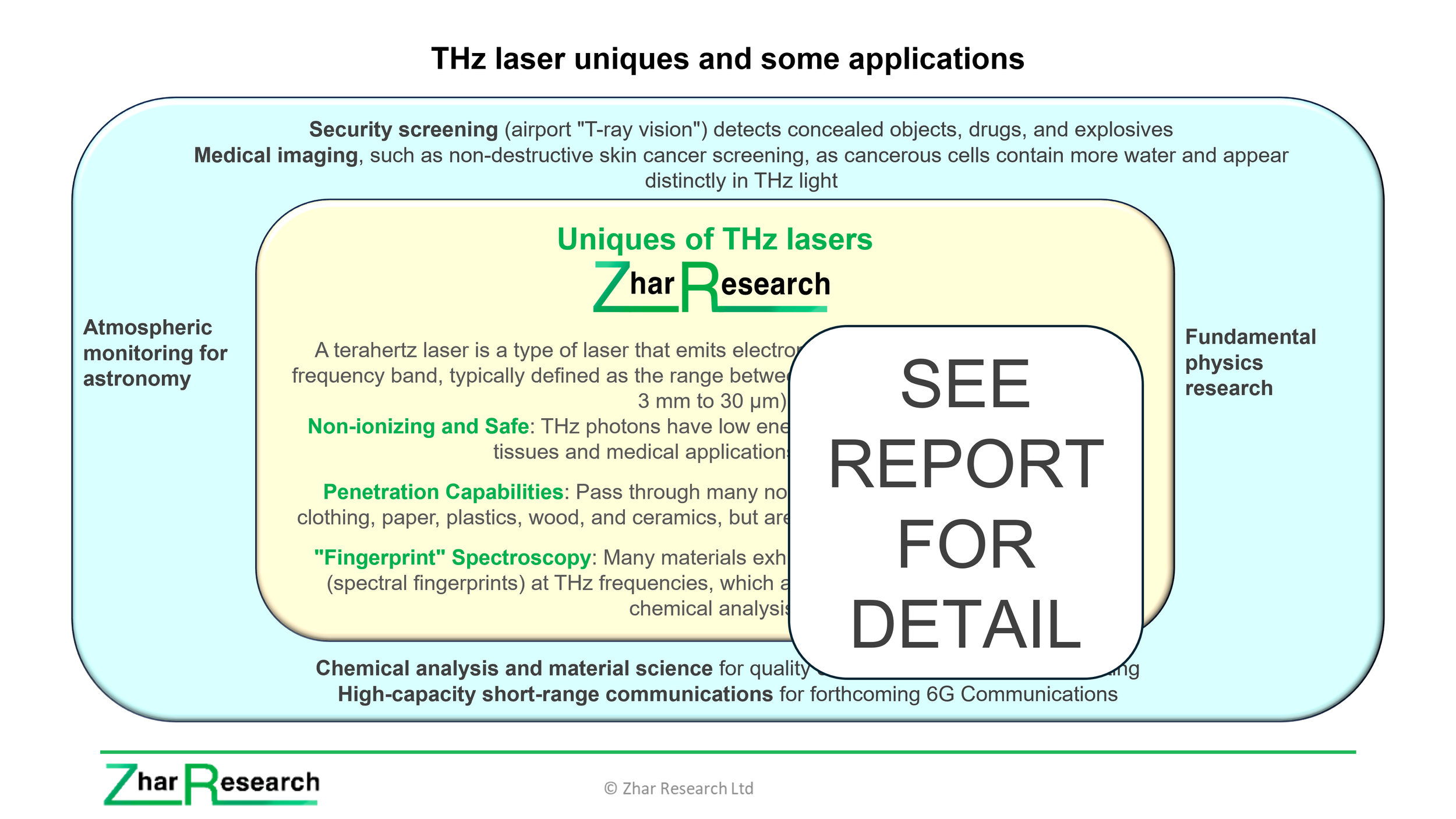
7.6.1 Uniques and applications
7.6.2 Technologies
7.6.3 Research advances through 2025-6
-
8.1 Overview with recent examples
8.2 Terahertz antennas
8.2.1 Challenges
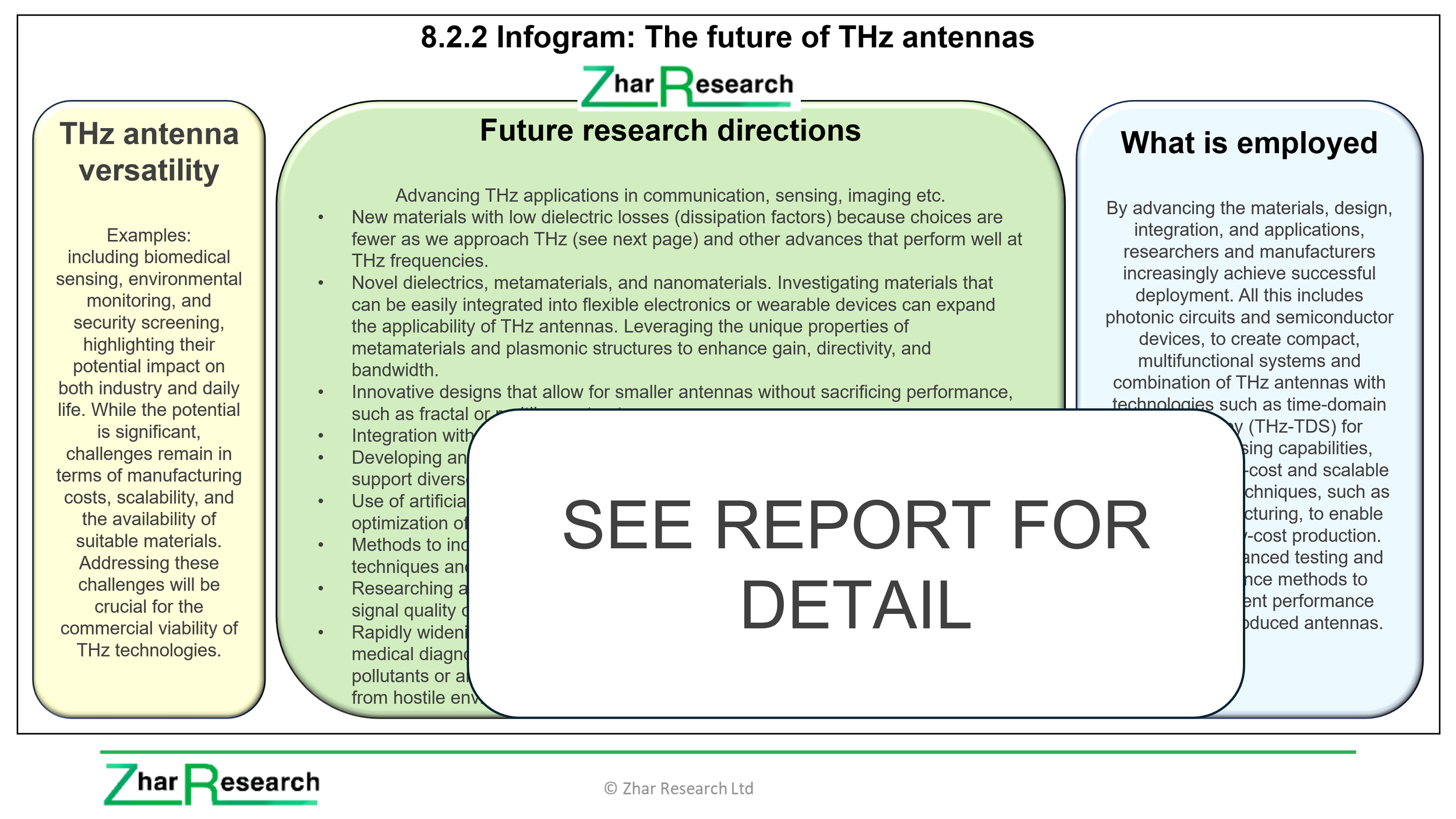
8.2.2 Infogram: The future of THz antennas
8.2.3 THz antenna design options with research advances 2025-6
8.2.4 THz photoconductive antennas: research advances 2025-6
8.3 Spintronics and plasmonics
Terahertz is now a rapidly-growing, large opportunity and your essential guide is the new 301-page Zhar Research report, “Terahertz Business Opportunities: Energy, Medical, Security, Telecoms, Other Markets, Technology 2026-2046”. Its PhD level analysis intensively covers research and initiatives 2025-6 because old news is useless in this fast-moving topic. It is commercially-oriented.
Your next growth opportunity
Here is your next growth opportunity leveraging your device and materials skills with many examples of premium pricing embracing new cancer treatments to energising planned fusion power reactors. Monetise your skills in state-of-the-art materials and fabrication including graphene, sensors, antennas and lasers achieving what was previously impossible.
Wide scope, independent viewpoint, lucid presentation
The report spans microwatt to megawatt applications – electronics to heavy electrical engineering. It includes existing and potential applications created by the valuable, unique properties of certain materials and devices in this region – sometimes called sub-THz at 0.1-0.3THz and far infrared beyond that.
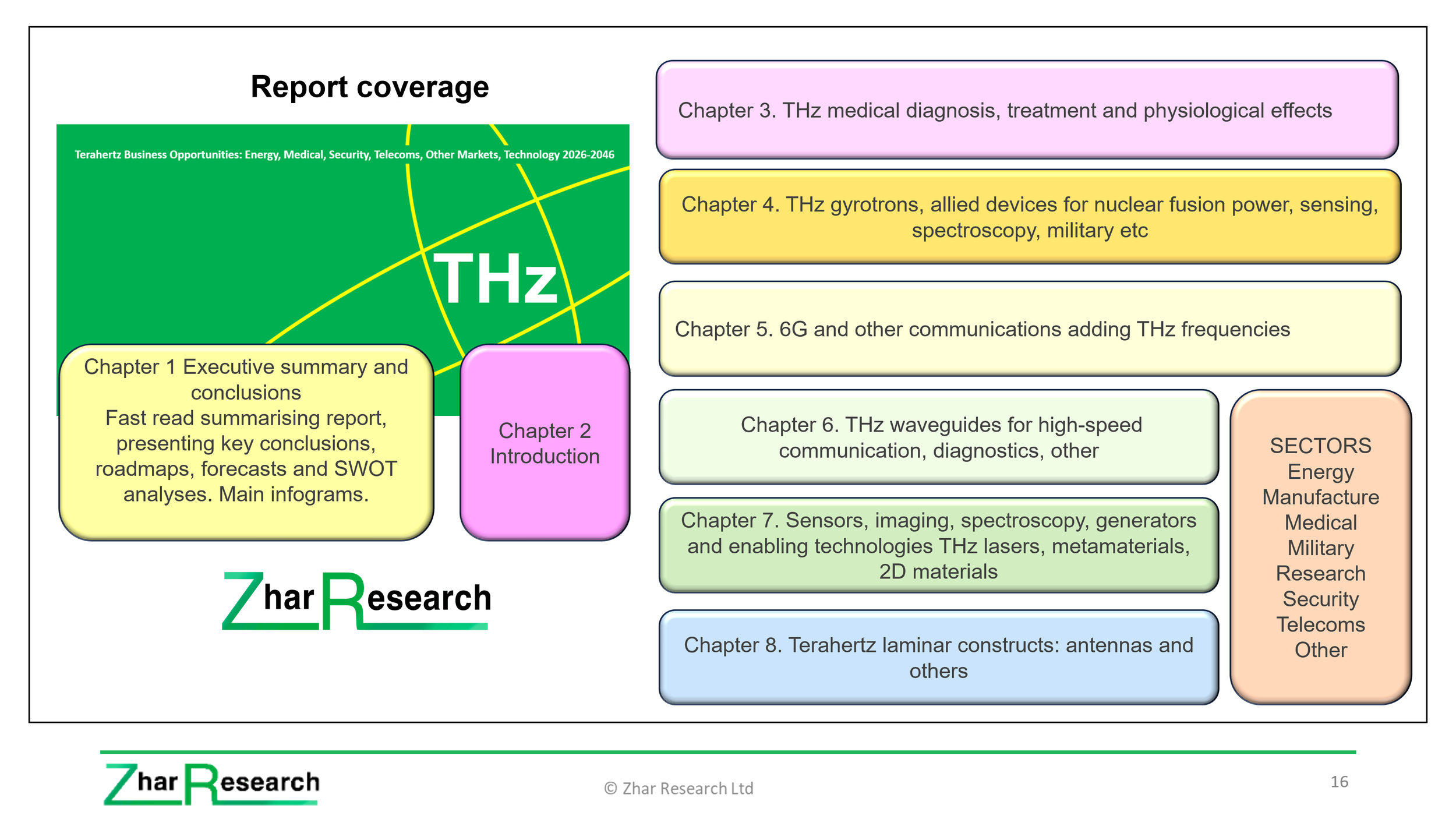
The report assists all in the terahertz (mostly 0.1-10THz) value chain, particularly those in materials, hardware and systems. See 8 chapters, 8 SWOT appraisals, 27 new infograms, several roadmaps and 42 forecast lines with explanations because the emphasis is on clarity concerning achievement of commercial success and benefitting society. What partners and acquisitions? Which applications and industries are most promising? Negatives are presented alongside positives not evangelism and frothy forecasting. A flood of scientific reports and company advances are assessed and referenced for your further reading.
The executive summary and conclusions (46 pages) has basics, key conclusions, materials analysis, the SWOT appraisals, main infograms and roadmaps. The introduction (13 pages) explains terahertz frequencies and several applications with 2025 research examples.
Exceptionally wide medical uses, companies involved
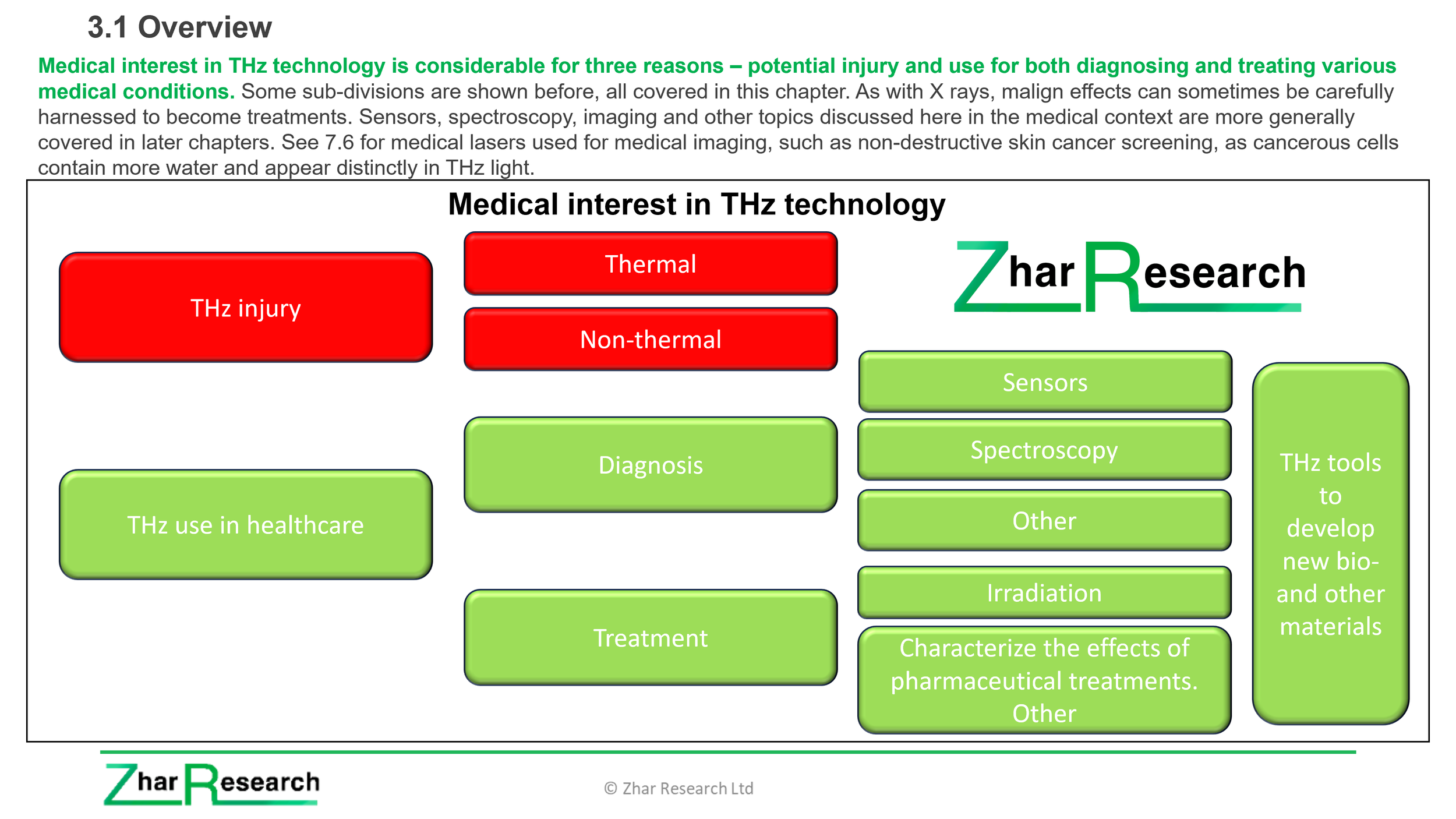
Chapter 3. THz medical diagnosis, treatment and physiological effects takes 36 pages to cover one of the sectors that is most advanced in commercial use of THz frequencies. Indeed later chapters on various THz technologies have much on medical aspects as well. See physiological effects, thermal and non-thermal from heavy doses, THz terahertz technology in neuroscience and generally with many examples from research and current practice using harmless low doses. Terahertz endoscopy advances through 2025-6 are here. Understand other THz medical tools notably sensors including sensing and imaging molecules, proteins, cells: THz bio-detection, nanoscopy, super-resolution imaging, including medical super-resolution imaging, nanoscopy and spectroscopy: many major advances 2025-6. Three company activities are profiled: SHINE Technologies, TeraSense and Teraview.
Gyrotrons and derivatives demanded
Chapter 4. concerns THz gyrotrons, allied devices for nuclear fusion power, sensing, spectroscopy, military etc (29 pages) concerns these large devices that are starting to be commercialised and have a large potential. About half concerns their design evolution with much emphasis on latest research advances 2025-6 including use of advanced materials such as high temperature superconductors. Then applications, actual and potential of THz Gyrotrons are detailed including military, security, plasma heating for nuclear fusion power and other high power compared to use for sensing, imaging and in security scanning, material processing, nuclear magnetic resonance, other high precision spectroscopy and more.
Communications big later
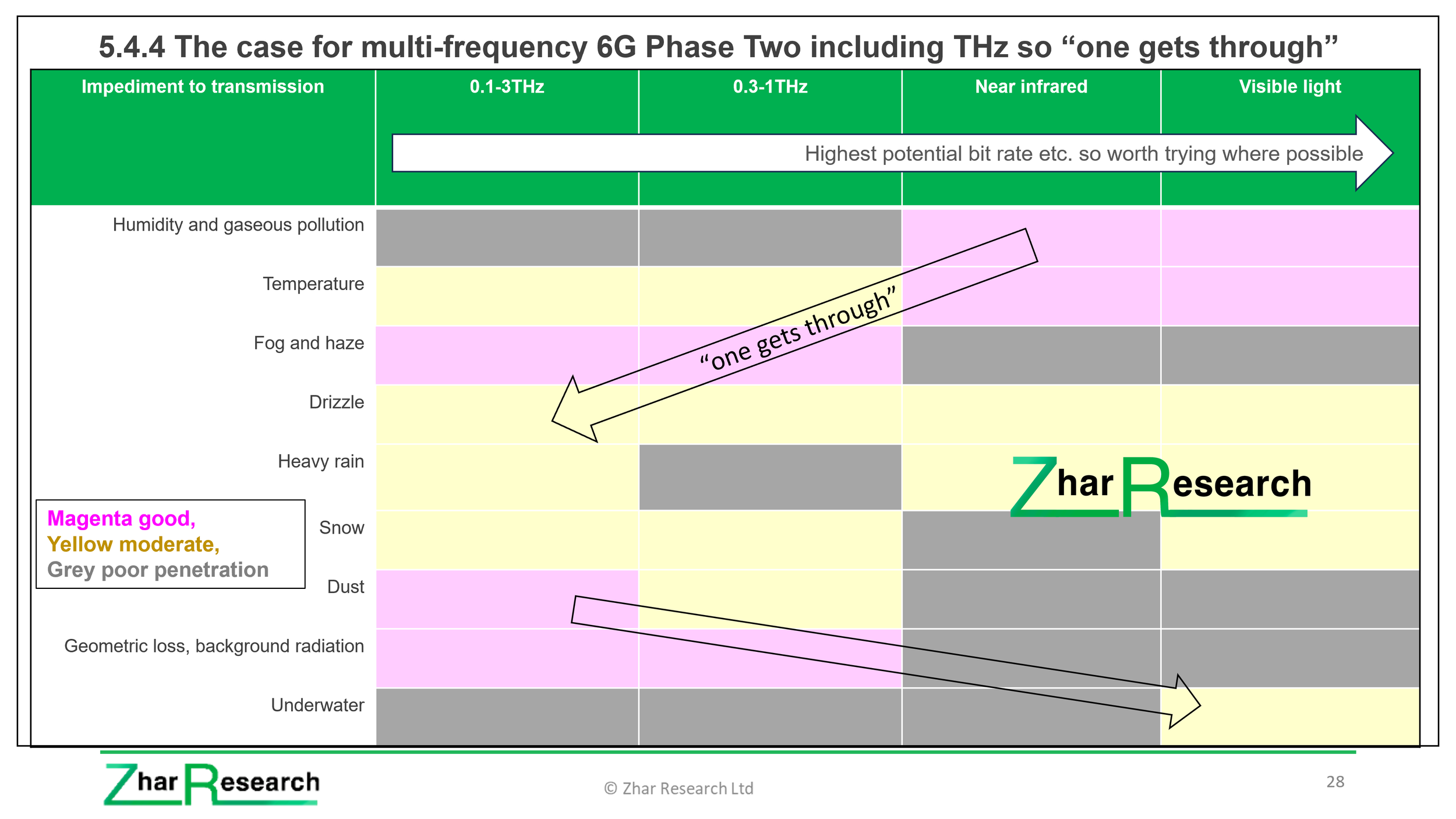
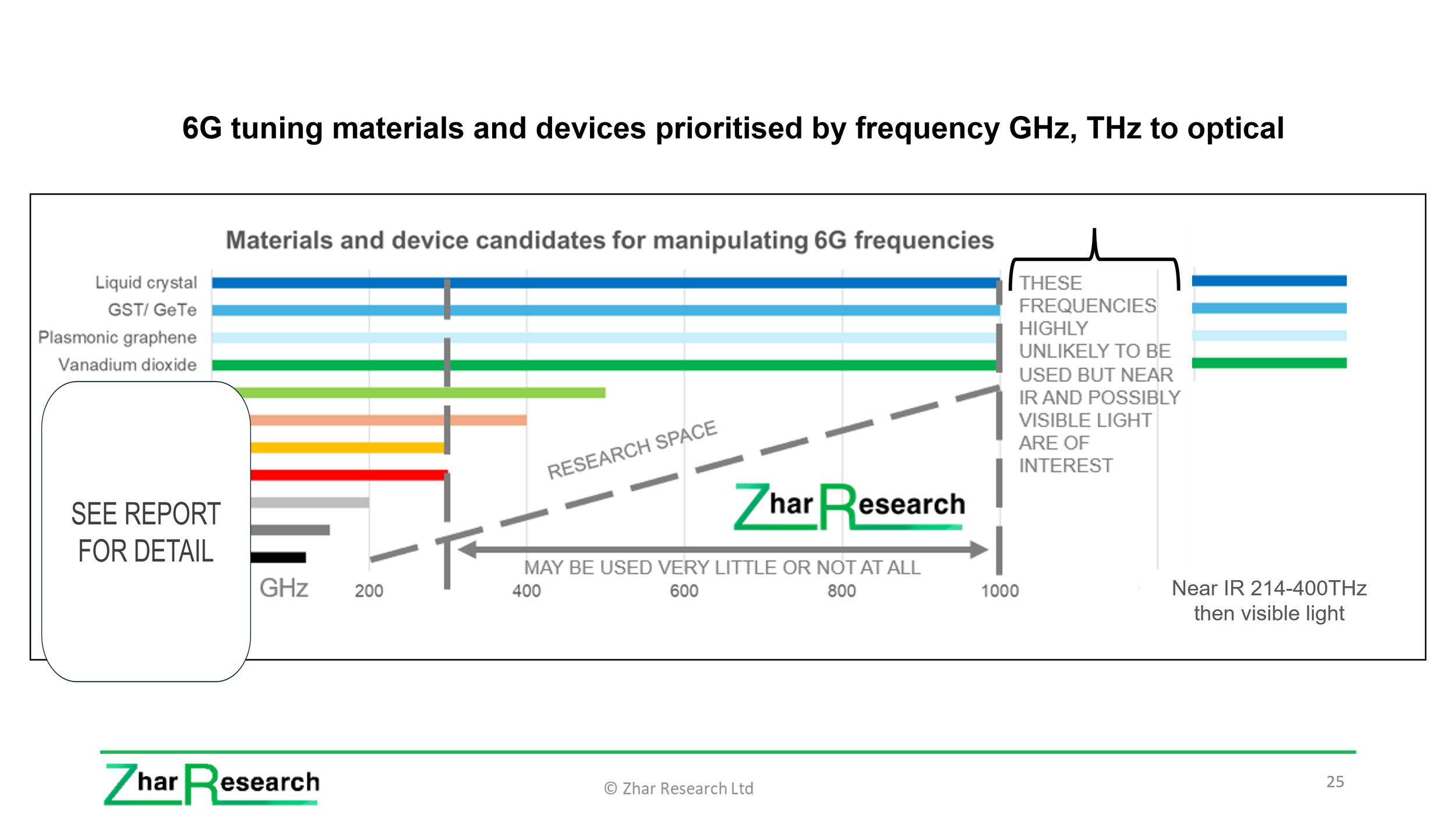
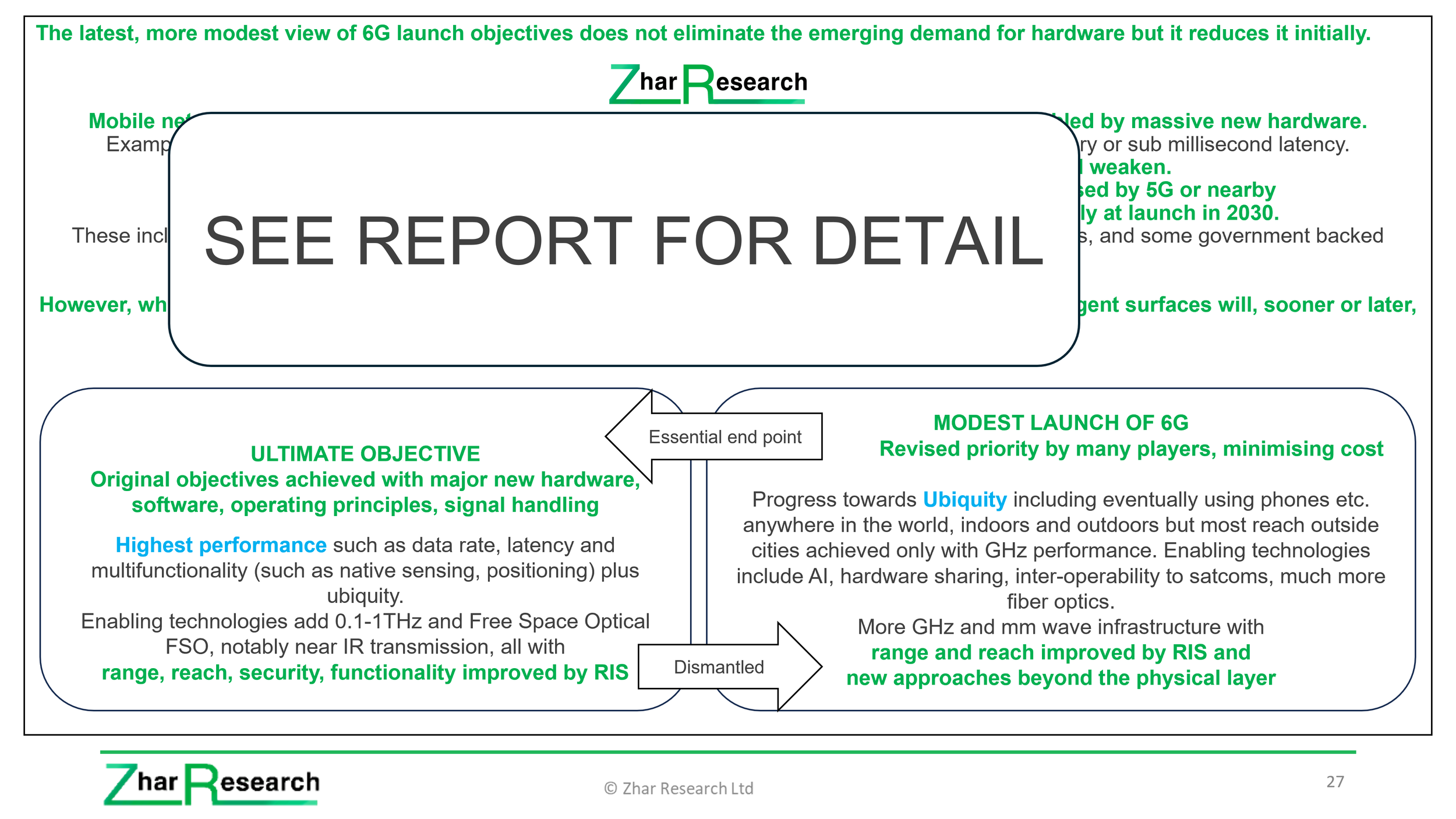
6G Communications is planned to launch in 2030 but with almost no use of THz because it will relay almost entirely on 5G frequencies and advances above the physical layer to save cost. However, around 2035 it must heavily use THz and optical frequencies if it is to meet most of its promises so Chapter 5. “6G and other communications adding THz frequencies” covers this large commercial opportunity for many THz technologies in detail. This includes transmitters, reconfigurable intelligent surfaces enhancing the propagation path, receivers and other aspects. There are many SWOT appraisals and 2025-6 research advances interpreted, even analysis of the winning materials. Learn how multi-frequency systems will emerge, “so one gets through” in various weather conditions but, in the THz band, over 1THz is assessed as useless for wireless telecommunications.
Enabling technologies
The remaining chapters concern enabling technologies for emerging THz applications- devices and special materials and constructs – all widely-applicable “horizontals”. Chapter 6. Is “THz waveguides for high-speed communication, diagnostics, other” (38 pages). Learn how they will be important in astrophysics, chemical analysis, high-speed communication and wireless systems, non-destructive testing, medical diagnostics,, sensing, biomolecule identification and non-invasive cell analysis, process monitoring, security, inspection, spectroscopy, transmitters and accelerators. Advanced materials demonstrated for THz waveguides include PTFE porous fiber, PBVE, PE-PP metamaterials, InAs, GaP and sapphire all covered in detail emphasising 2025-6 advances and THz waveguide manufacturing technologies such as infinity 3D printing.
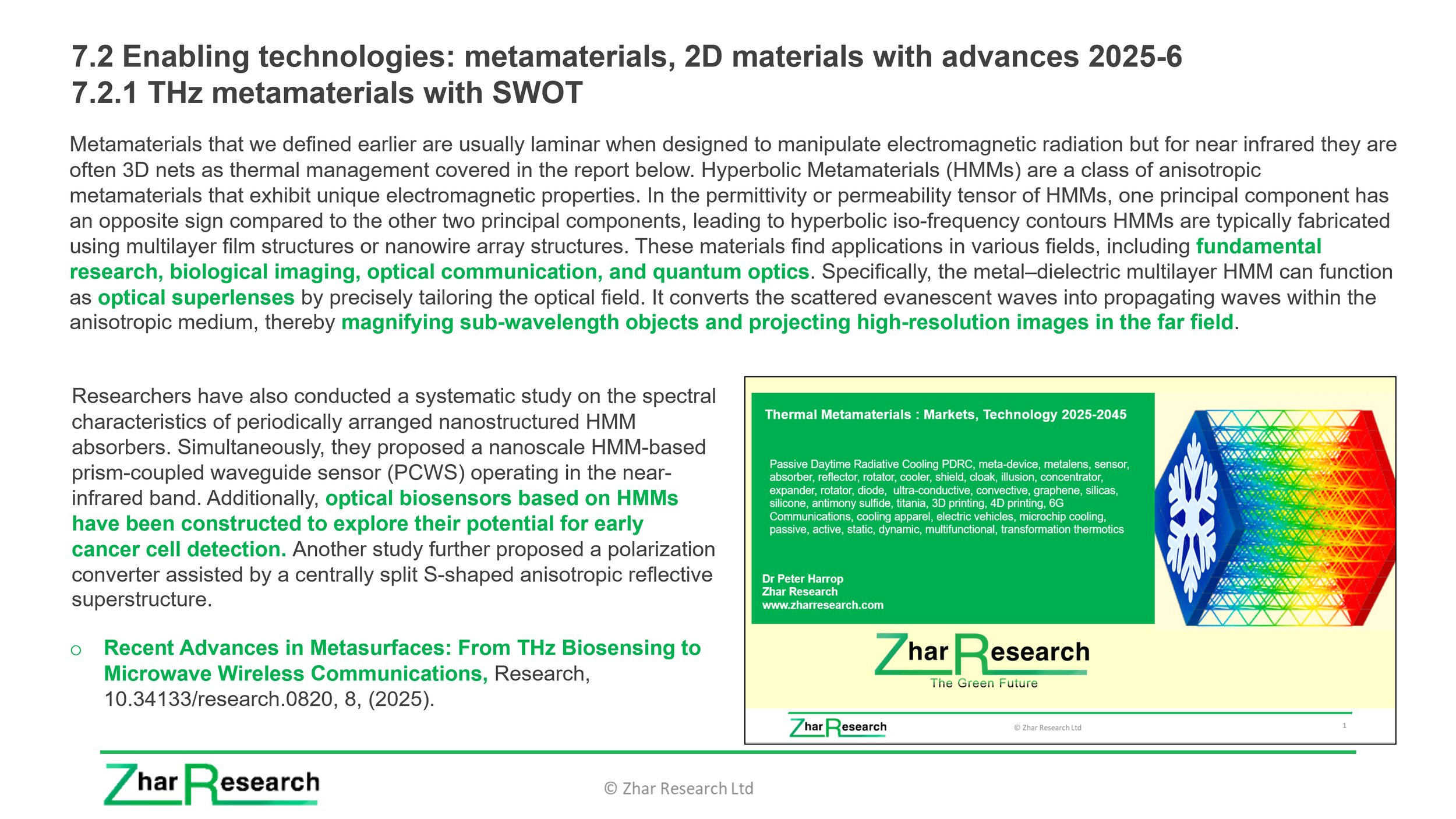
Chapter 7. Sensors, imaging, spectroscopy, generators and enabling technologies THz metamaterials, 2D materials, THz lasers (56 pages) teaches you how THz metamaterials are mainly usefully laminar, populated with components to create metasurfaces but trending to multi-purpose structural electronics. THz metamaterials. Graphene is, by far, the winning THz 2D material but what others are in contention and why? Sensors are so important, they are covered from basics to biomimetics, inputs, anatomy, outputs, smart sensors. Enjoy the example Photonic Crystal Fiber Surface Plasmon Resonance (PCF-SPR) THz sensors and other sensors using or detecting THz with advances through 2025-6. Then comes THz super-resolution imaging and spectroscopy basics and advances through 2025-6, generators: X-ray sources, THz lasers and THz laser-generated fields advances through 2025-6, uniques and applications.
Chapter 8 then ends the report with 15 pages on “Terahertz laminar constructs: antennas, spintronics and plasmonics”. There is an overview with recent examples, THz antennas including challenges, infogram on their future, design options with research advances 2025-6. Here are THz emerging new photoconductive antennas and the employment of spintronics and plasmonics.
This is the clearest, unbiassed, most up-to-date guide to your large new commercial opportunities with this technology. Get in just as the sales surge.