

 Image 1 of 2
 Image 2 of 2
Sample Pages




Contents List
-
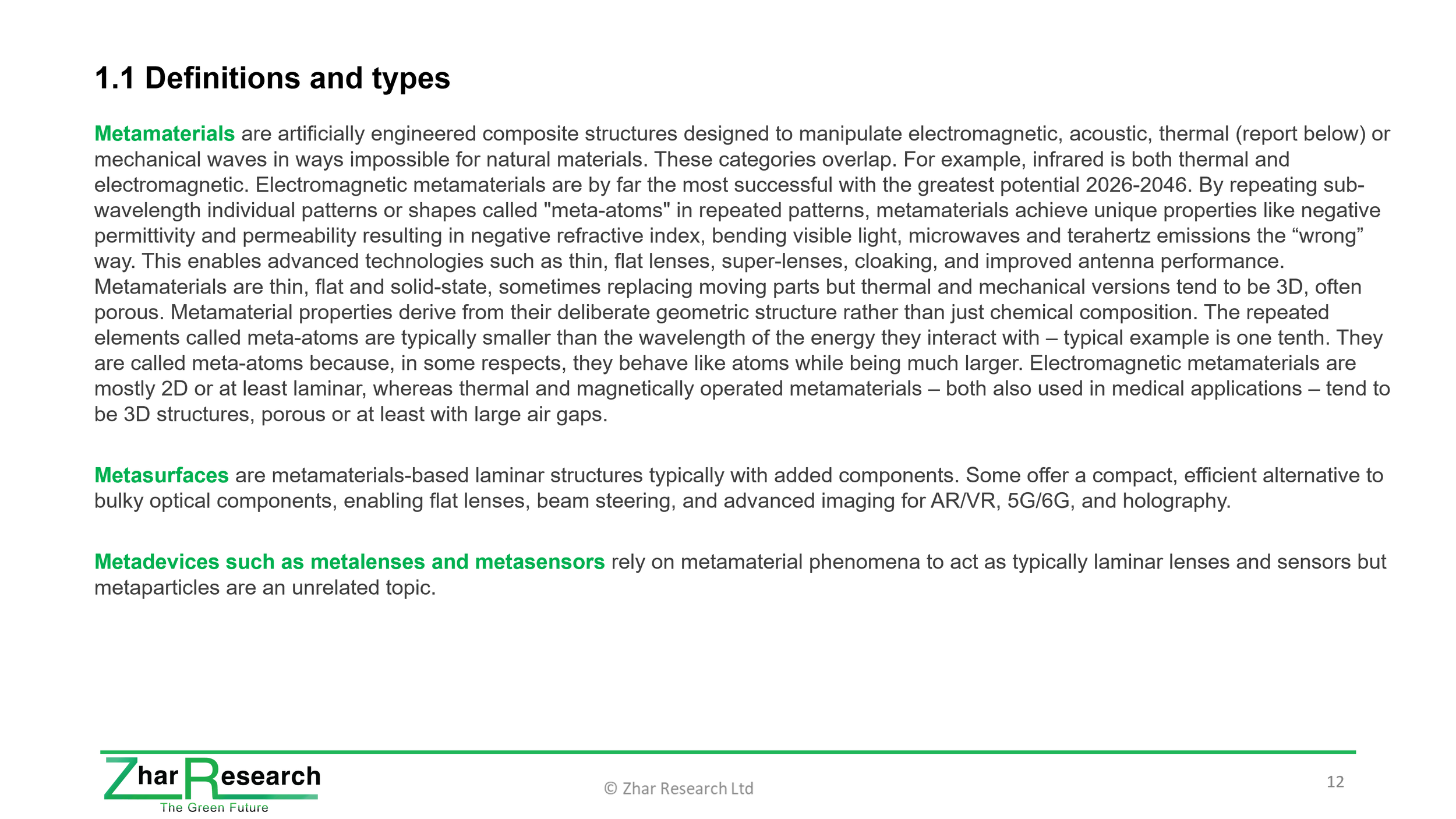
1.1 Definitions and types
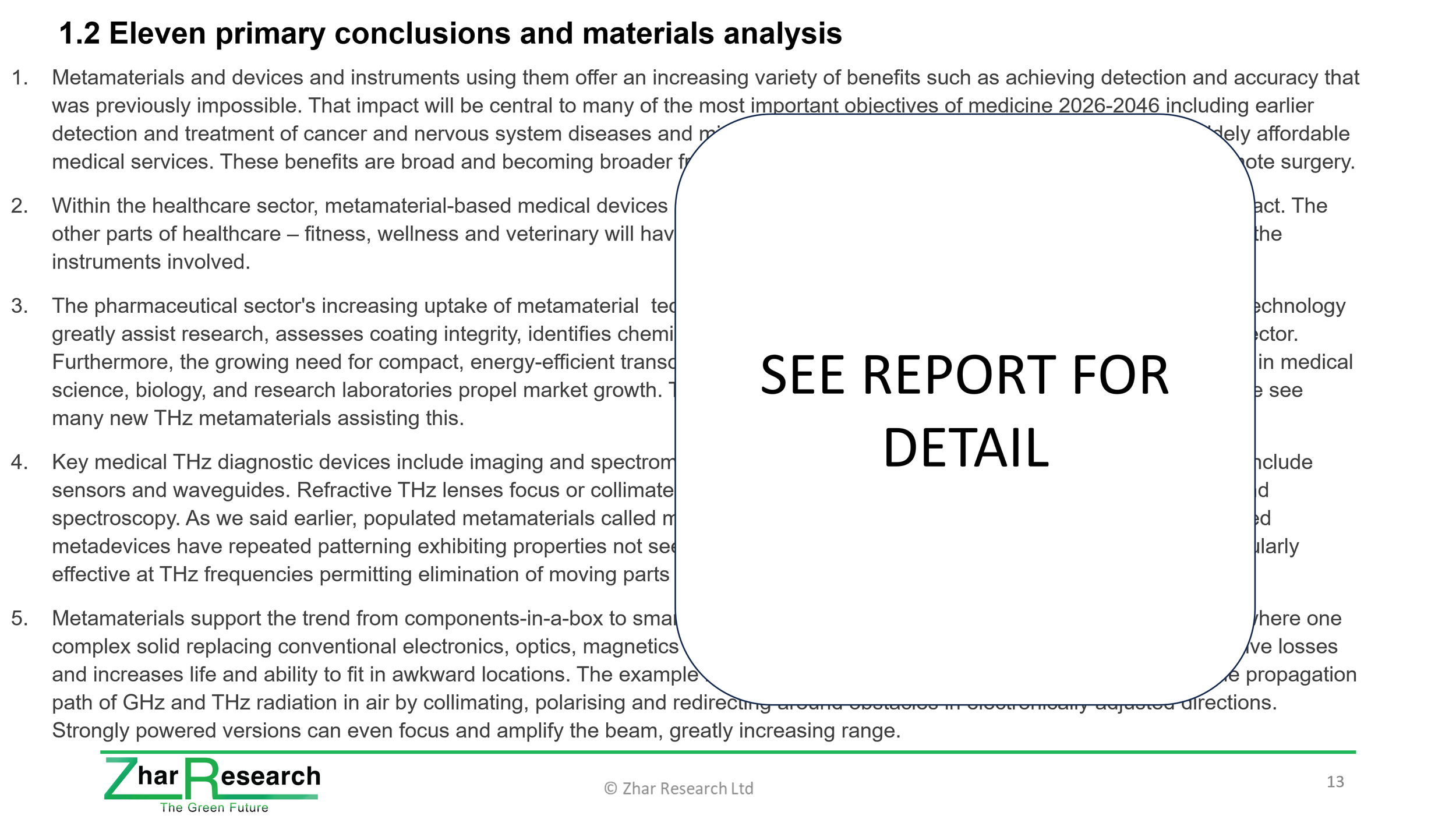
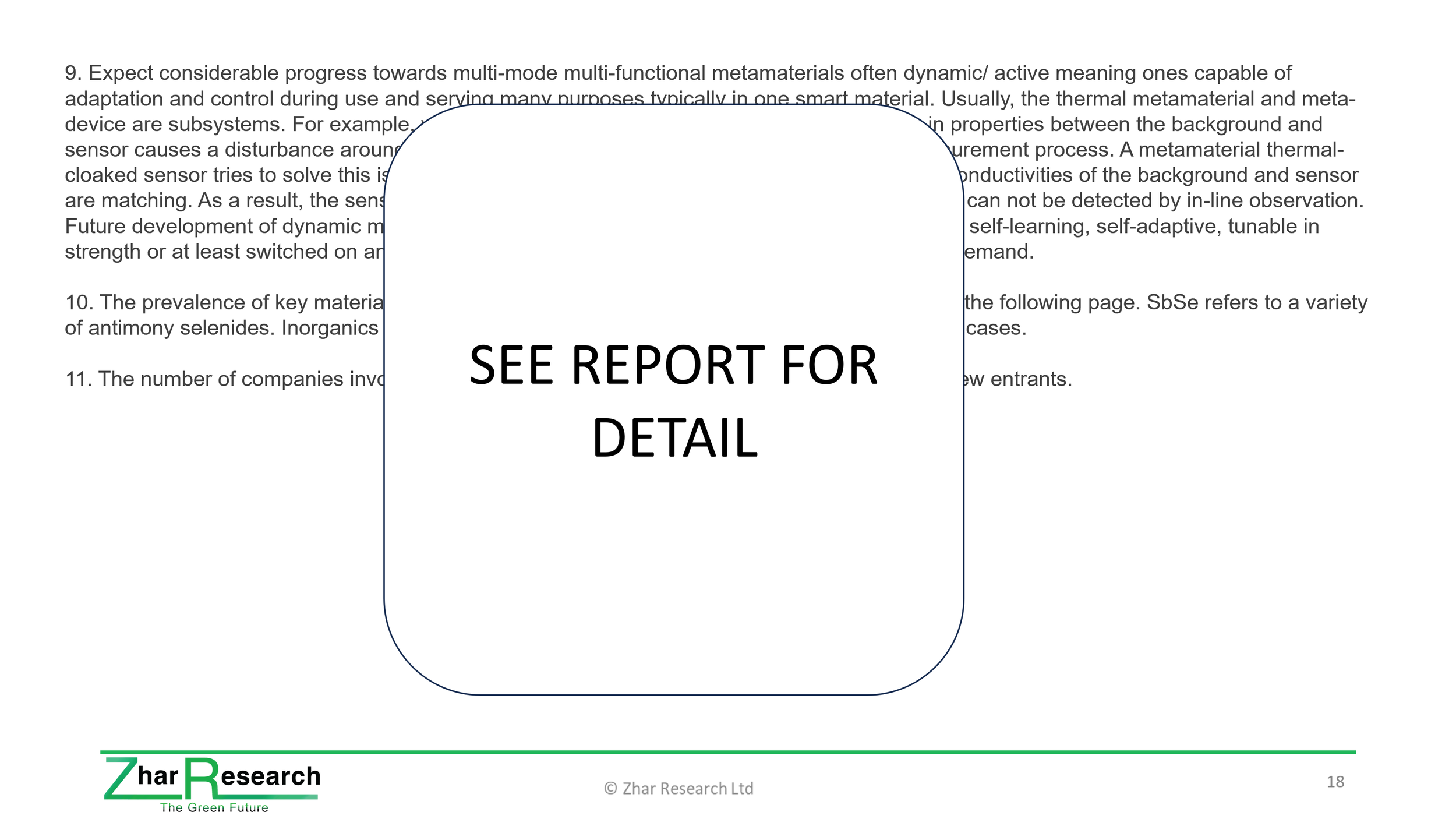
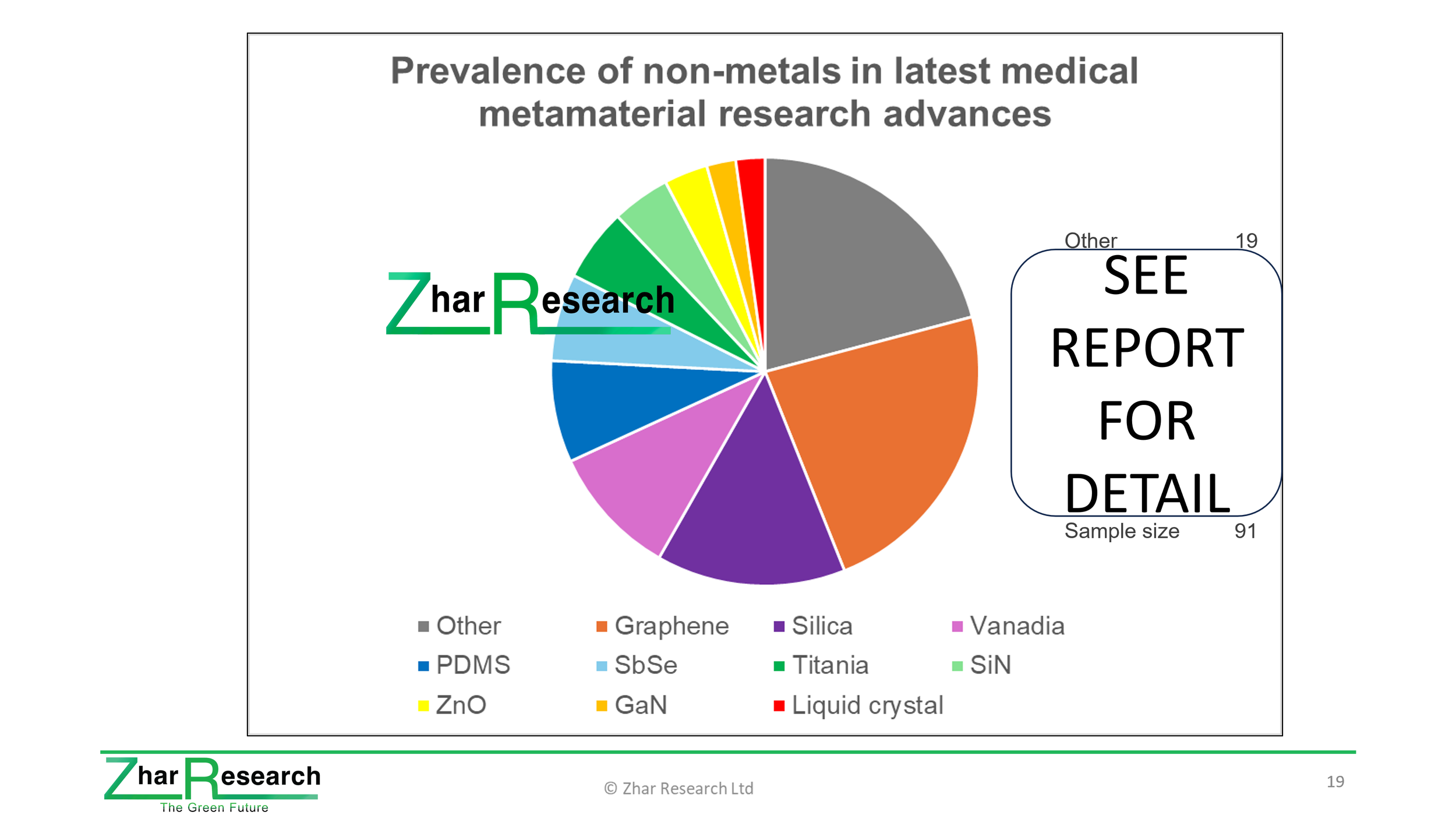
1.2 Eleven primary conclusions and materials analysis
1.3 Five SWOT appraisals
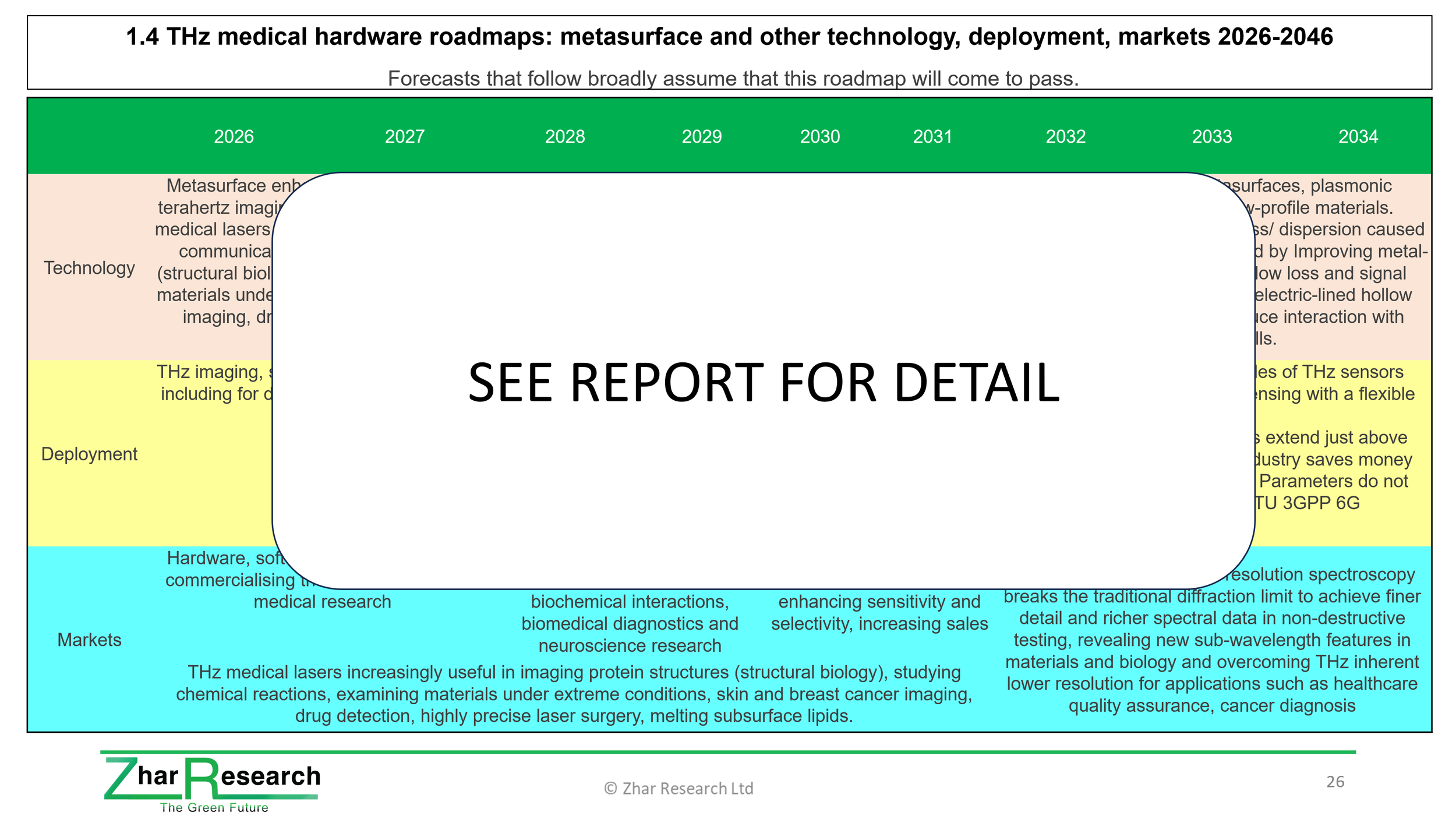
1.4 THz medical hardware roadmaps: metasurface and other technology, deployment, markets 2026-2046
1.5 Market forecasts in 35 lines with tables, graphs and explanation 2026-2046
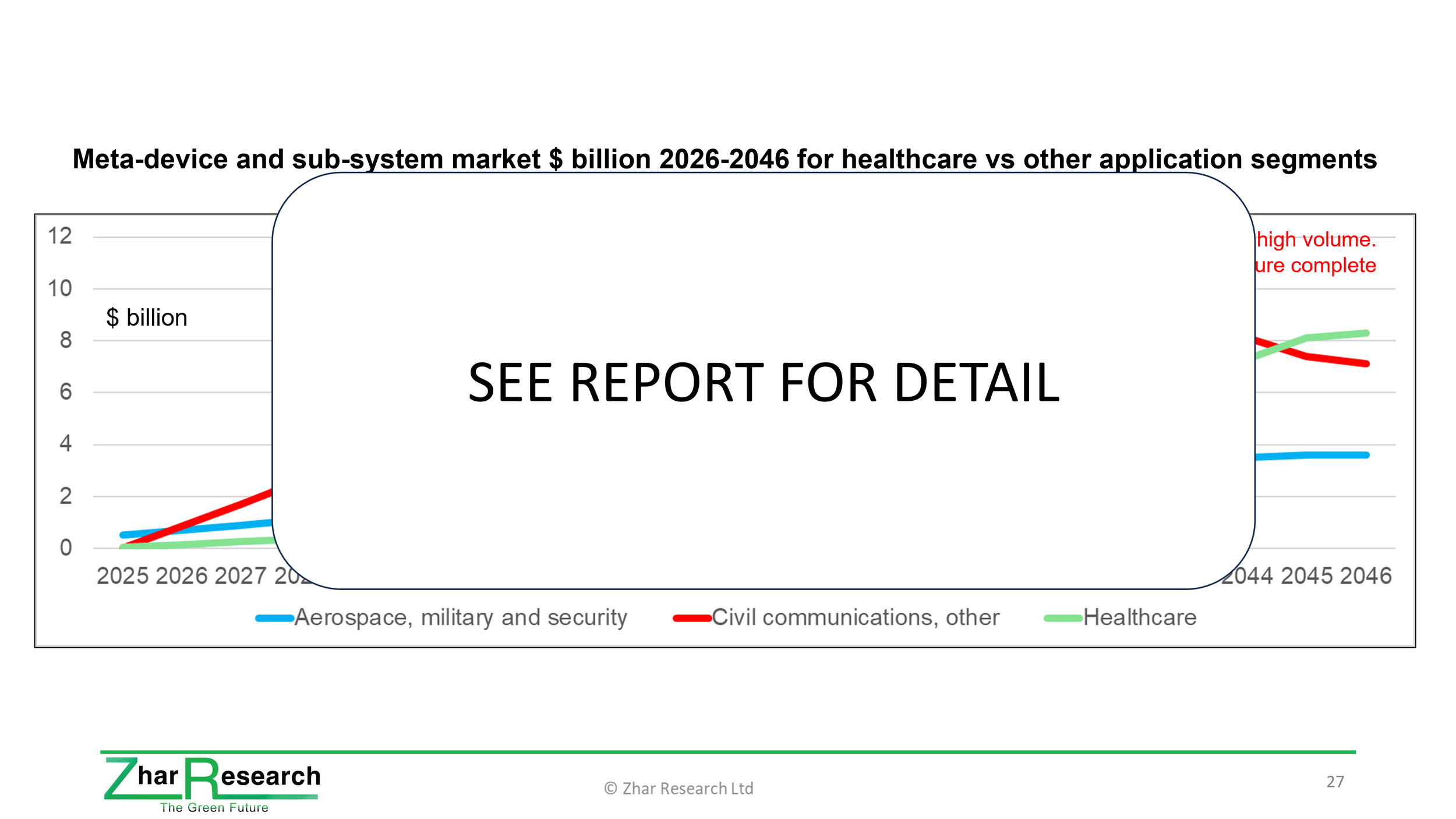
1.5.1 Meta-device and sub-system market $ billion 2026-2046 for healthcare vs other application segments
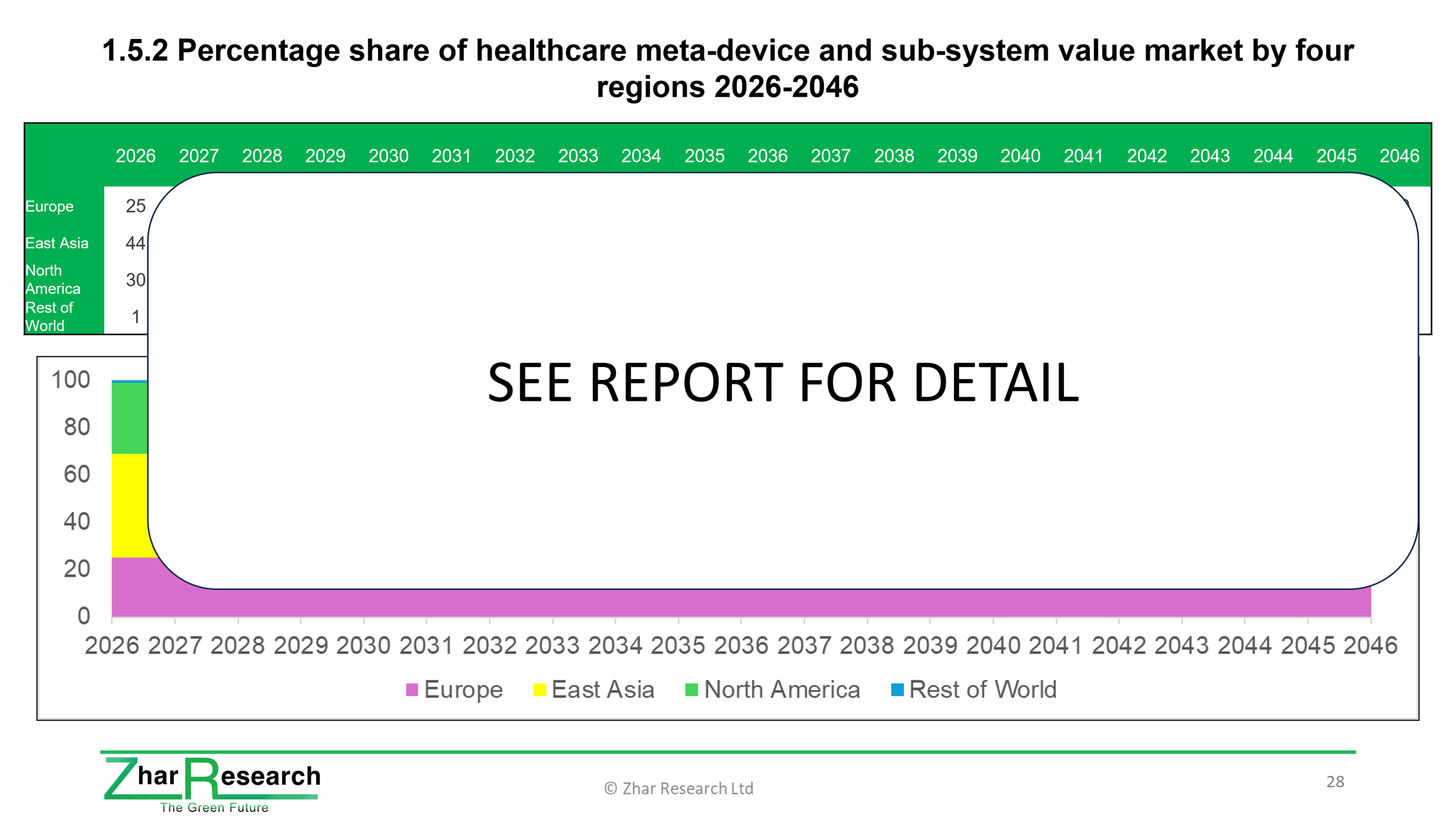
1.5.2 Percentage share of healthcare meta-device and sub-system value market by four regions 2026-2046
1.5.3 Fully passive metamaterial reflect-array market for optical wireless communications and total $ billion 2029-2046
1.5.4 THz hardware in 5 categories, two tables/ two graphs: $ billion 2026-2046
1.5.5 Optical and optronic 6G materials and device market 2026-2046
1.5.6 Percentage share of global 6G hardware value market % by four regions 2026-2046
1.5.7 6G Reconfigurable intelligent surface RIS area sales billion square meters 2027-2046
1.5.8 6G RIS area sales vs average panel area, panels sales number, total panels deployed cumulatively 2027-2046
1.5.9 Average 6G RIS price $/ square m. ex-factory including electronics 2028-2046
1.5.10 6G RIS value market $ billion: active vs four semi-passive categories by THz and other frequency 2026-2046
1.5.11 Market for semi-passive vs active RIS 0.1-1THz vs non-6G THz electronics 2027-2046
-
2.1 Definitions
2.2 The meta-atom and patterning options
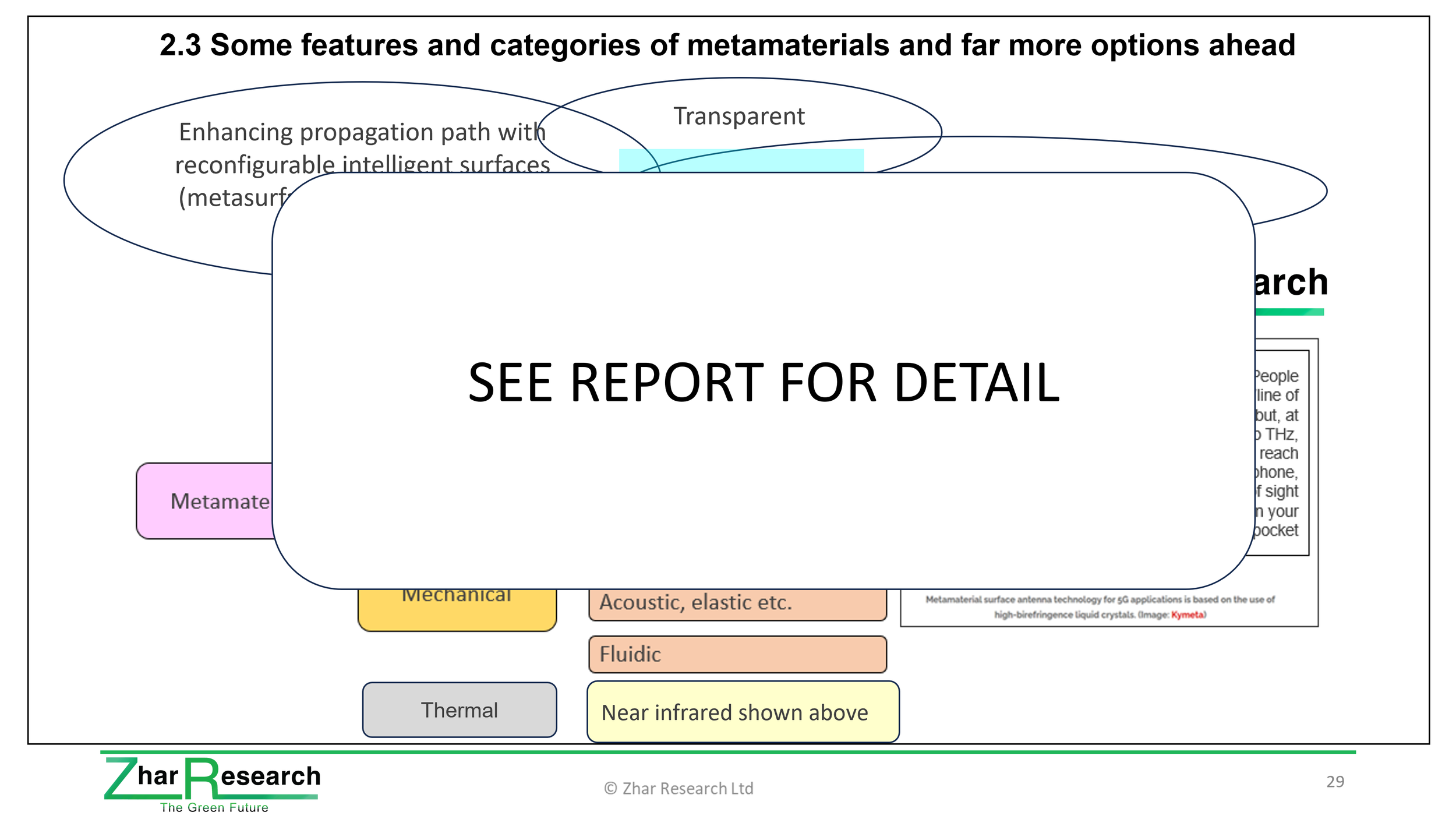
2.3 Some features and categories of metamaterials and far more options ahead
2.4 Medically-useful metamaterial patterns, structures and materials: emerging examples
2.4.1 Beam steering
2.4.2 Terahertz absorption and biosensing
2.4.3 Chiral metamaterials for biomedical and healthcare applications
2.4.4 Electro-active animate piezoelectric medical metamaterials
2.4.5 Soft multistable magnetic-responsive metamaterials for future biomedical and soft robot applications
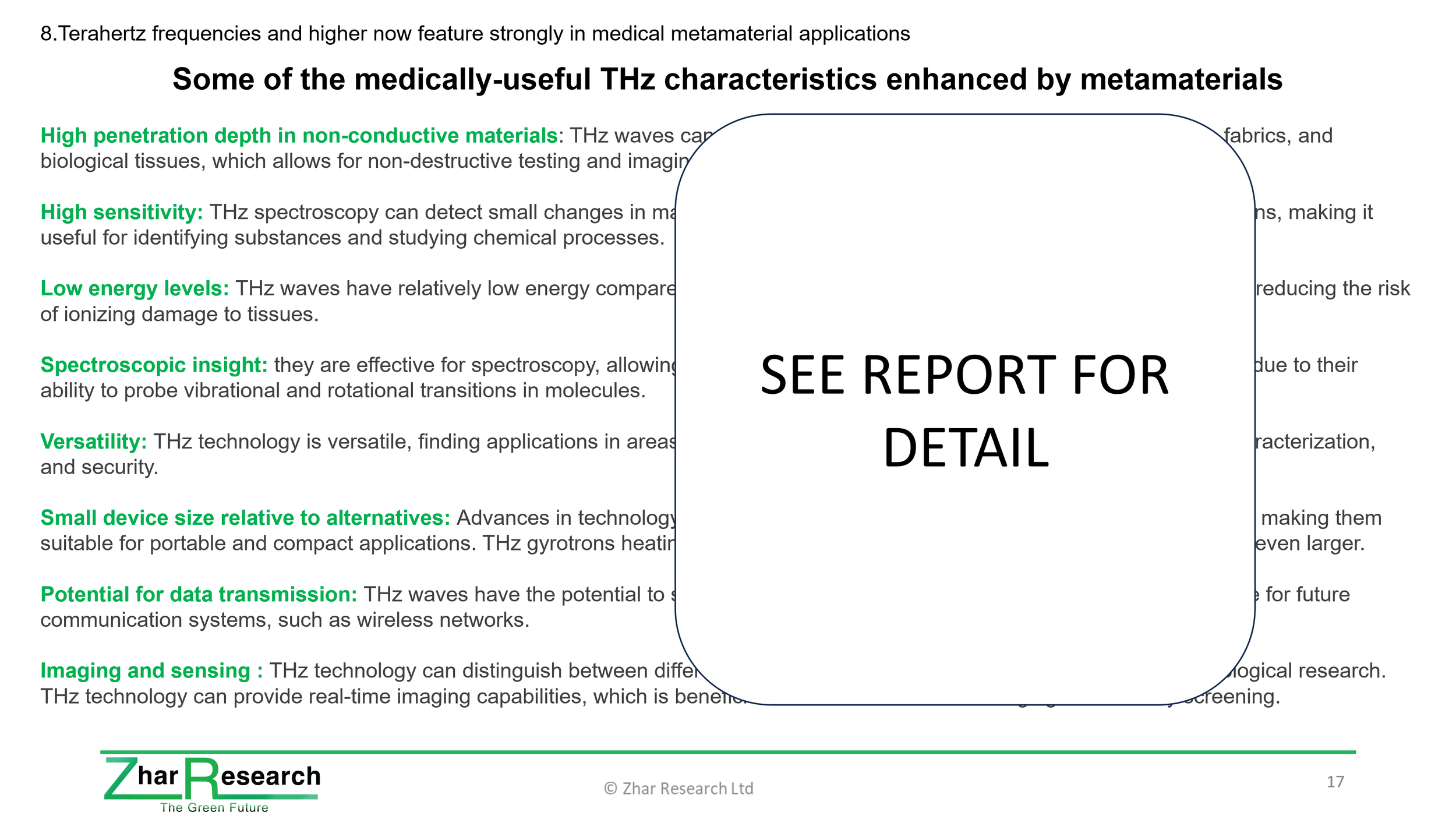
2.5 Some of the medically-useful THz characteristics enhanced by metamaterials
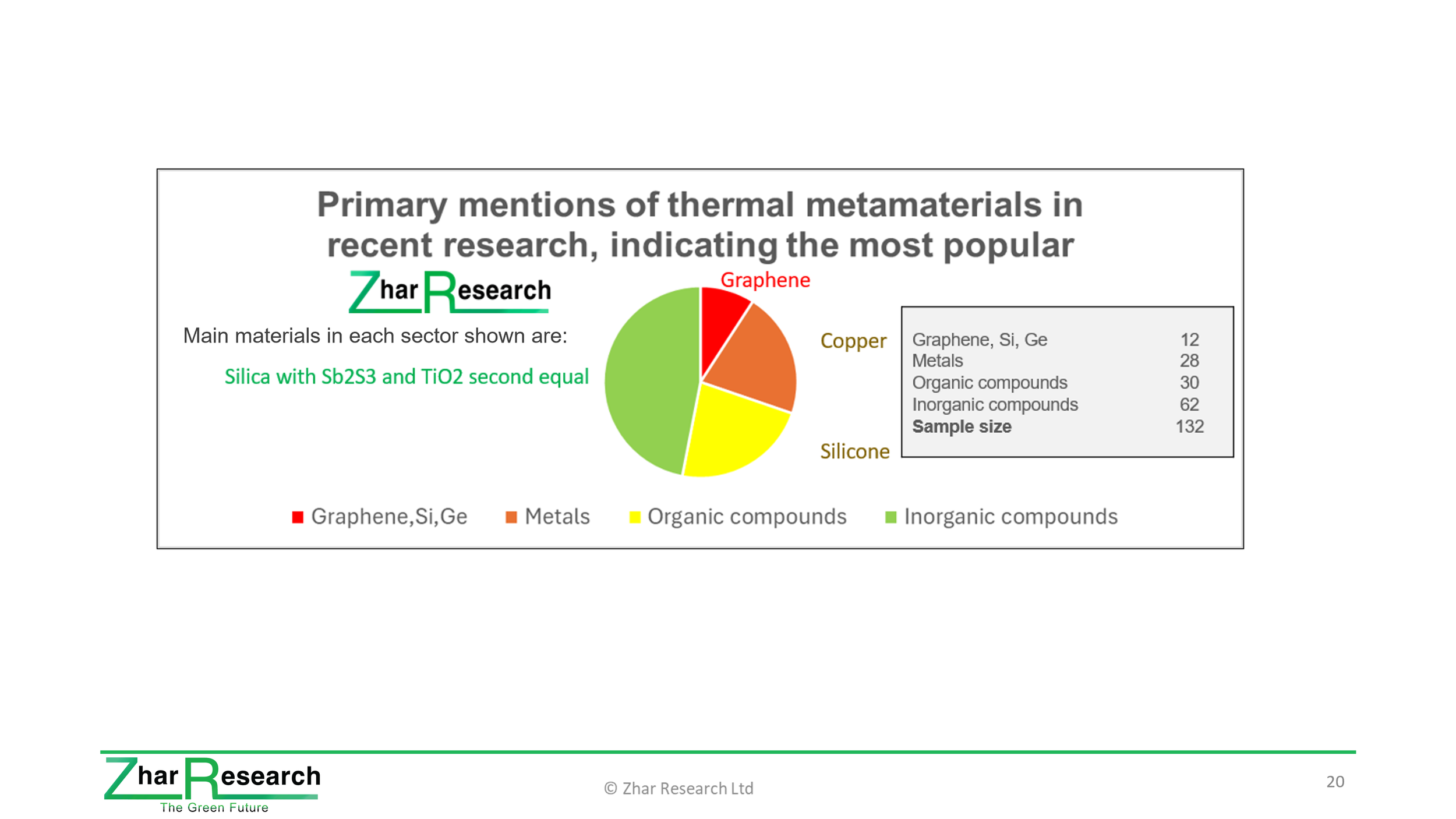
2.6 Metamaterial thermal management and energy harvesting with medical examples
2.7 SWOT appraisal for metamaterials, metasurfaces, metadevices
2.8 Overview of medical metamaterial subsystems
2.8.1 Primary sectors
2.8.2 Key devices and systems
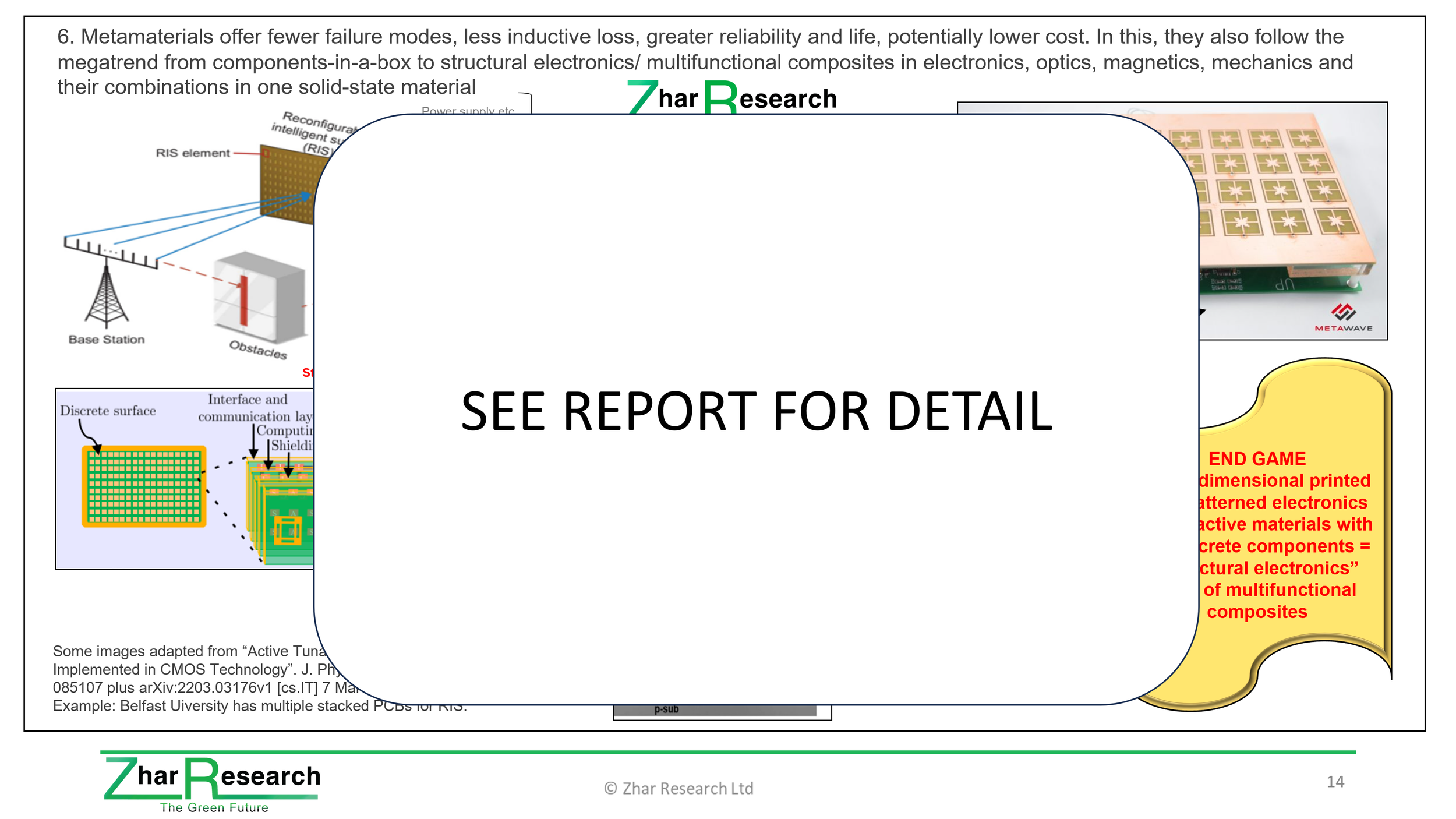
2.8.3 Components-in-a-box trends to smart materials/ structural electronics
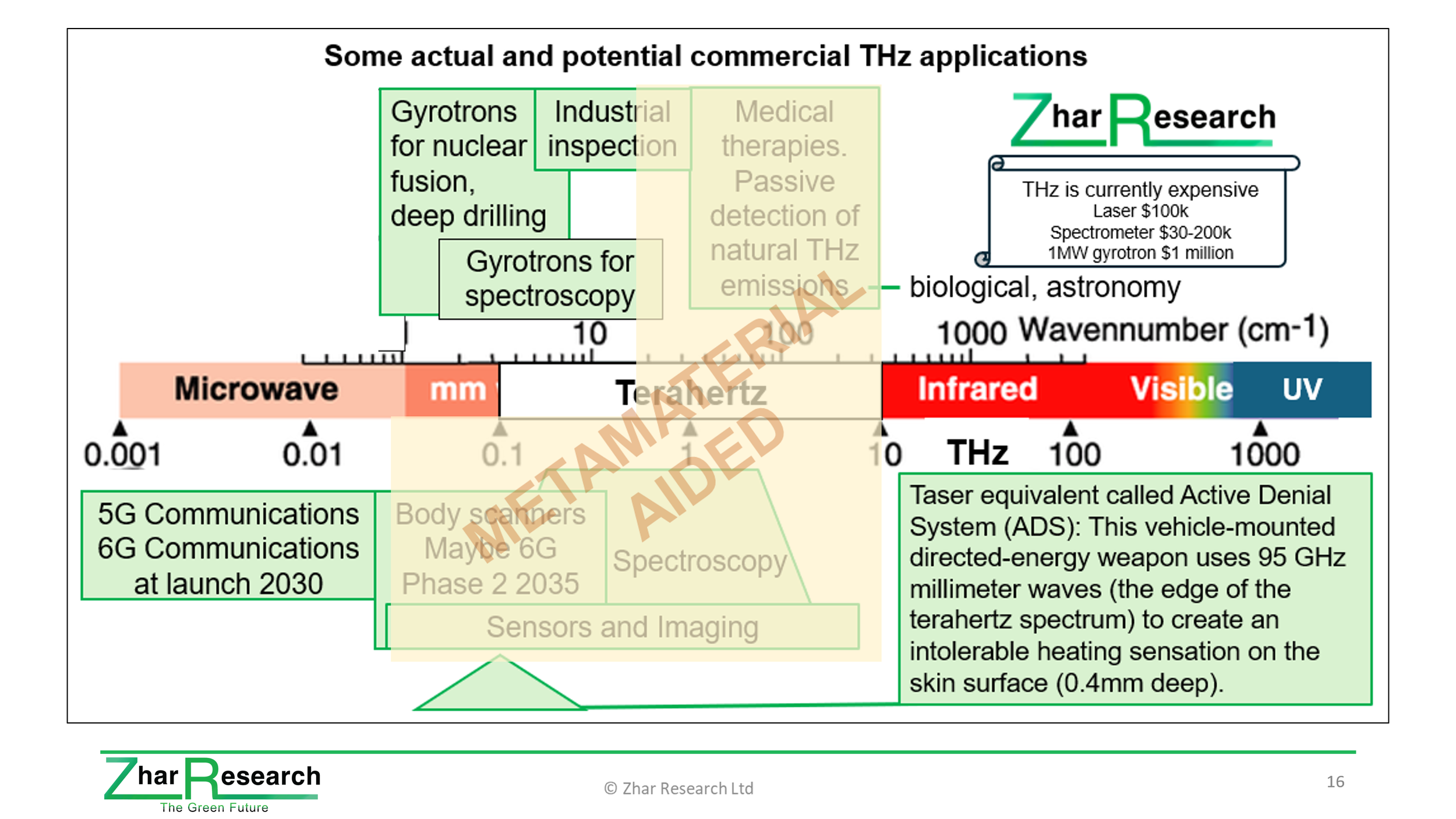
2.8.4 Some THz examples with three SWOT appraisals
2.9 Key metamaterial-based subsystems emerging for medical hardware
2.9.1 Absorbers and modulators
2.9.2 Antennas
2.9.3 Metalens for endoscopy and more
2.9.4 Photonics guiding light with metamaterials
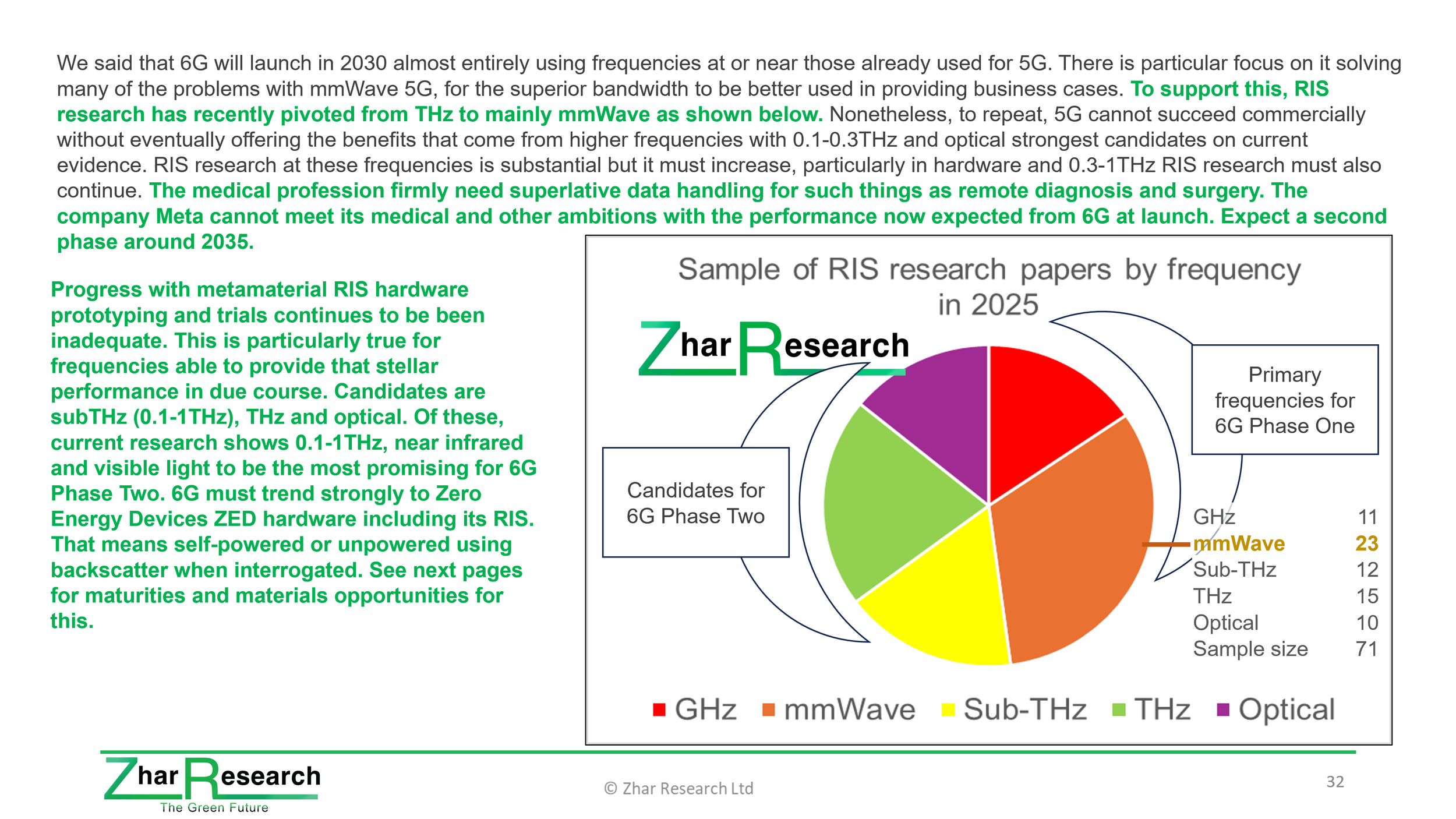
2.9.5 Reconfigurable intelligent surfaces, 6G, with five SWOT appraisals and activity analyses
2.9.6 Waveguides
2.9.7 Soft robotics
-
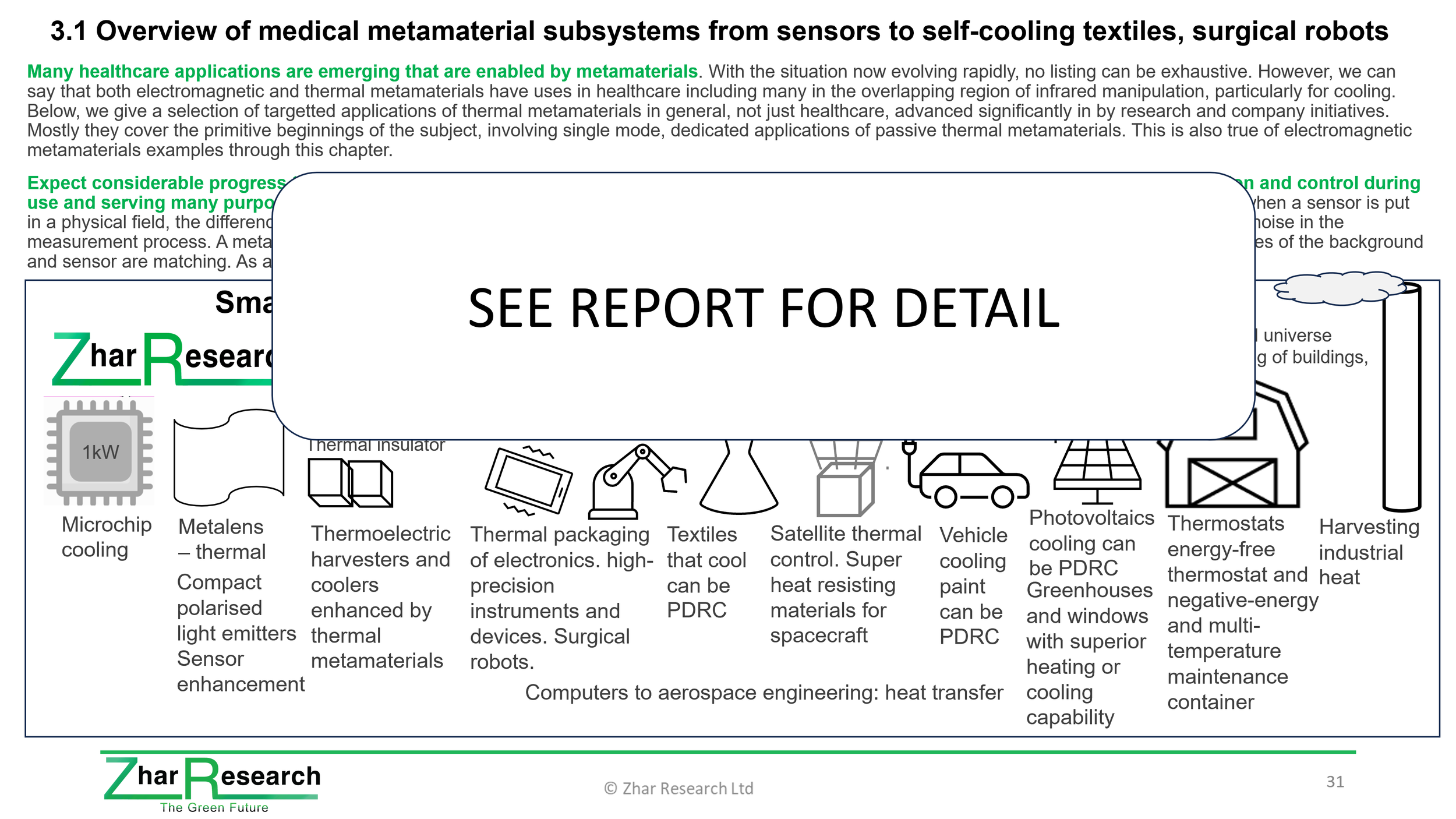
3.1 Overview: Applications from sensors to self-cooling textiles, surgical robots
3.2 Examples of merging applications of metamaterials, metasurfaces and metadevices
3.2.1 Augmented reality and higher data rate transmission
3.2.2 Bacteremia detection and in situ elimination
3.2.3 Biointerfaces and biomedical implants: remotely-operated, wireless, minimally invasive, self-monitoring
3.2.4 Biosensing including faster, earlier cancer cell detection, biomolecules, medical analytes
3.2.5 Blood sugar: earlier diabetes monitoring by blood glucose detection
3.2.6 Brain tumour: Glioma tissue detection
3.2.7 Glioblastoma: Metasurface-enhanced THz imaging for glioblastoma
3.2.8 Medical diagnostics and imaging including enabling portable devices
3.2.9 Microplastics identification and other health-related non-destructive testing
3.2.10 Nanotransmitter research tool
3.2.11 Pathogen surveillance and pesticide detection in food
3.2.12 Phenylalanine and other amino acids in pharmaceuticals and diagnostics
3.2.13 Radiative cooling
3.2.14 Retinal, cochlear, cardiac implants: Precise stimulation and wireless control
3.2.15 Self-powering of medical devices
3.2.16 Serum amyloid AA amyloidosis: Ultrasensitive sensing of trace proteins
3.2.17 Skin diagnostics by THz imaging
3.2.18 Urine bilrubin detection
-
4.1 Overview with infograms and two SWOT appraisals
4.2 4D printing and multi-coupling of thermal metamaterials
4.3 Use of electrochemistry
4.4 Examples of progress and target applications
4.4.1 Tunable liquid-solid hybrid thermal metamaterials
4.4.2 Unified static and dynamic thermal metamaterials
4.4.3 Sensing and responding to ambient temperatures
4.4.4 Advanced thermal radiation devices: stealth with thermal management
4.4.5 Active remote sensing and thermal camouflage
4.4.6 Dynamic control of heat flux and heat flow direction possibly for electric vehicle batteries
4.4.7 Adaptive radiative cooling and passive thermoregulation
4.5 Thermal-mechanical metamaterials
4.5.1 Overview
4.5.2 Programmable mechanical-thermal metamaterials
-
5.1 Overview with printing options and cost structures
5.2 Manufacturing 3D metamaterials
5.3 Manufacturing metalenses for biomedical imaging
5.4 Manufacturing thermal meta-structures
5.5 4D printing and multi-coupling of thermal metamaterials
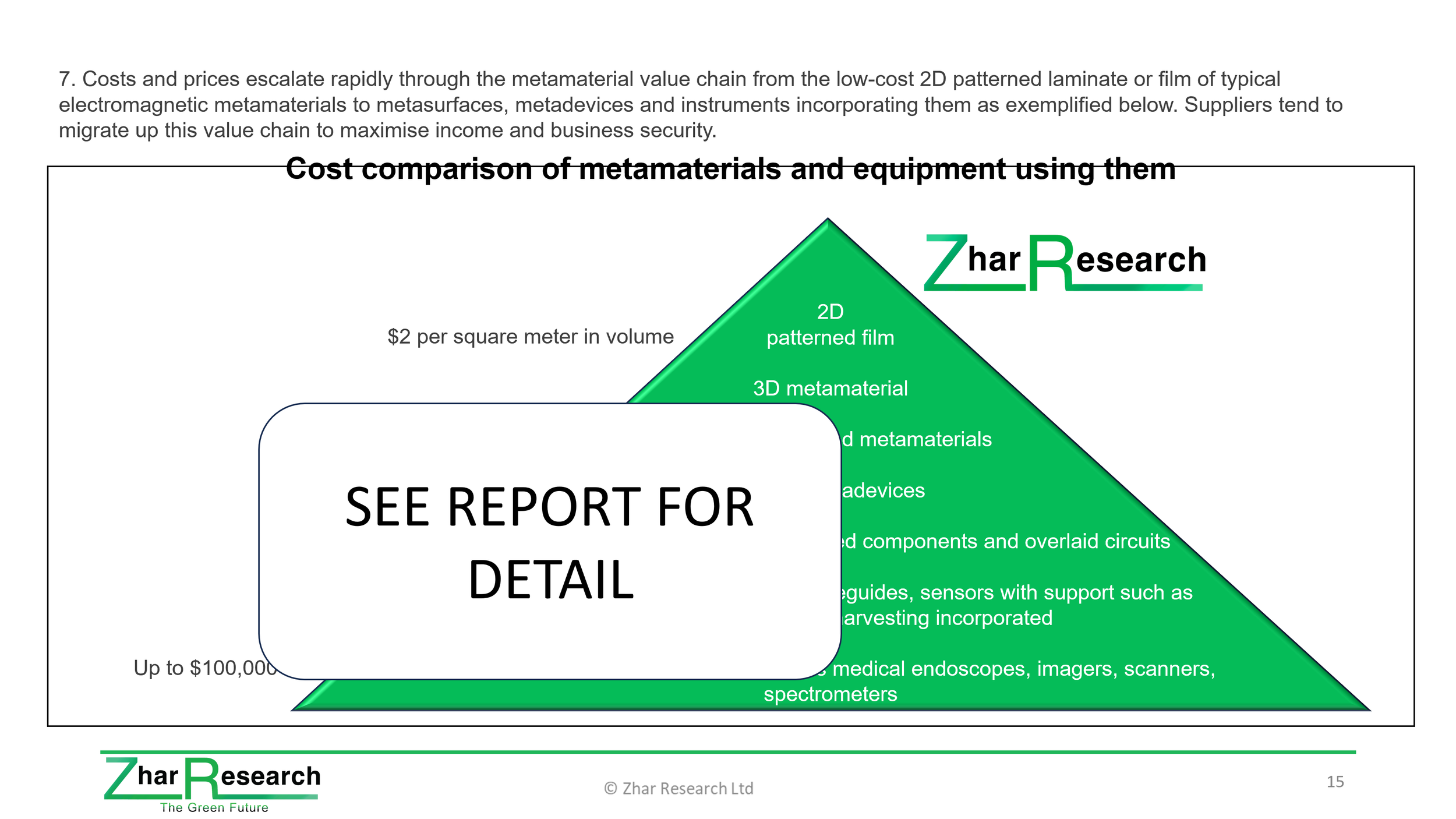
5.6 Cost hierarchy
-
6.1 Advantest Japan sensors and imaging
6.2 EVOQ Inc USA antimicrobial silver metamaterial for catheters, implants etc.
6.3 Greenerwave France reconfigurable intelligent surface, scanner
6.4 HÜBNER Photonics Germany biosensors and imaging
6.5 INO Canada imaging diagnostics, sensors, antimicrobial metamaterials
6.6 Luna Innovations USA brain computer interface, sensors, photonics
6.7 Menlo Systems Germany spectrometer, metasurfaces
6.8 Metaboards UK wireless chargers for medical wearable monitors, test equipment
6.9 Metacrystal Switzerland faster PET scanners
6.10 Multiwave Technologies AG Switzerland brain imaging, portable MRI scanners
6.11 Pivotal Commware USA wireless data transfer in medical facilities
6.12 Plasmonics Inc USA, Kymeta USA, Metalenz USA detection of biomolecules, viruses, antigens
6.13 Radi-Cool Japan, Malaysia solid-state cooling with pharmaceutical example
6.14 ROHM Japan health monitoring, drug sensing
6.15 TeraSense USA pharmaceutical quality assurance
6.16 TeraView UK pharmaceutical quality control
6.17 Toray Industries Japan materials for making metamaterials, medical materials
6.18 ZTE China 6G Communications RIS benefitting healthcare
Many of the primary objectives in medicine are being enabled by metamaterials and metadevices. They include earlier cancer detection, faster CAT scans, faster, better and portable MRI, improved pharmaceutical quality control, medical robotics and remote surgery. Add precise stimulation, wireless control and self-monitoring of implants and even metamaterial antimicrobials to use on them. Miniaturisation and self-powering of medical devices will be aided by metamaterials and there is much more in the pipeline. For instance terahertz frequency is one of the newer frontiers for metamaterial-based medical instruments, providing information not otherwise available.
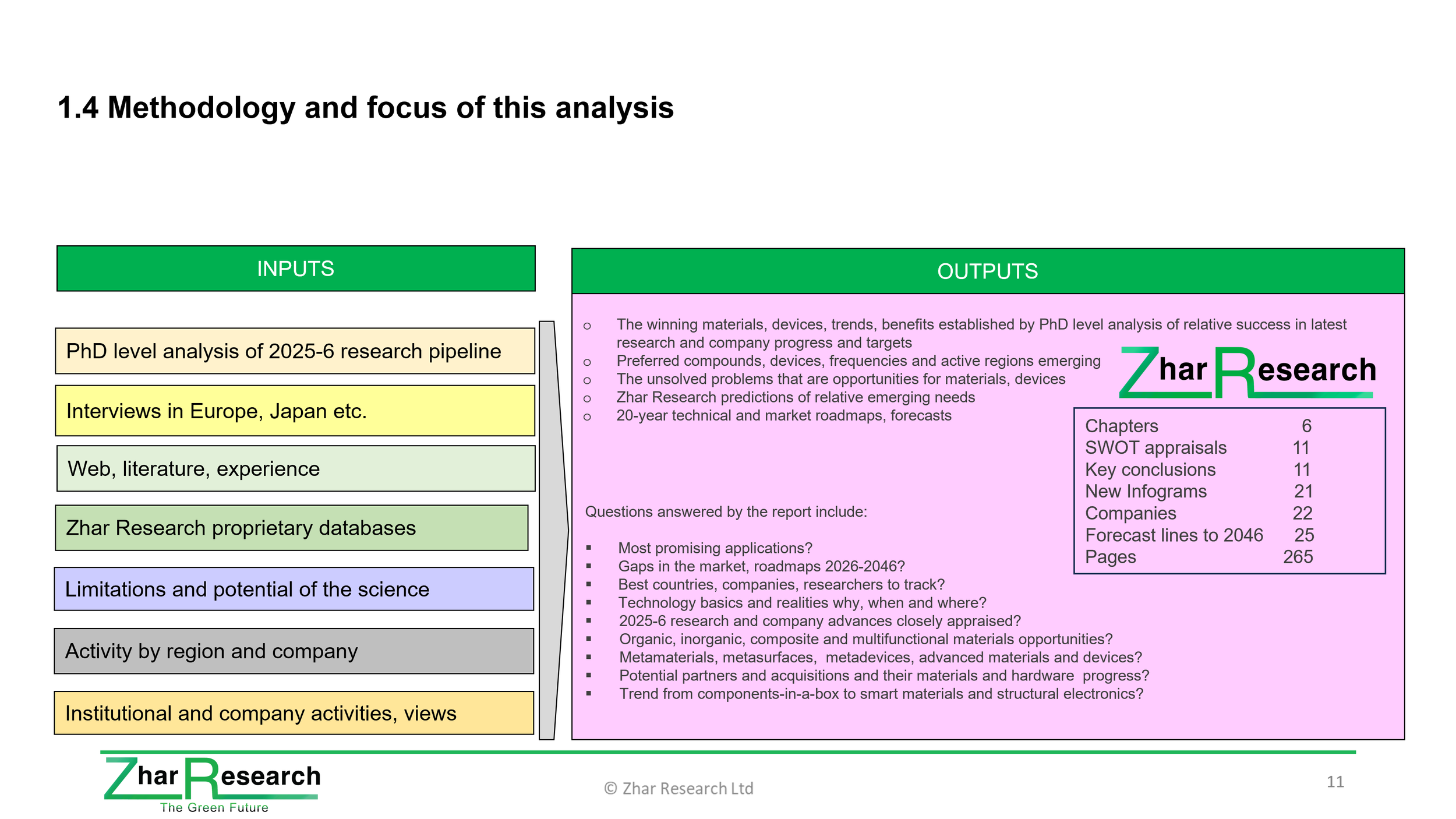
The commercially-oriented 266-page Zhar Research report, “Medical Metamaterials Opportunities: Markets, Technology 2026-2046” is your guide to this fast-growing new market that will exceed $8 billion in 2046. Its six chapters have 11 key conclusions, 11 SWOT appraisals, 21 new infograms, 18 company profiles and 35 forecast lines 2026-2046. Importantly, all chapters have advances from 2026 and 2025. The Executive Summary and Conclusions (32 pages) is a quick read with the definitions, context, conclusions, main SWOT appraisals, roadmaps and all forecasts 2026-2046. The Introduction (74 pages) details the metamaterial basics then key metadevices and systems and their specific medical usefulness.
Chapter 3. Metamaterials in healthcare applications 2026-2046 with advances in 2025-6 (52 pages) explains a large number of very diverse emerging applications and the materials, structures and integration of the metamaterials that enable them. We then return to more on the technologies with Chapter 4. Basic, active, dynamic and tunable thermal metamaterials with advances in 2025-6 (36 pages). That includes many emerging applications and capabilities including the adjacent topic of thermo-mechanical metamaterials in healthcare.
Chapter 5. Metamaterial, metadevice and instrument manufacturing technologies, materials, costs (26 pages) explains the manufacturing options, used and emerging, for all those metamaterials covered in the preceding chapters. Here are photolithography, 2D, 3D and 4D printing and more. Learn how costs rapidly escalate from the basic additively-manufactured electromagnetic metamaterial to complex thermal, mechanical and other 3D metamaterial structures and their product integration.
The report closes with detail on the healthcare metamaterial activities of eighteen companies, five USA, four Japan and fewer elsewhere. The race is on. Zhar Research report, “Medical Metamaterials Opportunities: Markets, Technology 2026-2046” is the essential guide to your latest opportunities in this field whether for materials, subsystems or instruments. It is constantly updated so you do not miss the latest advances in this fast-moving field.