

 Image 1 of 2
 Image 2 of 2
Sample Pages
Contents List
-
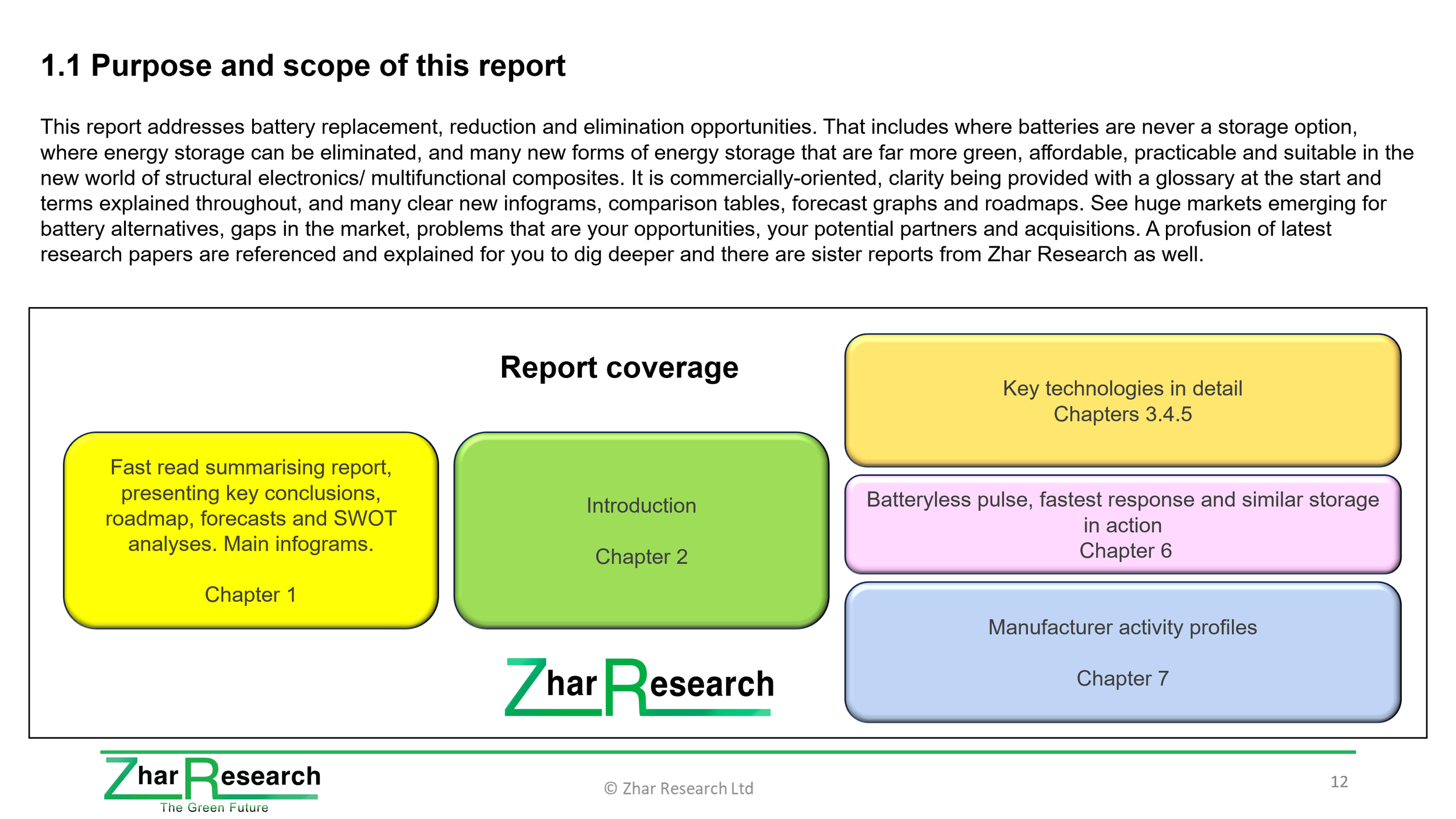
1.1 Purpose and scope of this report
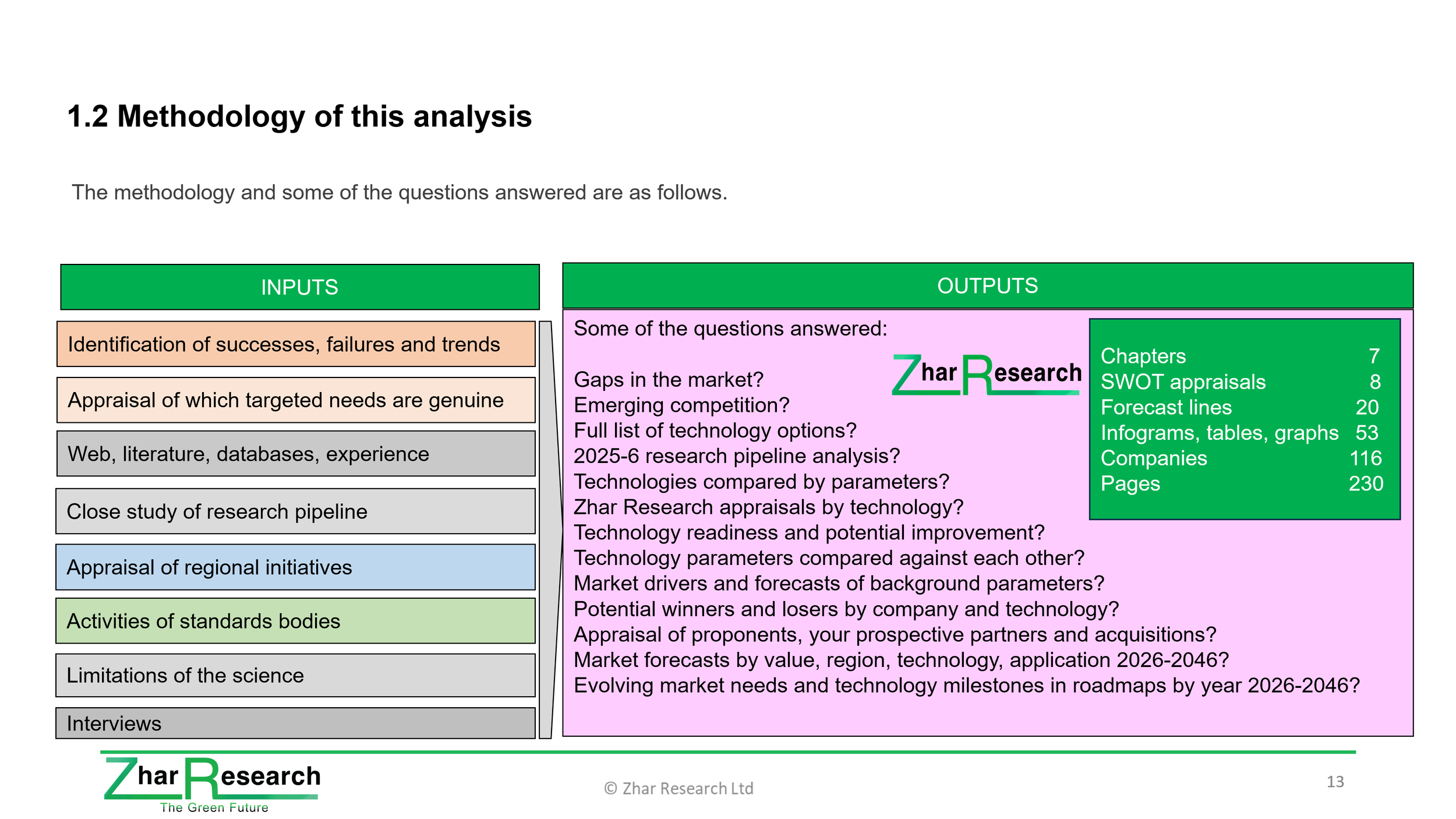
1.2 Methodology of this analysis
1.3 Primary conclusions
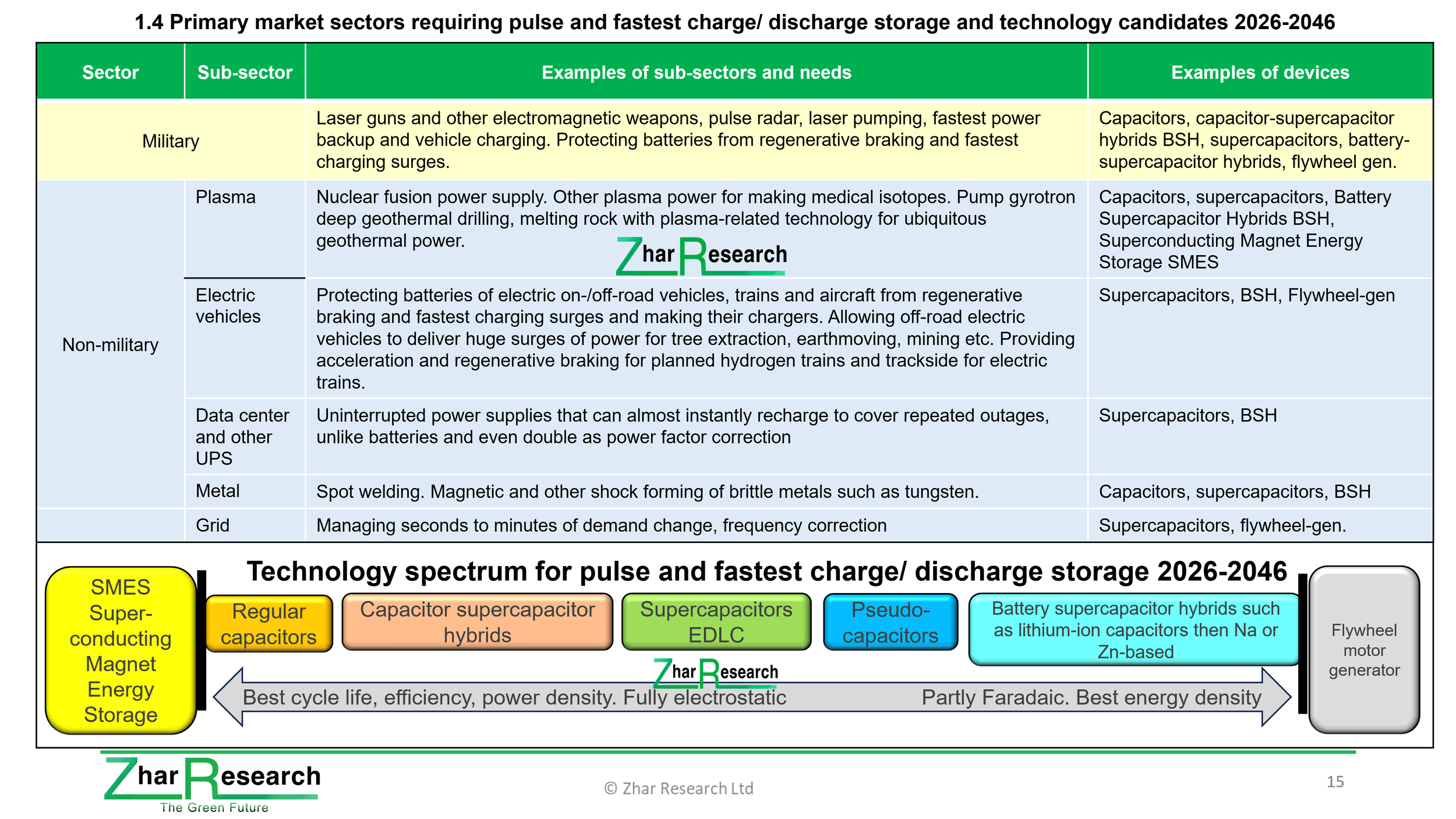
1.4 Primary market sectors requiring pulse and fastest charge/ discharge storage and technology candidates 2026-2046
1.5 Strategies for improving supercapacitors and variants
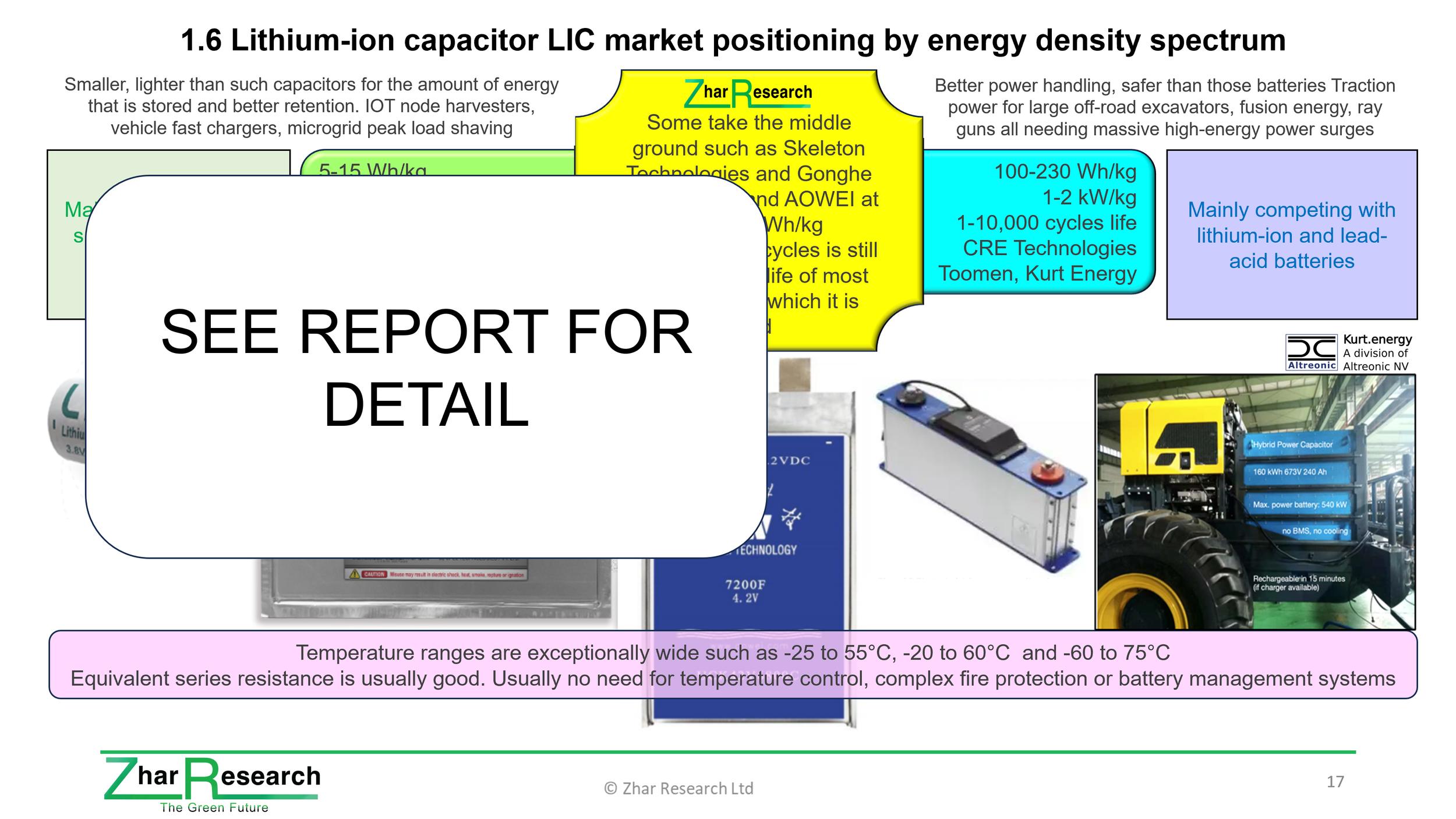
1.6 Lithium-ion capacitor LIC market positioning by energy density spectrum
1.7 Eight SWOT appraisals
1.7.1 SWOT appraisal of supercapacitors and their variants
1.7.2 Graphene supercapacitor SWOT appraisal
1.7.3 SWOT appraisal of capacitor-supercapacitor hybrids CSH
1.7.4 SWOT appraisal of LIC form of BSH
1.7.5 SWOT appraisal of Lithium-Ion Capacitor LIC form of BSH
1.7.6 Graphene LIC SWOT appraisal
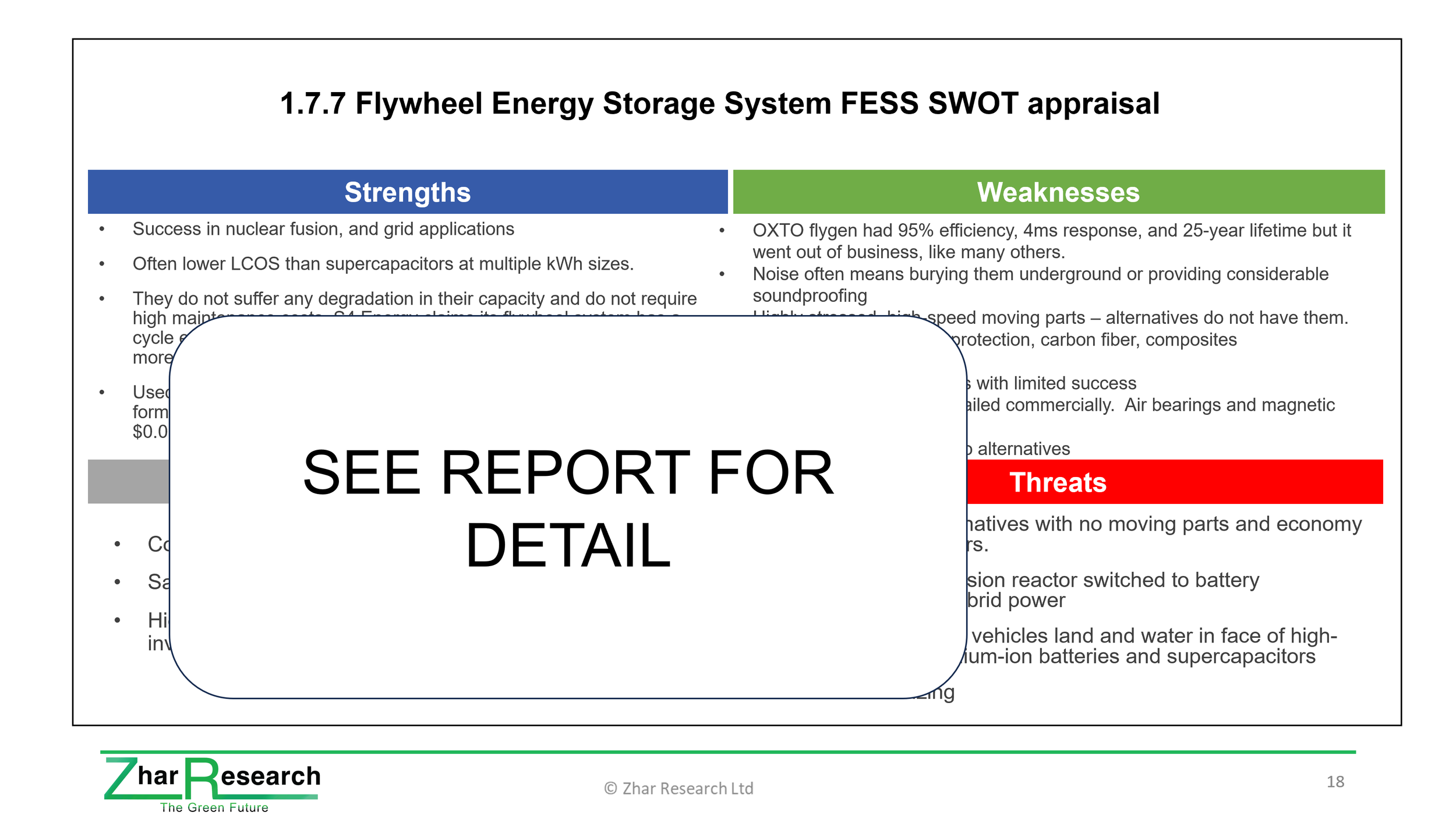
1.7.7 Flywheel Energy Storage System FESS SWOT appraisal
1.7.8 SWOT appraisal of Superconducting Magnet Energy Storage SMES
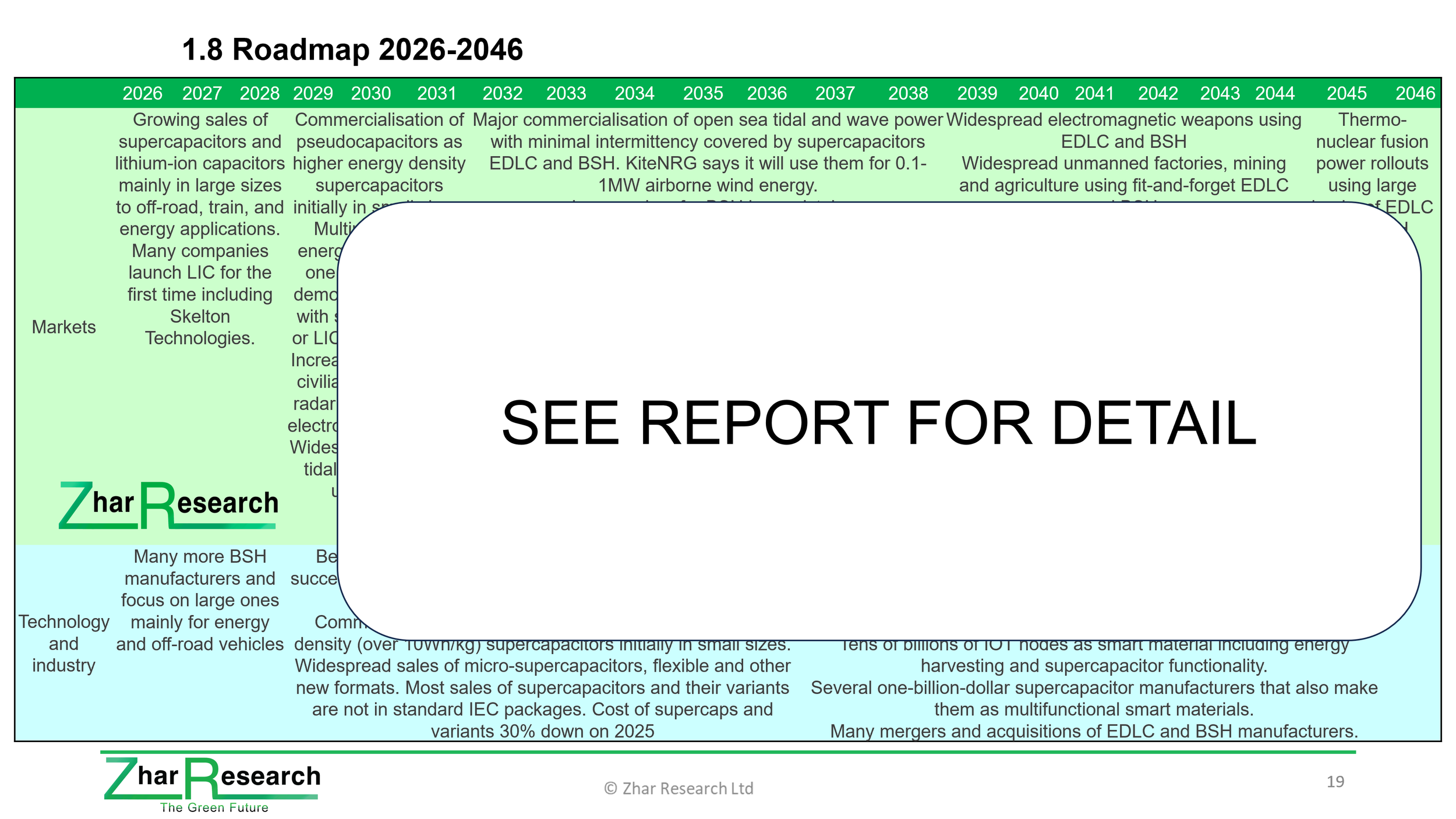
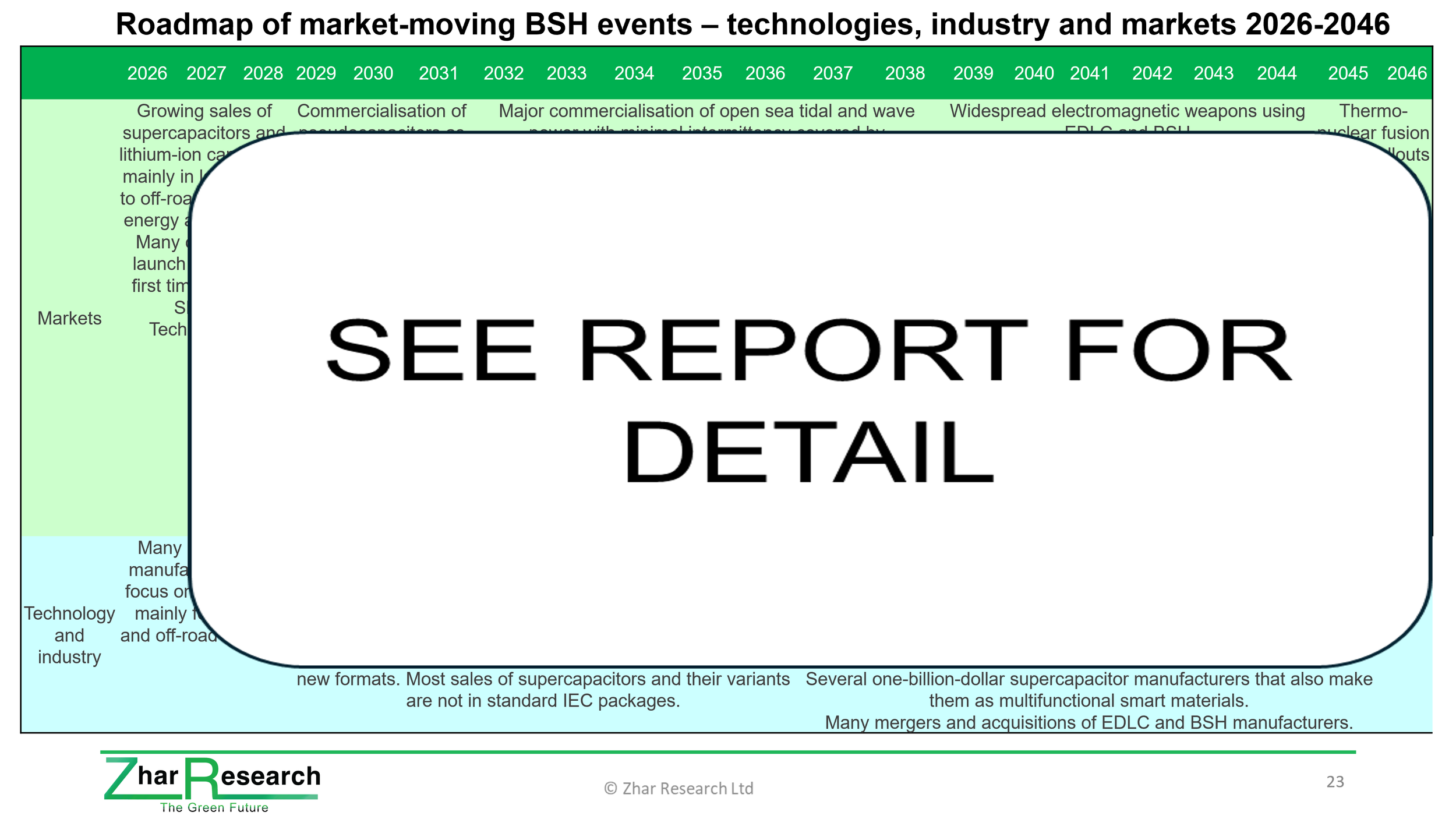
1.8 Roadmap 2026-2046
1.9 Market forecasts 2026-2046 in 20 lines
1.9.1 Energy storage device market battery vs batteryless $ billion 2025-2046
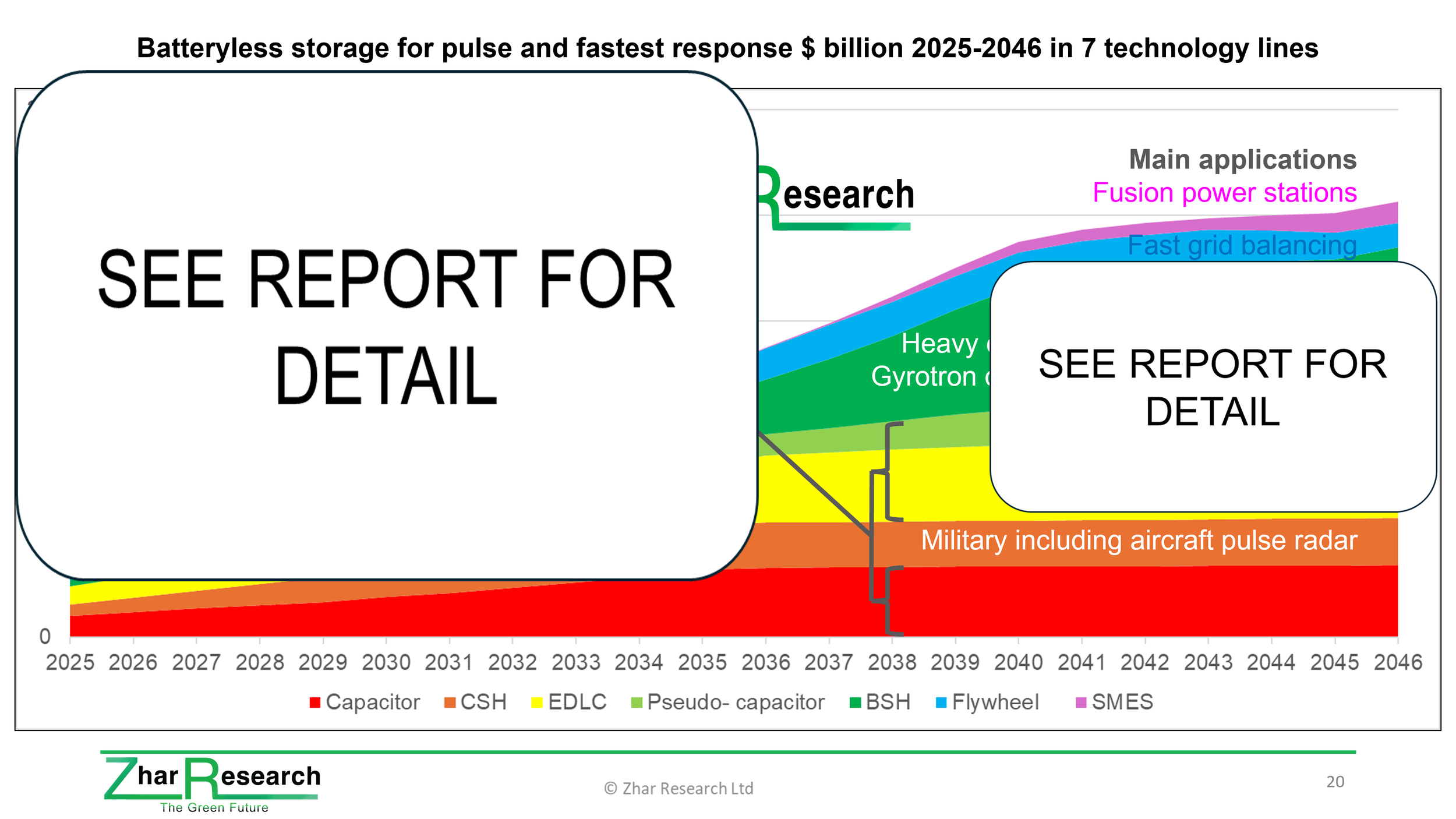
1.9.2 Batteryless storage for pulse and fastest response $ billion 2025-2046 in 7 technology lines
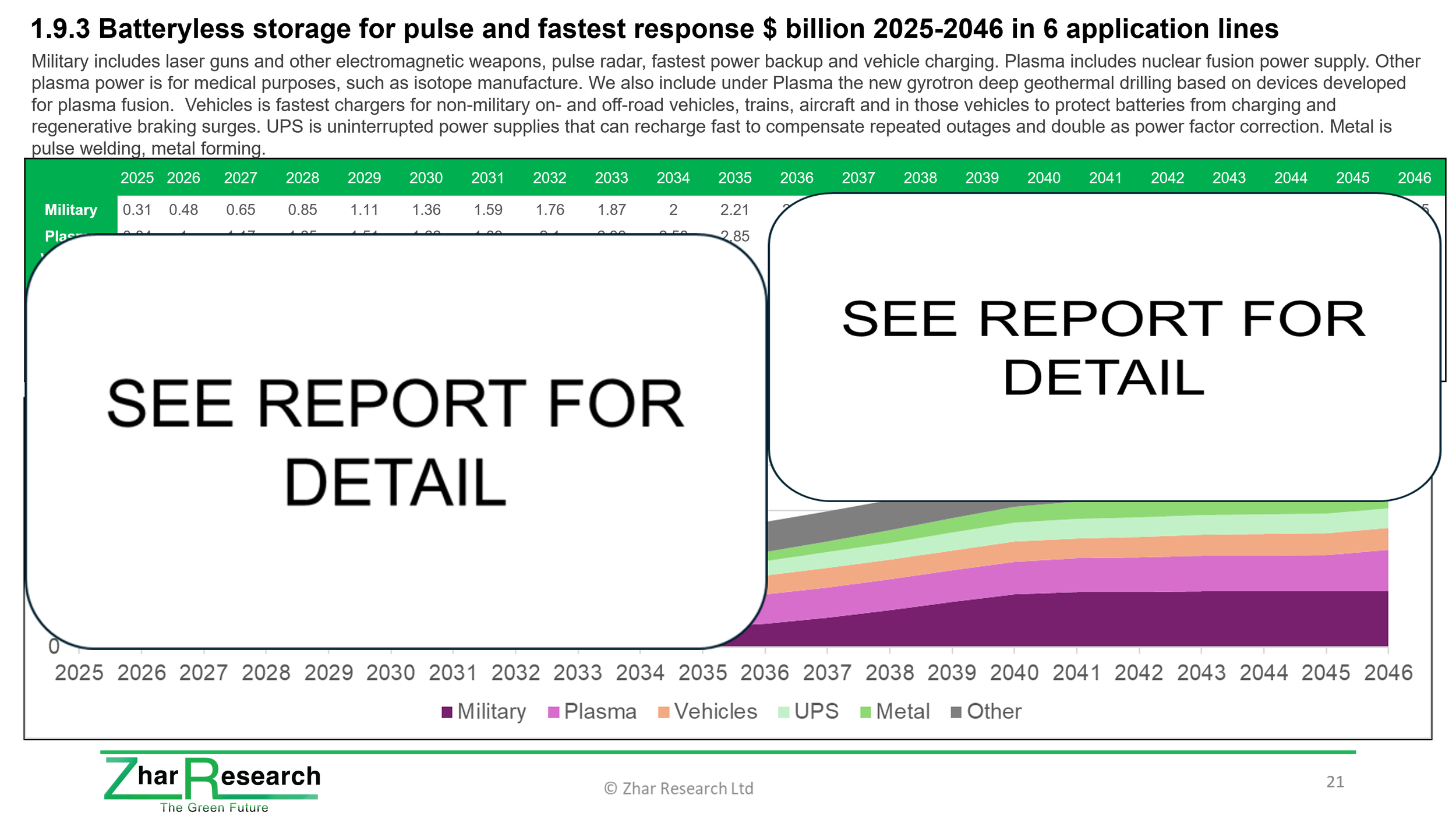
1.9.3 Batteryless storage for pulse and fastest response $ billion 2025-2046 in 6 application lines
1.9.4 Regional share of pulse and fast response storage value market % in four regions 2026-2046
-
2.1 Overview
2.2 Energy storage options in general
2.3 Energy storage toolkit by operating principle
2.4 Battery limitations
2.4.1 General
2.4.2 Lithium-ion battery fires are ongoing emitting toxic gas
2.5 Capacitors and their variants compared to batteries including coil gun example
2.6 BSH and EDLC research activity by country and technology
2.7 Flywheel energy storage systems FESS and superconducting magnet energy storage systems SMES
2.7.1 Background, basics, progress
2.7.2 Flywheel motor-generator SWOT appraisal
2.7.3 SMES
2.8 Sister reports from Zhar Research
-
3.1 Overview
3.1.1 Capacitors and their variants: basics
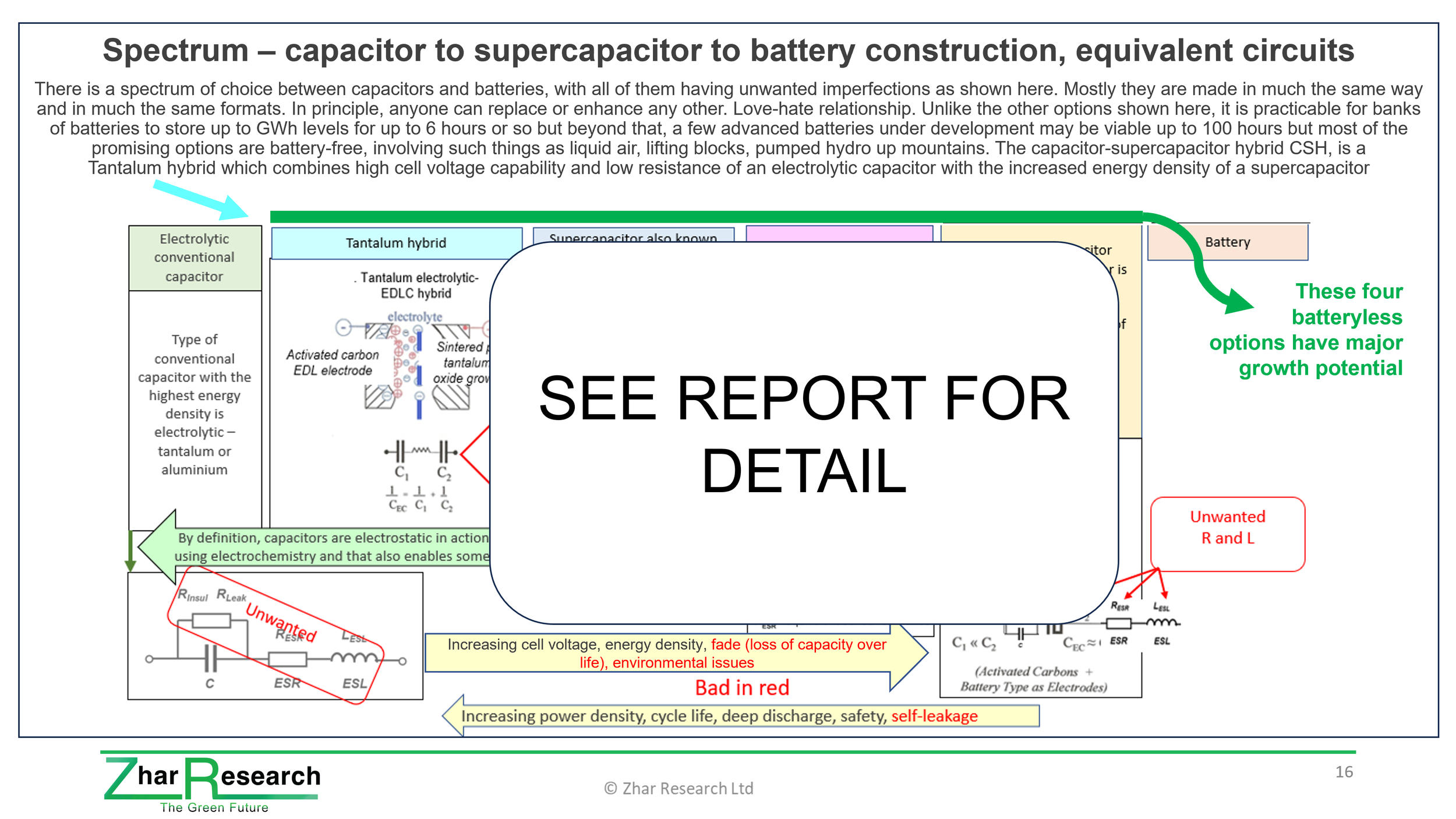
3.1.2 Spectrum– capacitor to supercapacitor to battery construction, equivalent circuits
3.2 Factors influencing key supercapacitor parameters driving sales
3.3 Materials and format choices
3.4 Strategies for improving supercapacitors
3.4.1 General
3.4.2 Prioritisation of active electrode-electrolyte pairings
3.4.3 Significance of graphene in supercapacitors and variants with SWOT
3.4.4 Eleven graphene supercapacitor material and device developers and manufacturers compared in five columns
3.5 Research pipeline: pure supercapacitors 2025
3.6 Capacitor-supercapacitor hybrid CSH design and uses
-
4.1 Understanding pseudocapacitance
4.2 Three mechanisms that give rise to pseudocapacitance and the intrinsic/ extrinsic phenomena
4.3 Ferrimagnetic pseudocapacitors 2025-6 research
4.4 Pseudocapacitor optimisation routes emerging
4.5 Research advances with pseudocapacitors 2025-6
-
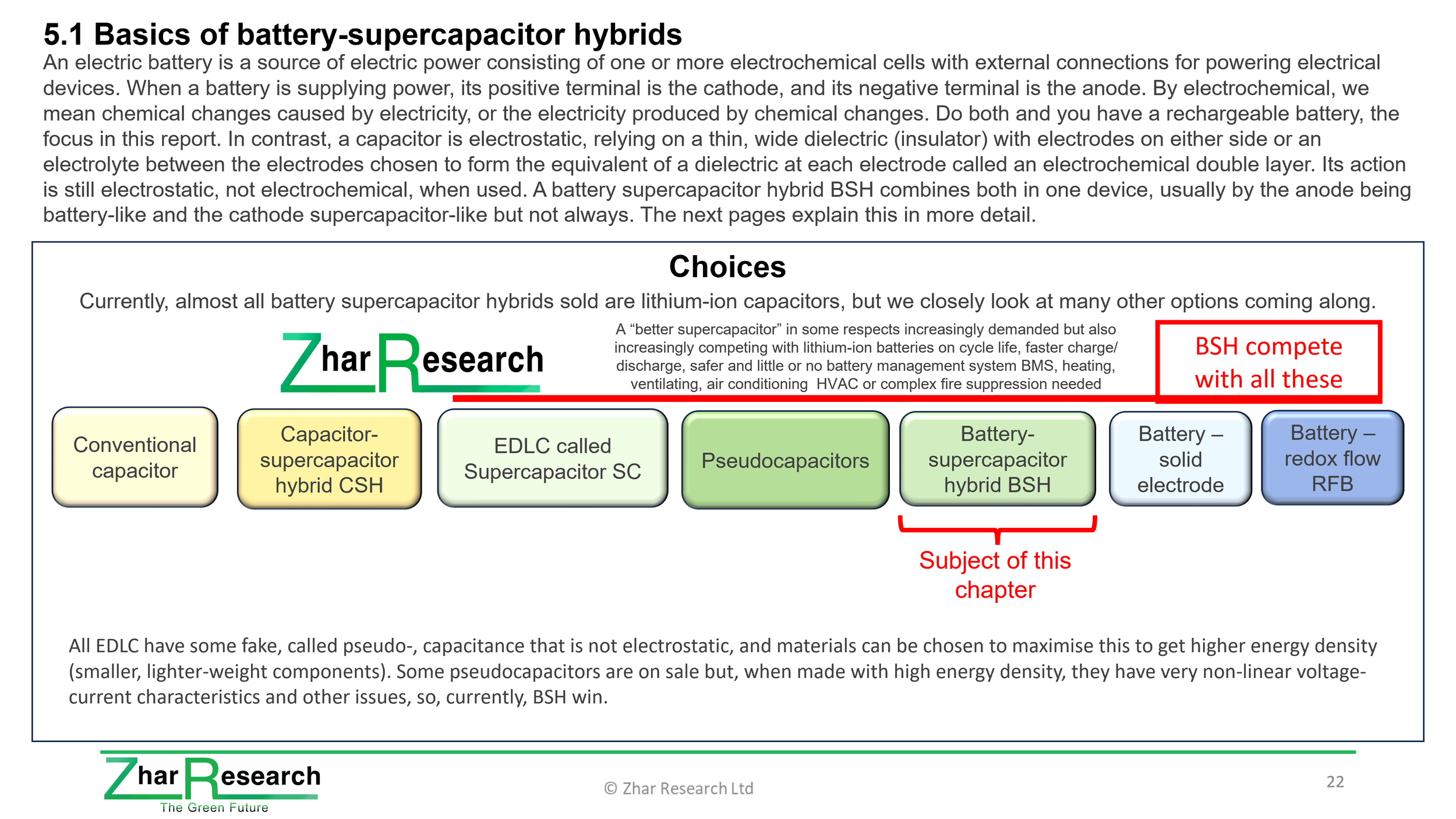
5.1 Basics of battery-supercapacitor hybrids
5.2 BSH and in particular LIC create some valuable tipping points
5.3 The many advantages of lithium-ion capacitors LIC and the energy density choices
5.4 Lithium-ion capacitor LIC market positioning by energy density spectrum
5.5 How strategies for improving supercapacitors will benefit BSH including LIC
5.6 Prioritisation of active electrode-electrolyte pairings
5.7 13 Primary conclusions: BSH markets including LIC
5.8 Technology uses by applicational sector for EDLC vs BSH - examples
5.9 18 primary conclusions: technologies and manufacturers
5.10 How research needs redirecting: 5 columns, 7 lines
5.11 SWOT appraisals and roadmap
5.12 Research on BSH beyond LIC: sodiumc-ion BSH, zinc-ion BSH, other
-
6.1 Electric vehicles: AGV, material handling, car, truck, bus, tram, train
6.2 Supercapacitor replacing battery on fuel cell system
6.3 Grid, microgrid, peak shaving, renewable energy and uninterrupted power supplies, medical
6.4 Military: Laser gun, railgun, pulsed linear accelerator weapon, radar, trucks, other
6.5 Power and signal electronics, data centers, truck
6.6 Welding, pulse metal forming and pulse machining
6.7 Gyrotron-drilled deep geothermal power
-
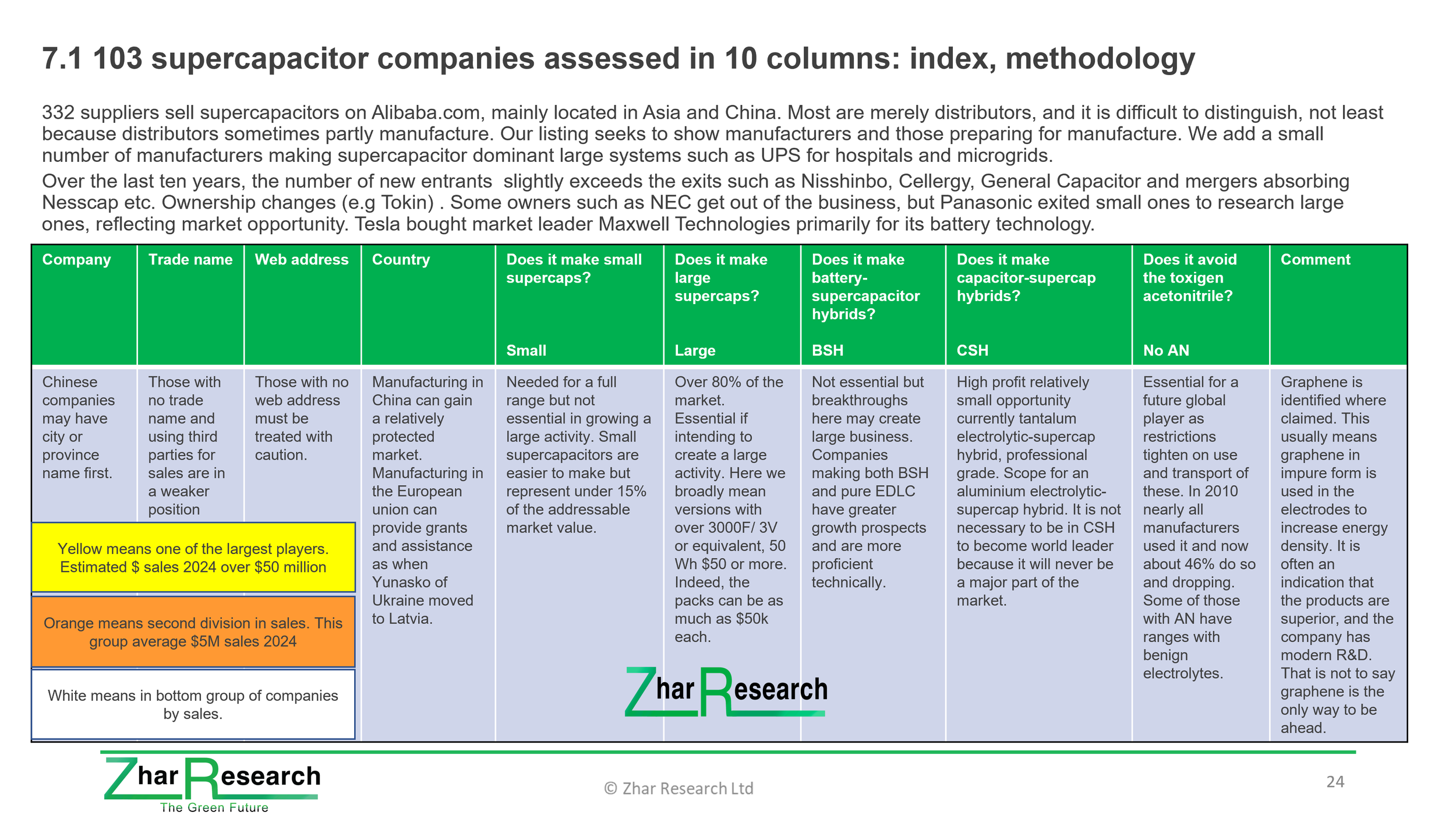
7.1 103 supercapacitor and variants companies assessed in 10 columns: index, methodology
7.2 Overview analysis
7.3 Listings
AI datacenters, nuclear fusion power, new electromagnetic weapons, jet fighters and fastest electric vehicle charging by land, sea and air all need energy storage beyond the capability of batteries alone. Such storage, capable of pulses, fastest charge/ discharge and other uniques has exceptional profit margins. Deliveries will increase sixfold in the next 20 years to over $20 billion yearly because these are all growth markets with the multiplier of increased adoption.
New analysis of rapidly increasing demand
The new Zhar Research report “Energy storage for pulse and fastest charge/ discharge applications (fusion power, laser gun, data center, EV fastest chargers etc.): technology, markets 2026-2046” details this excellent opportunity. It gives the spectrum of choice, including new lithium-ion capacitors and capacitor-supercapacitor hybrids compactly providing formidable power surges and regeneration to earthmoving, and laser guns and compact pulse radar signalling in new military aircraft.
Best backup, fastest grid management, next renewable energy
Critical facilities demand uninterrupted power supplies with near instant recharge to cover repeated outages, and we shall charge our cars in minutes - both better than batteries can provide. Expect new pulse capacitors, graphene and metal oxide framework MOF supercapacitors - some as structural electronics - and flywheel generators for fastest grid management. Other emerging applications include covering the modest intermittency and surges of next generation high altitude wind, wave and tidal stream power demanding non-flammable, non-toxic, fit-and-forget equipment.
Comprehensive report
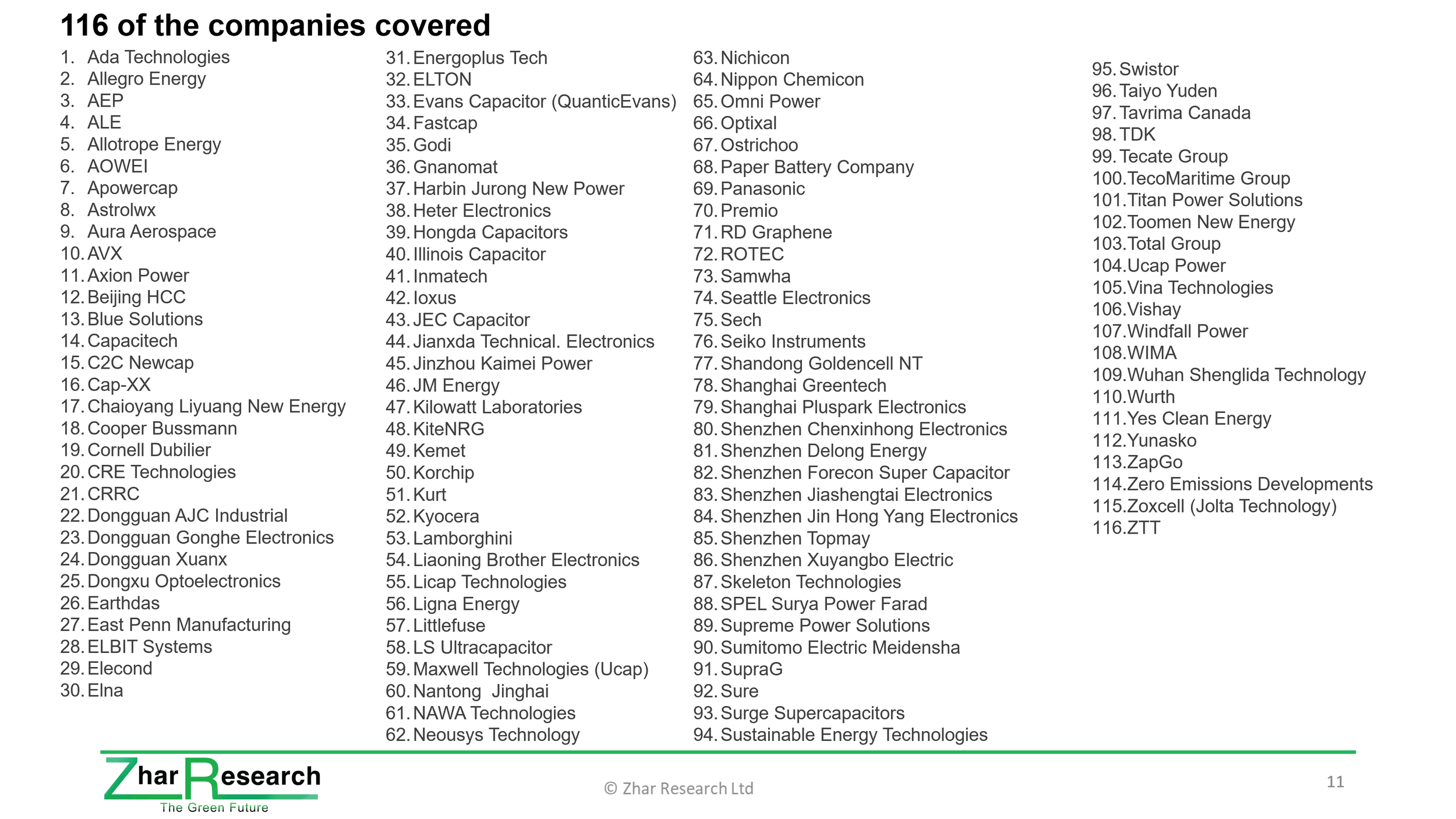
The 230-page report has 7 chapters, 8 SWOT appraisals, 20 forecast lines, 53 infograms and tables and covers 116 companies. Latest 2025-6 research advances are covered. The 25-page Executive Summary and Conclusions (25 pages) is sufficient for those in a hurry. See key conclusions, the SWOT appraisals and the forecasts as tables, graphs and explanation 2026-2046 aided by roadmaps 2026-2046 for markets, technology and industry. The Introduction then puts energy storage in context, explains ongoing battery limitations and the alternatives.
Chapter 3. Electrostatic storage : Capacitors and capacitor-supercapacitor hybrids gives the basics, materials and format choices, strategies for improvement and latest research advances 2025-6. Chapter 4. Electrostatic hybridised with faradaic functionality: pseudocapacitors explains how this phenomenon occurs in all supercapacitors and it is usually minimised to achieve more ideal performance. However, there is much ongoing research on optimising it to improve energy density at a cost in other performance. What is it? Why? How?
Chapter 5. Electrostatic hybridised with faradaic functionality: battery-supercapacitor BSH hybrids including lithium-ion capacitors takes 105 pages because this is a larger and more-immediate opportunity. Why are they succeeding from fusion power to earthmoving vehicles. See 18 conclusions. Who wants their spectrum of choice from almost-a-supercapacitor to almost-a-battery? What manufacturers and successes along that spectrum and what are the latest research results 2025-6? Why progressing from lithium-ion capacitors to others that are sodium or zin BSH? Results so far?
Batteryless pulse and fastest response in action
Chapter 6. is on batteryless pulse, fastest response and similar storage in action (38 pages). This brings the subject alive with use in electric vehicles: AGV, material handling, car, truck, bus, tram, train. See supercapacitors replacing batteries on a fuel cell system and grid, microgrid, peak shaving, renewable energy and uninterrupted power supplies and medical applications of the various options. Military is well covered with its high profit margins and exacting demands: laser gun, railgun, pulsed linear accelerator weapon, radar, trucks, other. Power and signal electronics, data centers, trucks, welding, pulse metal forming and pulse machining and also powering gyrotron-drilled deep geothermal power – no drill bit just microwave melting of rock.
132 manufacturers analysed
The report then closes with Chapter 7 presenting 132 manufacturer activity profiles in 50 pages mainly of tables using colours and ten columns for analysis but starting with overall analysis pie chart. This new Zhar Research report “Energy storage for pulse and fastest charge/ discharge applications (fusion power, laser gun, data center, EV fastest chargers etc.): technology, markets 2026-2046” is your essential reading for a sober, PhD level analysis of your opportunities in this fast-growing sector.